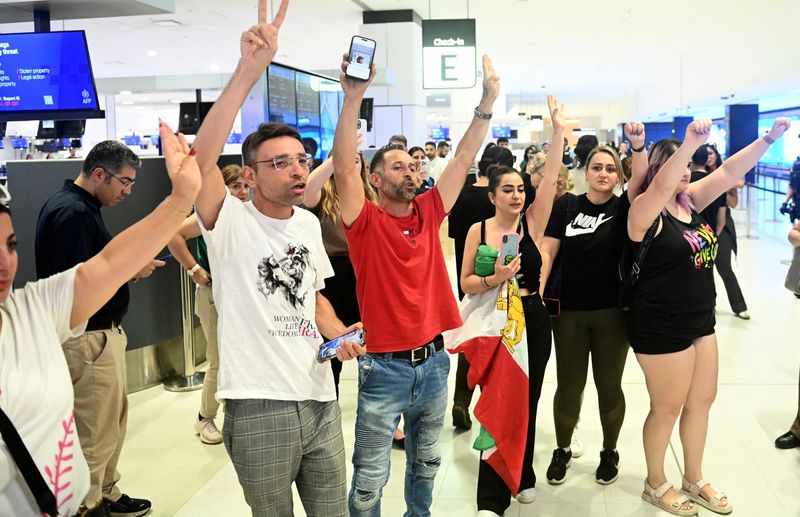

Two more members of the Iranian women’s soccer team were granted asylum in Australia before their teammates departed the country, Australian Home Affairs Minister Tony Burke said on Wednesday.This brings the number of women granted humanitarian visas in Australia to seven, after five Iranian players had earlier sought asylum, Burke told reporters in Canberra. One of those in the later group was a player and the other a team staffer. Both sought asylum before their teammates were transported to the airport.The rest of the team departed from Sydney to return to Iran during tense protests outside the delegation’s hotel and at the airport. Iranian Australians attempted to prevent the women from leaving the country, citing fears for their safety in Iran. Their flight departed late Tuesday.Women offered asylum before departureThe team had arrived in Australia for the AFC Women’s Asian Cup last month, before the Iran war began on February 28. The side was knocked out of the tournament over the weekend and faced the prospect of returning to a country under bombardment.Australia’s government on Wednesday revealed its final efforts to ensure that every member of the team could consider an asylum offer. Burke said that as the women passed through border security, they were taken aside individually to speak with Australian officials and interpreters without minders present.“Australia made the offer because we are so impressed by these women as individuals,” he said. “The choice that Australia gave — the choice of government officials standing in front of you and saying it is up to you — is a choice that every individual should be entitled to.”Some players called their families in Iran to discuss the offer, Burke added, but no additional members of the delegation chose to remain in Australia.“Everything was about ensuring the dignity for those individuals to make a choice,” he said. “We couldn’t take away the pressure of the context for these individuals — what might have been said to them beforehand, or what pressures they might have felt regarding other family members.”Those who sought asylum received temporary humanitarian visas that could lead to permanent residency in Australia, Burke said. He added that some members of the delegation were not offered visas because they had connections to the Islamic Revolutionary Guard Corps.Team’s fate draws national spotlightThe Iranian team became popular in Australia during the tournament. Iranian groups in the country had urged the government to halt the women’s departure after the players drew global attention when they did not sing the Iranian national anthem before their first match.The players did not publicly explain the reason for their silence. They later saluted and sang the anthem before their subsequent matches. Throughout the tournament, the women largely declined to comment on the situation at home and made no political statements.“When those players were silent at the start of their first match in Australia, that silence was heard as a roar all around the world,” Burke said. “We responded by saying the invitation is there. In Australia, you can be safe.”It was not immediately clear how many people were in the delegation, though the official squad list included 26 players along with coaching and support staff. Burke rejected suggestions that Australian authorities should have done more to stop the team’s departure.“Australia’s objective here was not to force people to make a particular decision,” he said. “We’re not that sort of nation.”The minister also said he had seen widely circulated footage that appeared to show a woman being led by the hand by her teammates from the team’s hotel on Gold Coast to their bus. Whether that amounted to coercion would be a matter for local police, he said.Iran criticises Trump’s remarksIran responded strongly to comments from Donald Trump, who criticised the Australian government for not offering asylum to the players earlier.“Iran welcomes its children with open arms and the government guarantees their security,” Iranian First Vice President Mohammad Reza Aref said on Tuesday.“No one has the right to interfere in the family affairs of the Iranian nation and play the role of a nanny who is kinder than a mother,” he added.Iranian state television reported that the country’s football federation had asked international soccer authorities to review what it described as Trump’s “direct political interference in football,” warning that such remarks could disrupt the 2026 World Cup.