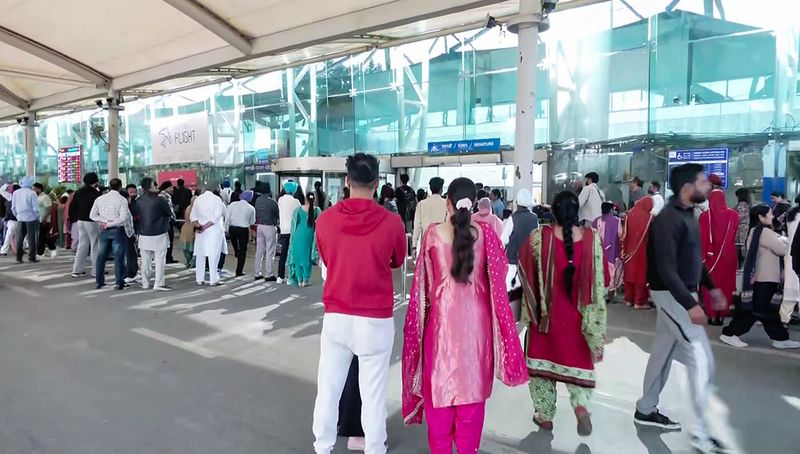

Limited flight operations between India and parts of West Asia resumed on Tuesday, even as multiple flights were forced to return mid-air, widespread cancellations continued and thousands of passengers remained stranded, with airlines operating restricted services due to the ongoing airspace closures triggered by the Iran-US conflict.The Ministry of Civil Aviation is continuously monitoring the evolving airspace situation and its impact on international flight operations. So far, 1,221 flights by Indian carriers and 388 flights by foreign carriers have been cancelled due to the ongoing situation.A total of 24 flights were operated by Indian carriers on Tuesday. In addition, Emirates and Etihad operated nine flights from the Gulf in the past 24 hours.Indian carriers are planning 58 flights on March 4, including 30 by IndiGo and 23 by Air India and Air India Express.Indian carriers have initiated a phased evacuation of passengers. Air India operated a flight, AI916D, bringing back 149 stranded passengers from Dubai to Delhi at 10.58 am IST, the first Indian-operated repatriation flight since the crisis escalated. Another flight, AI918D, returned with 143 cockpit and cabin crew members who had been stranded in Dubai.The airlines indicated that the services would resume gradually based on real-time security assessments. “Air India is deploying its widebody aircraft with higher capacity on its services to Jeddah and Dubai to facilitate the return of passengers impacted by the ongoing situation in West Asia. All flights are expected to operate at full capacity on their return sectors on March 4,arriving at Mumbai and Delhi, respectively,” said a spokesperson for the airline.IndiGo said it had launched repatriation operations with four return flights to Jeddah and planned to resume services to Muscat, Athens, Madinah and other destinations in phases. The airline said 13 return flights, covering 26 sectors, were expected to be restored, subject to approvals and airspace conditions. Additional repatriation services to UAE destinations were also being planned from March 4.Air India Express resumed operations to Muscat from Tuesday, but services to Bahrain, Kuwait, Qatar, Saudi Arabia and the UAE remain suspended until further notice. “Air India Express will continue to operate its scheduled flights to and from Muscat on March 4. Alongside regular services to/from Delhi, Kochi, Kozhikode, Mangaluru, Mumbai and Tiruchirappalli, we will also be operating additional flights to Delhi, Kochi and Mumbai,” it said.Meanwhile, SpiceJet announced four special evacuation flights on Tuesday connecting Fujairah with Delhi, Mumbai and Kochi, and the flights will return in the early hours of Wednesday. The airline said its regular services on the Fujairah-Delhi and Fujairah-Mumbai routes would resume from March 4, depending on operational clearances.Mumbai emerged as a key arrival hub for evacuation operations. According to officials, several repatriation flights landed throughout the day. These included Emirates flight EK8506 from Dubai which arrived at 1.55 pm, Star Air services S58503 and S58302 from Fujairah, which arrived at 7.30 pm and 9 pm, respectively, and IndiGo flights 6E8595 and 6E8636 from Jeddah, which reached around 11.30 pm and 11.55 pm, respectively. Air India Express flight IX1115 from Fujairah arrived around 10.55 pm.The impact was visible across Indian airports. At Indira Gandhi International Airport, 36 departures and 44 arrivals were cancelled on Tuesday, while several westbound international flights were delayed.In Bengaluru, 44 flights were cancelled, and Kolkata reported at least 10 international cancellations, with airlines such as Qatar Airways and Gulf carriers suspending services citing safety concerns.Passengers returning from the region described tense conditions. Olympic medallist PV Sindhu said she was relieved to return home after “intense and uncertain” days, thanking the airport and airline staff for their support.