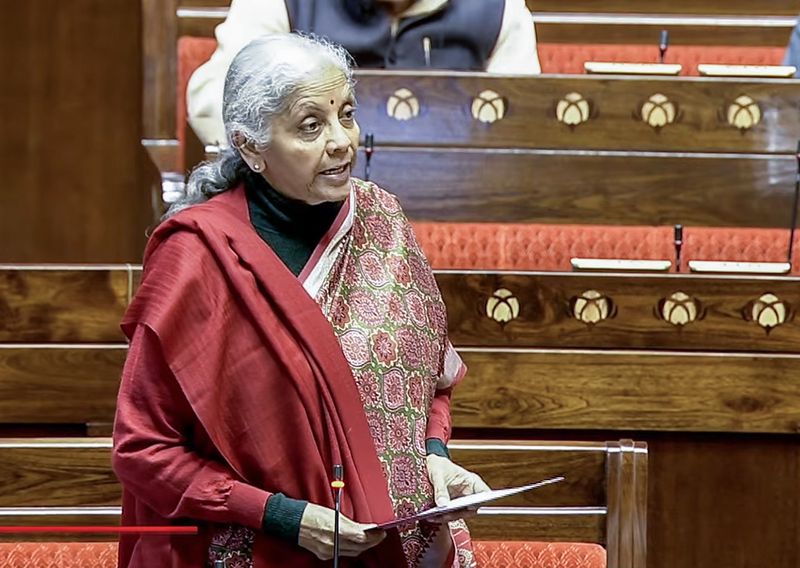

India’s economy is projected to grow 7.4 per cent in FY26 and between 6.8 per cent and 7.2 per cent in FY27, reaffirming its position as the fastest‑growing major economy for the fourth consecutive year, according to the Economic Survey 2025-26.The pre‑Budget guidance document, tabled by Finance Minister Nirmala Sitharaman in Parliament today, attributed the growth outlook to regulatory reforms, a strong macroeconomic base, renewed call for private sector investment and robust domestic demand.Chief Economic Adviser V Anantha Nageswaran, author of the survey, said, “Given the good growth performance and the kind of foundation laid for sustained growth into the second half of this decade, we are now projecting FY27 growth between 6.8 per cent and 7.2 per cent… notwithstanding the global situation, on the back of domestic reforms and accomplishments.”The survey highlighted policy reforms in recent years as key drivers lifting the economy.“Medium‑term growth potential is closer to 7 per cent. With domestic drivers playing a dominant role and macroeconomic stability well anchored, the balance of risks around growth remains broadly even… The survey projects real GDP growth in the financial year 2027 in the range of 6.8 per cent to 7.2 per cent. The outlook is one of steady growth amid global uncertainty requiring caution, but not pessimism,” it said.Calling FY26 an unusually challenging year on the external front due to high penal tariffs by the US, the survey said GST rationalisation, faster deregulation and simplification of compliance requirements supported the economy. “FY27 is expected to be a year of adjustment as firms and households adapt to changes, with domestic demand and investment gaining strength,” it added.While noting that the external environment remains uncertain, the survey said risks for India would remain manageable. It pinned hopes on an early conclusion of the trade deal with the US, stating, “Slow growth in India’s key trading partners, tariff‑induced disruptions to trade and volatility in capital flows could intermittently weigh on exports and investor sentiment at home. At the same time, ongoing trade negotiations with the US are expected to conclude during the year, which could help reduce pressures on the external front.”The survey said external factors were expected to remain stable for India and exports resilient. It noted that despite global trade uncertainty, India’s merchandise and services exports reached a record $825.3 billion in FY25, with momentum continuing in FY26. “Despite heightened tariffs imposed by the US, merchandise exports grew by 2.4 per cent from April to December 2025, and services exports increased by 6.5 per cent. Merchandise imports for April to December 2025 rose by 5.9 per cent,” the Survey said, adding that strong remittance inflows continued to anchor external stability.It noted that remittances had surpassed gross FDI inflows in most years, underscoring their importance as a key source of external funding. The current account deficit remained moderate at 0.8% of GDP in H1 FY26.The survey said the domestic economy remained on a stable footing and inflation had moderated to historically low levels. “Balance sheets across households, firms and banks are healthier and public investment continues to support activity. Consumption demand is resilient and private investment intentions are improving. These conditions provide resilience against external shocks and support continuation of growth momentum,” it said, explaining the basis for its FY27 projection.It added that India’s current account structure showed a high net inflow of intangible assets, driven by growing surpluses in services and private transfers, helping offset the trade deficit.The current account deficit declined from $25.3 billion in the first half of FY25 to $15 billion in the first half of FY26.India is better positioned than high-deficit peers such as New Zealand, Brazil, Australia, the UK and Canada in Q2 FY26. Service exports touched an all‑time high of $387.6 billion in FY25, growing 13.6 percent. Foreign exchange reserves rose to $701.4 billion as of 16 January 2026, up from $668 billion at the end of March 2025.Headline CPI inflation declined to 1.7 per cent, driven mainly by corrections in vegetable and pulse prices, supported by favourable farm conditions, supply‑side measures and a strong base effect. The survey noted that India remained the world’s largest recipient of remittances, with inflows reaching $135.4 billion in FY25, supporting external stability.It added that India ranked fourth globally in greenfield investment announcements in 2024 with over 1,000 projects, and emerged as the largest destination for greenfield digital investments between 2020-24, attracting $114 billion. Gross FDI inflows rose to $64.7 billion in April-November 2025, compared with $55.8 billion in the same period of 2024.Agriculture and allied activities are estimated to grow by 3.1 percent in FY26. Agricultural activity in the first half of FY26 was supported by a favourable monsoon, with agricultural GVA growing 3.6 per cent, higher than the 2.7 per cent recorded in the first half of FY25. Allied activities, particularly livestock and fisheries, continued growing at a stable 5-6 percent.The survey said the industrial sector was showing signs of strength, with manufacturing growing 8.4 per cent in the first half of FY26, outperforming the FY26 estimate of 7 per cent.India’s external debt stood at $746 billion at end‑September 2025, up from $736.3 billion at end‑March 2025. The external debt‑to‑GDP ratio stood at 19.2 per cent at the end of September 2025. External debt accounts for less than 5 per cent of India’s total debt, which helps mitigate external sector risks.Looking ahead, the survey said a unified effort to reduce manufacturing costs was essential for improving India’s export competitiveness. It added that durable external resilience and stronger currency credibility would depend on expanding manufacturing export capacity.