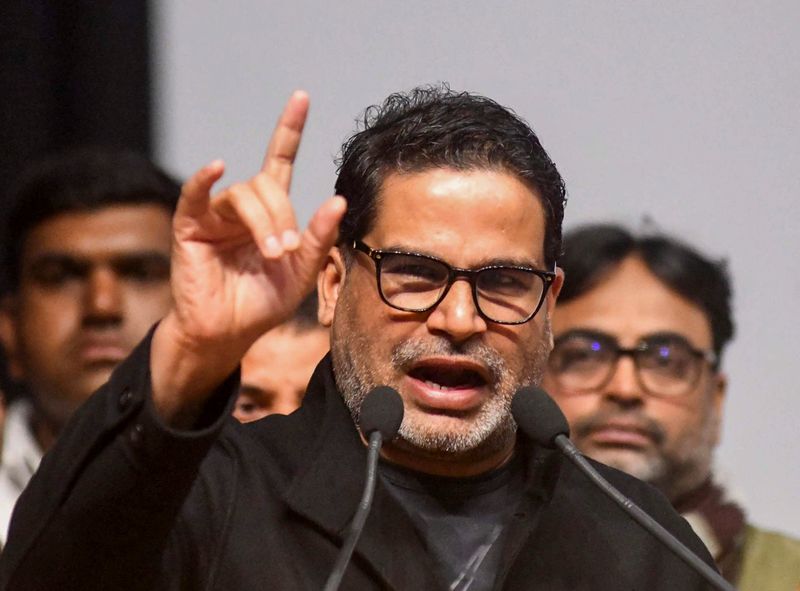
The Supreme Court on Friday refused to entertain Prashant Kishor-led Jan Suraaj Party’s petition challenging the Bihar Assembly Election, 2025, in which his party drew a blank despite contesting 238 of the total 243 seats.“How many votes your party got? If people reject, then you approach the judicial forum to get popularity,” a Bench led by CJI Surya Kant told senior counsel CU Singh, who represented the JSP.The Bench said the party should have challenged the cash transfer scheme but instead it wanted the entire Assembly election to be set aside and that there was no prayer against the scheme.As Singh said the prayer for setting aside the election can be segregated and the court could consider the freebies issue, the CJI asked him to approach the Patna High Court.“The High Court can certainly consider, it’s not a pan-India issue,” CJI Kant said.As the Bench, which also included Justice Joymalya Bagchi, was not inclined to entertain the JSP’s petition, Singh chose to withdraw it.The Bench wondered under which provision of the Representation of the Peoples Act an entire election could be set aside.”The Model Code of Conduct is in every state, and in a fiscal deficit state, which is one of the most indebted states, to offer so much crores as an election dole without any budgetary support, it will completely disrupt the level-playing field,” Singh argued.However, the Bench was not inclined to entertain the JSP’s petition.Alleging ‘illegal practices’, the JSP had challenged the November 2025 Bihar Assembly Election in which the BJP-led NDA retained power in the state, winning 202 seats. The INDIA bloc bagged only 35 seats, including six bagged by the Congress.The party had challenged direct transfer of Rs 10,000 each to a large number of women voters in the state while the Model Code of Conduct (MCC) was allegedly in force.It amounted to “corrupt practices” as it was meant to unduly influence voters in favour of the ruling alliance, the petitioner alleged, adding the direct cash transfer deprived other political parties of a level-playing field and struck at the core requirement of free and fair elections.The Mukhyamantri Mahila Rojgar Yojana provides an initial financial grant of Rs 10,000 to women entrepreneurs to launch small businesses and promote self-employment and women’s empowerment in Bihar.However, the JSP wanted the top court to direct the Election Commission to take action under Article 324 of Constitution (EC’s power of superintendence, direction and control of the preparation of electoral rolls for, and the conduct of, all elections) and Section 123 of the Representation of People Act against direct transfer of money to women voters in Bihar.The JSP said the eligibility for the scheme was linked to membership of JEEVIKA, a network of women’s self-help groups. The State announced that women not already part of JEEVIKA could enrol to receive the benefit.While around one crore women were already associated with JEEVIKA before the MCC came into force, media reports later showed that 1.56 crore women eventually received payments, the party submitted.It had also alleged that women, who were beneficiaries of the scheme, were deployed at polling booths on voting days in both phases of polling, even though many of them had already received the cash benefit, the party said, adding such deployment compromised the neutrality expected during elections.The JSP alleged that the distribution of money was approved by a Cabinet decision without any legislative sanction and money was withdrawn from the State’s Contingency Fund, allegedly in violation of Article 267 of the Constitution.It pointed out that EC’s earlier directions on MCC prohibited governments from announcing or expanding welfare schemes, releasing fresh funds, or processing beneficiary-oriented programmes once elections are announced, if such steps were likely to influence voters.The impact of a direct cash transfer scheme rolled out on the eve of elections and continued during the MCC, could not have been ignored by the poll panel, it submitted.