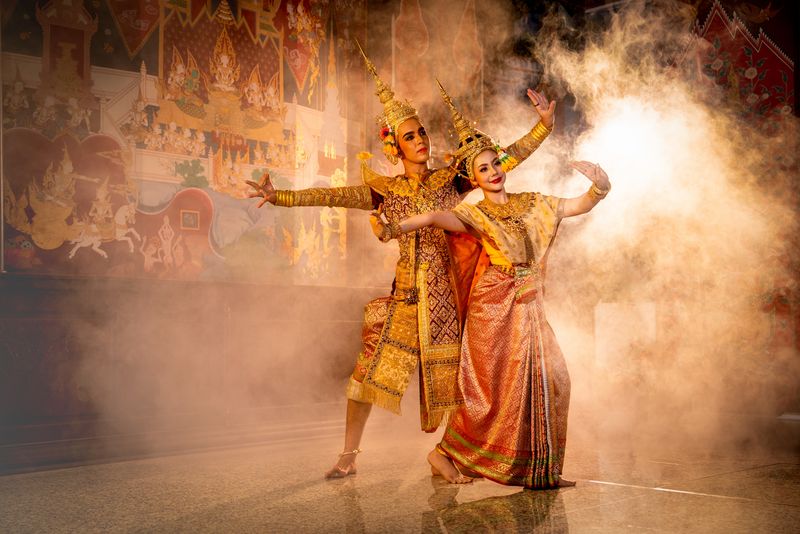

The Thai and Cambodian Ramayanas developed between the medieval and early modern periods as court-centred narratives shaped by performance, visual art, and Buddhist ethics. Though they share a common source, they reinterpret the story through parallel but contrasting treatments of kingship, heroes, villains, and moral order.In Thailand, the Ramayana appears as the Ramakien, with versions circulating from the 14th century during the Ayutthaya period and reaching a classical form in the late 18th century under King Rama I. Rama is presented primarily as a king rather than an ascetic. His authority flows from royal power, military success, and court ritual. Forest exile and renunciation are reduced, while palace politics, warfare, and diplomacy dominate the narrative. Divinity is present but subdued, secondary to kingship.In Cambodia, the Ramayana takes the form of the Reamker, whose earliest visual and narrative evidence dates to the Angkor period between the 9th and 13th centuries, with later literary and performance versions continuing into the 16th to 18th centuries. Here kingship is framed through Buddhist ethics. Power is legitimate only when aligned with karma, compassion, and moral restraint. Victory is meaningful not merely as conquest but as ethical resolution.In the Thai tradition, Hanuman is transformed into a trickster hero who is clever, flirtatious, and adventurous. He is not celibate. One of the most distinctive Thai episodes is the story of Supanna Matcha, the mermaid daughter of Ravana, who tries to sabotage Rama’s bridge by throwing stones into the sea. Hanuman confronts her, romance follows, and their union symbolically reconciles land and sea powers, reflecting Thailand’s maritime imagination.In the Cambodian tradition, Hanuman is disciplined and restrained. Erotic adventures are minimal or absent. He embodies loyal service, self-control, and moral discipline, closer to Buddhist monastic ideals. His heroism lies in obedience and ethical conduct rather than clever transgression.In Thailand, Ravana, known as Thotsakan, is portrayed as a cultured and refined ruler. He possesses courtly manners, family attachments, and artistic taste. His death is prolonged through multiple dramatic encounters designed for visual spectacle. The Ramakien is inseparable from khon-masked dance and from large mural cycles, especially those created in the late 18th and early 19th centuries at the Grand Palace in Bangkok. Episodes are chosen for visual balance and theatrical rhythm rather than narrative completeness.In Cambodia, Ravana appears as a tragic ruler whose downfall results from accumulated moral failure. His defeat is framed less as divine punishment and more as karmic consequence. Family relations, regret, and ethical collapse receive narrative emphasis, reinforcing Buddhist moral causality.In the Thai Ramakien, Sita’s role is present but relatively restrained compared to Hanuman and Rama. The narrative energy is invested in spectacle, warfare, and courtly drama, suited to performance and mural narration.In the Cambodian Reamker, Sita’s suffering, patience, and emotional endurance are expanded in detail. Her trials are ethical and psychological rather than purely ritual tests of chastity. The story becomes a meditation on the human cost of power and war, especially for women.In Thailand, the Ramayana functions as court theatre and royal imagery. In Cambodia, it functions as moral instruction carved into temple walls, most famously at Angkor Wat built in the early 12th century. Together, these traditions show how the Ramayana became a flexible medieval and early modern framework for imagining power, ethics, and order across Southeast Asia.— The writer is an acclaimed mythologist