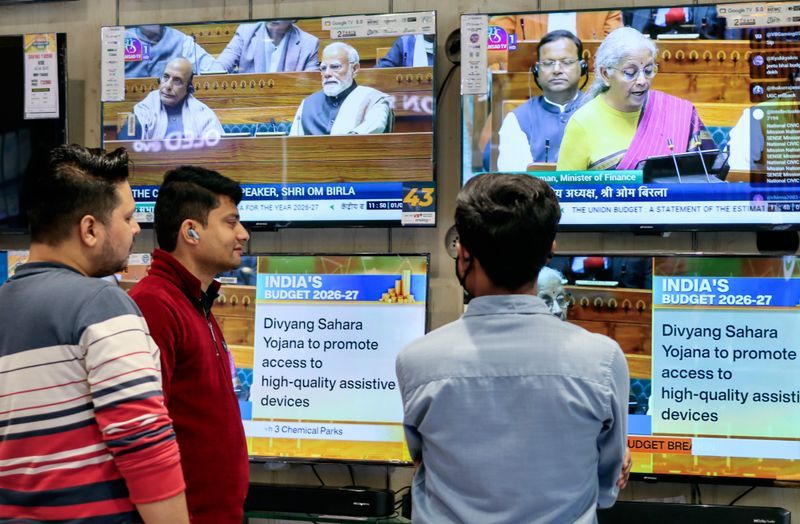
Finance Minister Nirmala Sitharaman presented her ninth consecutive Budget setting out the government’s fiscal strategy, spending priorities and key policy directions for the coming year. The most interesting data points from the Union Budget 2026-27 are income tax (I-T) collection numbers. I-T collections grew by just 6.2 per cent in this fiscal year, compared to 2024-25. Compare that to the 18.2 per cent and 25.4 per cent growth seen in the previous two financial years, writes senior economic analyst Aunindyo Chakravarty in his Edit article Budget red alert for the middle class. India’s upper middle class is not only earning less, it is also spending less than ever before, he writes. Every incumbent government uses the Budget as a fiscal tool to win elections. The Modi government is no different. Its expenditure is directed towards those who make up the electoral numbers, the poor are going to continue to get subsidised food, some amount of guaranteed work, and financial aid to build homes, he elaborates.The Budget has laid emphasis on skills and capability-building, but there is no engagement with pressing realities like wage stagnation and rural distress. The uncomfortable implication is this: We want European-quality public services with a much narrower tax base, says economist and strategic analyst Ajit Ranade in his Edit piece A Budget boxed in by fiscal arithmetic. One welcome feature of this Budget’s narrative is the ambition to capture 10% of the global market for tradeable services. One troubling omission is in not engaging with a central structural problem: the workforce share in agriculture remains high even as agriculture’s GDP share declines. That is the signature of distress, not transformation, he writes.The record-high defence allocation of ₹7.85 lakh crore in the 2026–27 budget is insufficient to meet India’s strategic and operational needs, writes ex-AOC-in-C, Central Air Command Air Marshal Amit Tiwari in his Op-Ed article Why Budget allocation for defence is not enough. Many European countries have enhanced their defence budgets keeping in mind the Russia-Ukraine war and the unreliability of US support. NATO countries in Europe have hiked their collective defence budget by 17% in 2024, amounting to 3-5% of GDP. Japan has recently increased the defence budget by 21%. In contrast, India’s defence budget hovering below 2% of GDP may be insufficient when compared to peers facing comparable or lesser multi-front risks and the Chinese defence budget of more than $314 billion. The defence budget of 1.9 per cent of GDP may not suffice to safeguard India’s sovereignty and strategic interests in the face of AI use in combat, space-based weapons and a hostile cyber environment.Coming next to the India-US deal, the stalemate extending over months has finally ended with Trump’s 50 to 18 pc tariff reduction, the arithmetic of which is still ambiguous as the presidential tariff order has not yet become an executive order. India ought to have challenged economic and moral foundation of Trump’s tariff tantrum, writes senior journalist Sanjaya Baru in his Edit piece Business as unusual. Trump’s policies place India in a position of relative disadvantage. The euphoria over the government’s projection of India-US deal as a big win is misplaced enthusiasm masquerading as expertise, he writes. The Trump administration has not dealt with India any differently than it has dealt with Pakistan or most other developing economies.Despite assurances from the Centre, the India-US trade deal has agitated the farming community. Questioning India’s silence, many farm leaders have expressed doubts on farmers’ interests having really been protected, writes food & agriculture specialist Devinder Sharma in his Op-Ed article India-US trade deal is too costly for farmers. What infuriates the farming community is that while Budget 2026 has remained largely silent on measures that are needed to prop up farm incomes, there has not been any farmers’ consultation on where to draw the red line in protecting the farm sector which is reeling in crisis.Coming to Gen Naravane’s autobiography ‘Four stars of destiny’ that paralysed the Lok Sabha last week, it has some interesting details on the Galwan India-China standoff in June 2020. On the face of it, the paragraph that has lit the political storm is almost harmless, and in fact makes the former Army Chief look a bit out of sorts, writes Editor-in-Chief Jyoti Malhotra in her weekly column The Great Game Much ado about a book and a film. However, there is certainly a debate worth having—Why were the Chinese able to push you around in Galwan, leading to the death of 20 Indian soldiers? What was the role of the corps commander and the Army commander? What are the lessons learnt from the Galwan tragedy? She writes. The ability to control information around strategic affairs, which is everything from foreign affairs to domestic security, is critical in a democracy. How much to tell the public is a question every government grapples with, she writes.