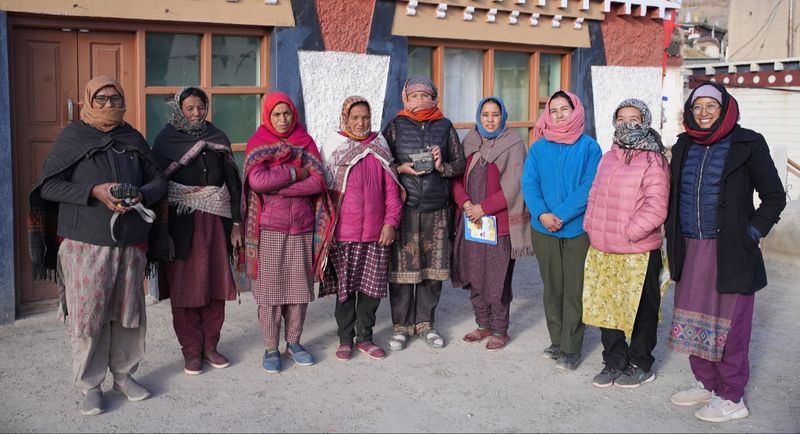
Local communities, especially women, in the remote Spiti Valley of Lahaul and Spiti district have emerged as key protectors of the elusive snow leopard, transforming a once-feared predator into a symbol of conservation and livelihood. Over the past few years, this change has been made possible through sustained efforts by the Nature Conservation Foundation (NCF) in collaboration with the Forest Department.A few years ago, snow leopards were widely viewed as a threat by local residents due to frequent livestock losses. As sheep, goats and yaks were often preyed upon, villagers opposed conservation efforts. However, continuous dialogue, scientific intervention and community engagement gradually changed this mindset.Tanzin Thinley, a youth from Kibber village associated with the NCF since 2002, told The Tribune that the core issue was unsafe livestock shelters. “Snow leopards could easily attack animals due to vulnerable living spaces. We worked with villagers to build safer enclosures for livestock and encouraged them to insure their animals. This reduced losses and financial stress,” he said. As a result, people who once opposed conservation came forward to support it.Over time, snow leopard conservation was also linked with tourism. Wildlife enthusiasts visiting Spiti hoped to spot the rare predator, creating new opportunities for locals. Around 50 women from Kibber, Chicham and Demul villages are now involved in conservation activities, either full-time or part-time. Many local youth and women have found self-employment as guides and porters.Lobzang Yangchen, a local woman working with the NCF, said conservation had become a source of livelihood. “Earlier, we depended mainly on knitting. Now we actively participate in snow leopard conservation. We install camera traps to track leopard movement and help discourage hunting practices,” she said. Yangchen currently leads a team of 11 women dedicated to the project.NCF programme officer Deep Shikha said women in Spiti were playing a crucial role and delivering encouraging results. “We trained them in camera trapping, monitoring and conservation methods, which has not only helped protect wildlife but also strengthened them economically,” she said.Divisional Forest Officer (DFO) Kaza, Goldi Singh, also acknowledged the contribution of local women and the NCF. He said their efforts had been vital in monitoring snow leopards, discouraging hunting and ensuring community participation in conservation.In the high-altitude terrain of Spiti Valley, women are now leading the protection of one of Asia’s most valuable predators. According to a nationwide survey conducted in 2023, India is home to around 700 snow leopards. In Himachal, their population has increased from 51 to 83 in just a few years.The community-led initiative, formally launched in 2023, trained local women in conservation activities and camera trapping. Today, the snow leopard is no longer seen merely as a threat but as a shared natural heritage — one that supports conservation, tourism and sustainable livelihoods for the people of Spiti Valley.