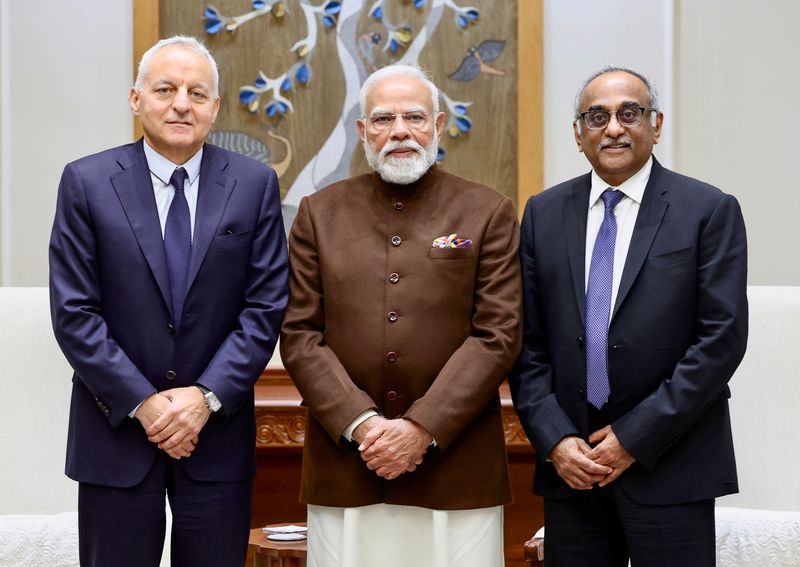
Rolls Royce has announced its intention to scale-up its business in India, and has offered co-development of a future aero-engine for fighter jets, along with partnerships across defence, civil aviation and energy sectors.The company in a statement on Thursday said that in collaboration with the UK Government, it has offered to co-develop a 120-kilo newton class combat jet engine core that could be India’s fastest route to an indigenous next-generation engine.The co-development will provide full technology transfer with IP ownership for India, supported by a dedicated design complex and manufacturing capabilities that will unlock significant job creation, the company said.As part of the push, Rolls-Royce Chief Executive Officer Tufan Erginbilgic met Prime Minister Narendra Modi in New Delhi on Thursday to discuss the company’s desire to be part of India’s growth journey and how its advanced technologies can support India’s growth plans and self-reliance.The move by the British technology giant comes less than two weeks after the Defence Research and Development Organisation (DRDO) invited bids from Indian defence and aerospace companies to partner in producing the next generation of engines.The DRDO has issued an expression of interest (EOI), asking for bids from Indian companies to become ‘Development-cum-Production Partner (DcPP)’ for what is termed as ‘advanced high-thrust class engine (AHTCE) programme.The Indian company will support design, development, manufacturing, integration, testing, and certification of a next-generation indigenous aero gas turbine engine.Foreign engine houses will assist. This is where global players like Rolls Royce are in the race which includes Safran of France, General Electric of US and IHI of Japan. The Gas Turbine Research Establishment (GTRE) under the DRDO will lead the programme. So far, India imports engines even for its indigenous fighter jet, the Tejas. With more than 500 jets to be produced the India over the next 15-17 years, the non-availability of an engine is seen as a handicap for growth.The DcPP will act as the primary industrial execution agency, responsible for transforming GTRE’s engineering outputs into flight-worthy engine. This includes tooling, manufacturing engineering, special processes, inspection systems, engine assembly, subsystem testing, and final integration.The scope includes manufacturing and assembly of compressor, combustor, turbine, afterburner, subsystems like the gearbox, oil system and fuel system.The selected Indian partner will support GTRE through detailed engineering, preparation of 2D drawings, 3D models, design iterations, and configuration. The partner will manufacture components, sub-assemblies, and modules, including raw material procurement.Meanwhile, Rolls Royce said, besides exploring opportunities in India for the co-development of a next-generation combat jet engine, the company is looking at partnerships to localise and manufacture engines for the Indian Army, Navy and Coast Guard and potentially power solutions for critical infrastructure and industry.Already more than 1,400 Rolls-Royce engines are currently powering various defence platforms such as the Jaguar combat aircraft and Hawk trainers of the Indian Air Force and Navy; the Arjun Main Battle Tanks of the Army, and a variety of vessels and submarines of the Indian Navy and Coast Guard including the prestigious Anti-Submarine Warfare Shallow Watercrafts and frigates.More than 4,000 people work across the Rolls-Royce ecosystem in India, including 2,800 engineers who contribute to global programmes across its businesses.