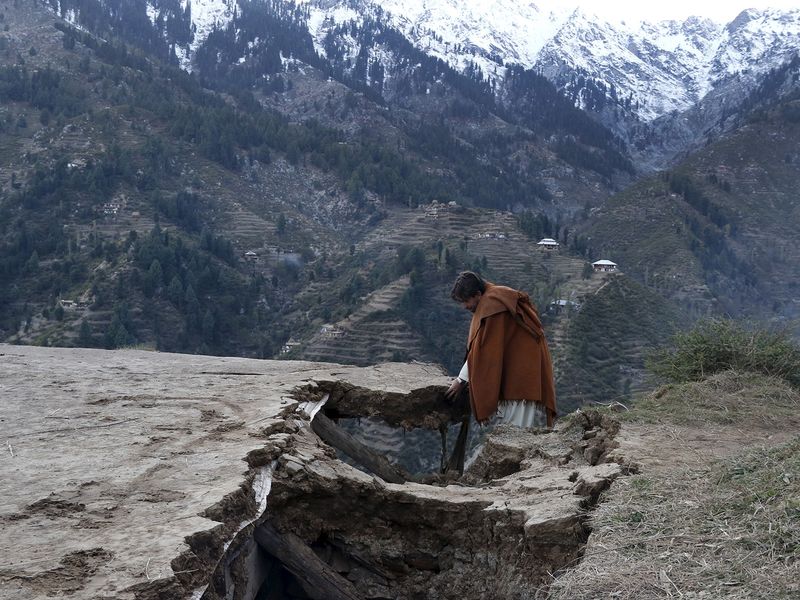
Islamabad [Pakistan], February 14 (ANI): An earthquake of magnitude 4.2 struck Pakistan late Friday, a statement by the National Center for Seismology (NCS) said.The earthquake occurred at a shallow depth of 25km, making it susceptible to aftershocks.In a post on X, the NCS said, “EQ of M: 4.2, On: 13/02/2026 23:53:39 IST, Lat: 28.32 N, Long: 67.40 E, Depth: 25 Km, Location: Pakistan.”EQ of M: 4.2, On: 13/02/2026 23:53:39 IST, Lat: 28.32 N, Long: 67.40 E, Depth: 25 Km, Location: Pakistan.For more information Download the BhooKamp App https://t.co/5gCOtjdtw0 @DrJitendraSingh @OfficeOfDrJS @Ravi_MoES @Dr_Mishra1966 @ndmaindia pic.twitter.com/VpP50KBXSW— National Center for Seismology (@NCS_Earthquake) February 13, 2026Shallow earthquakes are generally more dangerous than deep earthquakes. This is because the seismic waves from shallow earthquakes have a shorter distance to travel to the surface, resulting in stronger ground shaking and potentially more damage to structures and greater casualties.Earlier, a devastating earthquake struck Pakistan-occupied Gilgit-Baltistan on January 19, destroying hundreds of homes and leaving numerous families in urgent need of relief.Despite the magnitude of the disaster, residents say the PoGB interim government has taken little more than formal steps, leaving communities frustrated and helpless.Aid from China, including tents, blankets, and other essential relief items, has reportedly been stuck at Sost Port since 2022. Villagers in Chapursan are demanding that at least this minimal assistance be released immediately to alleviate their suffering.Afghanistan, Pakistan, and northern India lie in one of the most seismically active zones in the world, where the Indian and Eurasian tectonic plates meet. The region frequently experiences moderate to strong earthquakes, often felt across borders due to the proximity of fault lines.Pakistan is among the seismically active countries in the world, crossed by several major faults.This collision zone makes the country highly vulnerable to violent earthquakes. Provinces such as Balochistan, Khyber Pakhtunkhwa, and Gilgit-Baltistan lie on the southern edge of the Eurasian plate, while Sindh and Punjab are located on the northwestern edge of the Indian plate, contributing to frequent earthquake activity.Balochistan is located near the active boundary between the Arabian and Eurasian tectonic plates.Other vulnerable regions, such as Punjab, which lies on the northwestern edge of the Indian plate, are susceptible to seismic activity. Sindh, though less prone, is still at risk due to its location. (ANI)(This content is sourced from a syndicated feed and is published as received. The Tribune assumes no responsibility or liability for its accuracy, completeness, or content.)