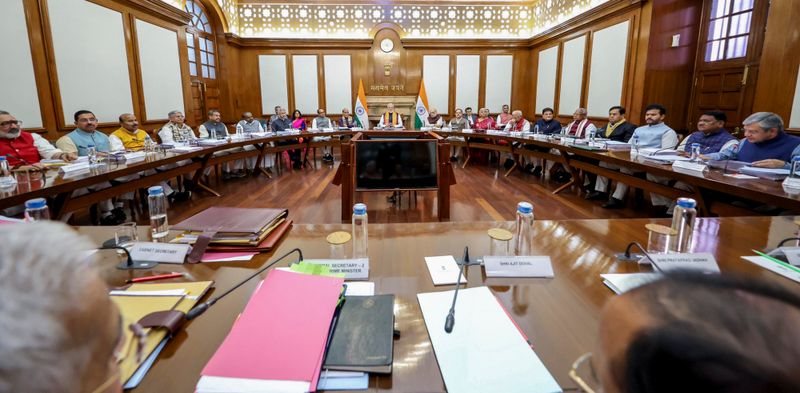
As it met in the Prime Minister’s Office (PMO) located in South Block for one last time on Friday, the Union Cabinet adopted a resolution framing the shift of the PMO from the British-era building to Seva Teerth as a transition from “culture of power to culture of service”.The resolution led by Prime Minister Narendra Modi noted with happiness that the Cabinet was meeting for the last time in a colonial-time complex.“North and South Blocks were constructed by the British to keep India bound in the chains of colonial rule. Although India attained freedom from the colonial rule in 1947, these buildings were retained by the then government for the discharge of its functions. Since Independence, the PMO has functioned from this building in South Block. Today, we feel happy that the meeting of the Union Cabinet is being held for the last time in this chamber of South Block. This is not merely a moment of change of place; it is also a moment of the confluence of history and the future,” the resolution says.It said the Secretariat Complex consisting of the North and South Blocks — now vacated — has witnessed and shaped many historic events from slavery to freedom and then of independent India.“This complex has witnessed important decisions taken by Cabinets formed under the leadership of 16 Prime Ministers of the country. From Jawaharlal Nehru to Prime Minister Narendra Modi, their footprints are on its stairs. The steps climbed on the stairs of this building have made an important contribution in taking the country to new heights,” says the resolution while approving the preservation of the building as part of the upcoming Yuge Yugeen Bharat Museum, billed as the world’s largest.“Today, the Cabinet also resolves that North and South Blocks be made part of the ‘Yuge Yugeen Bharat National Museum’, which will continue to inspire generations from our thousands of years old civilisation. This museum will celebrate our timeless and eternal cultural heritage and connect our glorious past with a prosperous future,” said the resolution.It added that India is now moving forward with the resolve of a developed future and for this, there was need for a modern, technological and environmentally friendly office.“We needed a workspace that increases the productivity of every karmayogi working here and encourages his resolve of service. With this spirit, nearly 95 years after the inauguration of South Block, on February 13, 2026, the Government of India is vacating these buildings and shifting to Seva Teerth and Kartavya Bhavans,” the resolution added.It said symbolically, the shift was another step of the country from the past of slavery towards the future of ‘Developed India’.“In the past years, instead of the culture of ‘power’, the culture of ‘service’ has been strengthened in the country. Today’s transition will further strengthen these values,” the Cabinet added.With the resolution and the eventual shifting of Government of India to its own buildings, curtains fell on an era when the location of the Secretariat Buildings — atop Raisina Hills — was also a carefully calibrated move.Historical texts about the project state, “The Secretariat’s location served practical needs by convenient proximity to the Viceroy’s house (now Rashtrapati Bhavan). Herbert Baker (the architect) thought that for the government house to have been the sole splendid occupant of Raisina’s crest would have given too pointed an emphasis to the Viceroy as supreme authority and believed that Members of the Council and Departmental Secretaries when installed in grand new buildings, would rise to the distinction thus given their office.”Noting that the Secretariats were meant to house the elite Indian Civil Service, the historical accounts mention these as a special corps more powerful than even the royalty.Seva Teerth has, however, been framed by PM Modi as a “democratic workspace to bring the government closer to the people rather than have people in awe of it”.