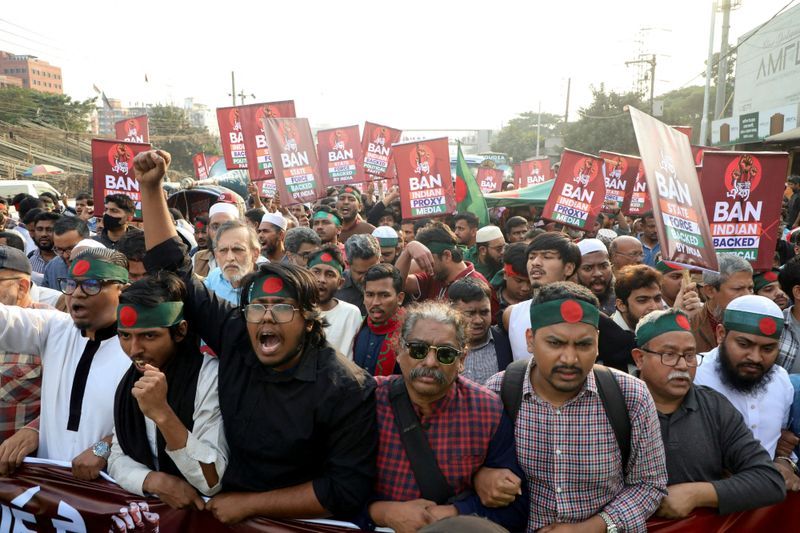
In Bangladesh, Tarique Rahman’s Bangladesh Nationalist Party won a majority in the February 12 election in the 350-member Parliament. If the poll mandate spurs transparency, accountability and genuine reform, it could mark the birth of a resilient democracy, writes our Deputy Editor Vikramdeep Johal in his Edit piece Trial by fire for Bangladesh. Perhaps the most hopeful sign is the importance of young voters, when nearly 5 million citizens voted for the first time. A stable, peaceful Bangladesh is of immense importance to India. The US and China are among the other key stakeholders, he writes.The primary expectation is that the government will make parliament the central platform for all national decisions, writes Bangladesh-based researcher & political analyst Altaf Parvez in his article A new mandate for the renewal of Bangladesh. To counter the seeds of armed extremism, three vital things will have to be done — a pro-poor economic reform; ensuring democratic practice at every level of administration and firm policing against any form of extremism. Without these measures, securing a peaceful future will be difficult, he writes.Back home, the 16th Finance Commission’s recommendation to withdraw Revenue Deficit Grants from states has created an uproar, the worst hit being the small hill state Himachal Pradesh. The Commission has rewired the devolution of funds from the Centre to the states by adding a brand new criterion — the amount of funds a state gets from the Centre will henceforth depend upon how much it contributes to the national GDP. This means that resilient and investor-friendly states like Tamil Nadu, Karnataka and Maharashtra will benefit; while states like Himachal, whose capacity to earn is limited, will be hurt, writes Editor-in-Chief Jyoti Malhotra in her weekly column The Great Game A strategy forged from revenue deficit. However, it is fascinating to see that Himachal has actually got a greater share of funds from the 16th Finance Commission than the 15th. So, the FinMin babus will rightfully point out the Congress government must learn to do a better job of managing its finances, she writes. Another big takeaway is that BJP-ruled states like Bihar, Uttar Pradesh and Madhya Pradesh have been given a lower share of taxes this time, as compared to last time. So, it’s clear the 16th Finance Commission has sown the seed. Now to water the plant and see how it blooms, she sums up.The Commission’s decision to withdraw the RDG (revenue deficit grant) rang alarm bells in the power corridors of the hill state Himachal Pradesh. This move reflects a mindset of over-centralisation, where the Union consolidates fiscal power while states are reduced to implementation agencies, writes former Shimla deputy mayor Tikender Singh Panwar in his Op-Ed piece How the RDG cut pushes Himachal to the brink. Revenues from HP projects flow overwhelmingly to Central utilities and private corporations. The resource is local, the land is local, the risks are local; the profits are not, he argues. When the Centre withdraws support without building alternative revenue pathways, it pushes the state towards alienation and political resentment, he writes.Former Army Chief General Manoj Mukund Naravane’s book ‘Four Stars of Destiny’ created quite a stir, thanks to LoP Rahul Gandhi. Giving a perspective, former MEA Secretary Vivek Katju writes in his Op-Ed article Why Parliament needs quiet conversations, military and civilian officers who have held sensitive and senior positions have to eschew the temptation of treading into the territory of confidential information while penning their memoirs. They have to be conscious that their interaction with the political leadership, while they were in service, was always based on trust, and this trust should be maintained while in service or after retirement. Even if these officers feel that political leaders erred or that they were let down, they do not have the luxury or liberty to break that trust after their retirement, he feels.Referring to the June 2020 Galwan skirmish in Ladakh between Indian and Chinese armies which Naravane’s book talks about, ex-Deputy Chief of Army Staff Lt Gen Raj Kadyan (retd) writes in his Op-Ed piece When military leadership is put to the test that instead of taking a decision on a problem, which at the time was purely of a military nature, the Army Chief chose to raise it with the political leadership. This amounts to a shifting of responsibility. At that instant, for the Army Chief to ask the political leadership ‘what are my orders?’ is strange, he writes. General Naravane has also reportedly mentioned his apprehension of the incident ending his career, or words to that effect. The occurrence of such a thought at a time when national security and lives of subordinates are at stake goes against the very ethos of the military, he writes.Looming American sanctions have put Iranian Chabahar port project in jeopardy. It’s puzzling that India transferred $120 million to Iran despite warnings about US sanctions, writes P Stobdan ex-Ambassador and Senior Fellow, Delhi Policy Group, in his Edit piece Tightrope walk for India on Chabahar. India’s delays in Chabahar led Iran to ally with China, which has invested significantly there. India aims to maintain access to Afghanistan while navigating US sanctions. How? India should propose linking the Kandla port to Almaty and Kashgar, bypassing Pakistan, he writes. Improved connectivity via China can enhance India’s access to Afghanistan and Central Asia and beyond, but a border agreement is needed to get things going, he writes. Engaging with any Islamic regime poses risks as Central Asian nations don’t view India as a viable energy partner. Chabahar was set to lower shipping costs and times, and boost trade with Iran, Afghanistan and Central Asia, while connecting to the International North-South Transport Corridor (INSTC) and countering China’s Belt and Road Initiative (BRI) as well as the China-Pakistan Economic Corridor (CPEC).