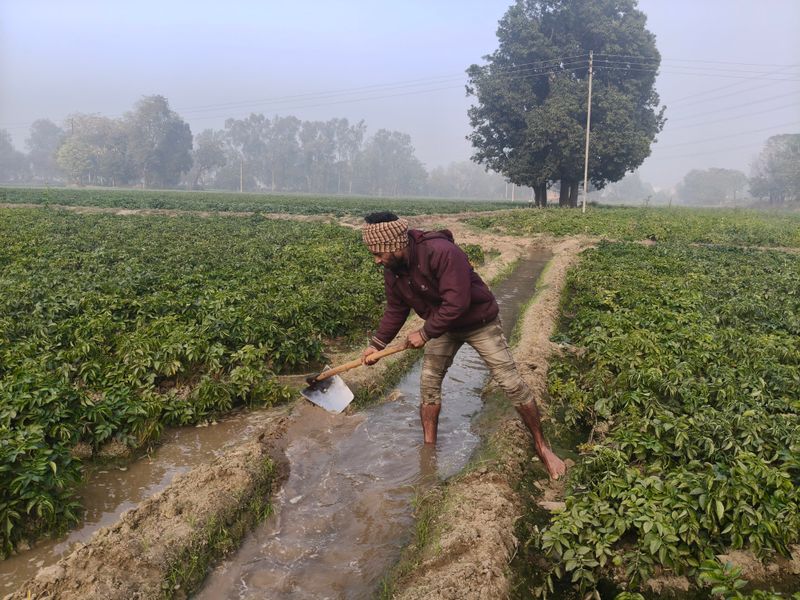
Agriculture sits at the complex intersection of India’s Viksit Bharat aspirations and its net-zero ambition. As the backbone of the rural economy, the sector supports 46 per cent of the workforce, ensures national food security and contributes about 14 per cent to Gross Value Added (GVA).A NITI Aayog report, however, warned that this foundational role — characterised by the dominance of small and marginal farmers — is increasingly threatened by climate change, soil degradation and acute water stress.The report also pointed out that agriculture accounts for nearly 14 per cent of India’s total greenhouse gas emissions, driven largely by methane and nitrous oxide from soils and livestock. Reducing the sector’s climate footprint, it said, is a prerequisite for achieving the Viksit Bharat goal.It outlined pathways to cut emissions while balancing food security, farmer livelihoods and climate objectives, and discussed the scale of transformation needed across crops, livestock and farming systems.“Shifting consumption from water- and energy-intensive rice towards climate-resilient millets can reduce emissions while strengthening resilience. This could be supported by behaviour-change initiatives such as the Eat Right Movement and the National Millet Mission (NMM),” the report stated.The government’s think tank further noted that for such transitions to scale without compromising farmer incomes or food and nutritional security, the state must deploy “phased”, “spatially targeted” and “socio-economically differentiated” roadmaps, particularly for expanding natural and chemical-free farming interventions.“Consequently, agriculture in India cannot be approached through a narrow mitigation-centric lens. The priority is safeguarding productivity, farmers’ incomes and food and nutritional security. This will require a focus on measures that build resilience to climate change,” it said.Economist Akash Jindal said crop diversification could be a key strategy, with farmers shifting away from rice-, wheat- or sugarcane-dominated monoculture systems towards high-value crops such as horticulture and oilseeds, or nutri-cereals, as a climate adaptation measure.“This transition can enhance farm incomes by reducing risk and increasing value per hectare, while also strengthening nutritional security. It yields mitigation co-benefits as greenhouse gas emissions per hectare decline when farmers move from input-intensive monocultures to more diversified cropping systems,” he said.The report also highlighted the role of Integrated Assessment Modelling (IAM) in generating data-driven insights for decision-making and navigating the complex interdependencies between climate, agriculture and socio-economic systems.“For example, dietary shifts towards healthier diets could reduce India’s emissions by 60 per cent compared to the baseline. A robust IAM assessment, calibrated to India’s national context, can integrate supply-side interventions with demand-side dynamics, while quantifying trade-offs such as land-use competition between food security, afforestation goals and the needs of other land-dependent sectors,” it underlined.Scaling natural farming in rain-fed areas for more equitable and sustainable agricultural growth was another key recommendation in the report as India moves closer to its net-zero goal.Rain-fed agriculture covers 51 per cent of the country’s net sown area and contributes 40 per cent of food production. It is characterised by low productivity, low input use and monsoon-dependent yield volatility.These regions face acute climate risks while supporting 81 per cent of the rural poor, including marginal, tribal and smallholder farmers.Natural farming, the report said, offers a low-risk, high-reward opportunity for these areas. Transitioning to such practices can enhance productivity, raise yields and profitability and improve health and nutrition outcomes, particularly since many farmers consume their own produce.It can also bring stability and resilience to rain-fed farming systems by improving soil health and promoting climate-resilient practices. The National Mission on Natural Farming (NMNF) prioritises rain-fed regions for scale-up, the report added.