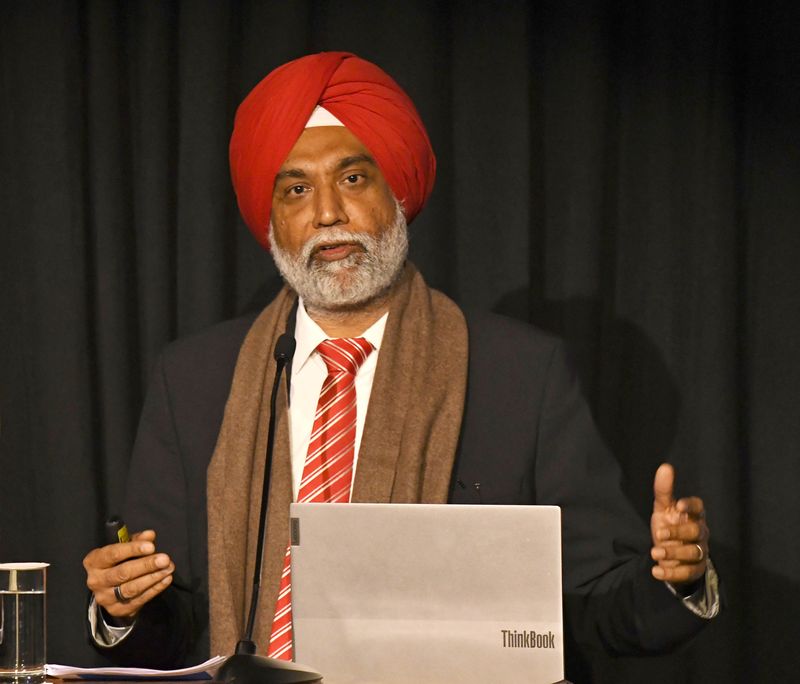
A top official of the United Nations (UN) has warned that AI resembles earlier transformative technologies such as steam and electricity, but may be even more disruptive.Lessons from past industrial revolutions show that diffusion —speed at which countries adopt and apply technology —determines who benefits, said Amandeep Singh Gill, the UN Under-Secretary-General and Special Envoy for Digital and Emerging Technologies.He was speaking on ‘Multilateralism and the Future of AI’ at the India International Centre (IIC) here this evening.“AI is often misunderstood due to Hollywood narratives and incomplete notions of intelligence. In reality, AI systems identify statistical patterns in data to approximate perception, reasoning and action, not genuine understanding,” said Gill, how is an alumnus of the Panjab University in Chandigarh.Gill, sharing another data, said modern-day large language models (LLMs) could now function as autonomous agents capable of multi-step tasks, significantly altering white-collar jobs.AI also presents opportunities in scientific breakthroughs, productivity gains, improved government services, better agriculture, health and climate solutions.Highlighting uneven computation capacities that create a deep “AI divide”, Gill pointed out that entire Africa had just 10,00 graphics processing units (GPUs), while Meta, the parent company of Facebook and WhatsApp alone had 6 lakhs GPUs. These units are needed to make machines think faster, process images, run AI programmes.These biased datasets could result in exclusion or concentration of power in private technology companies. Individually, AI feels empowering, however, at a policy level, it is concerning due to insufficient governance structures.Speaking about the role of the United Nations, Gill said AI cuts across peace and security, human rights, and sustainable development.The UN provides universality, convening power, and a foundation of norms required for global governance. UN has already set up an international scientific panel on AI.A proposed $3 billion global fund aims to help 80–90 countries lacking minimum AI capacity. A network of cooperation centres is emerging, with participation from countries, including India, Brazil, Kenya, Saudi Arabia, and others.“AI must be governed for the benefit of all humanity, ensuring fairness, reducing inequalities, and avoiding the mistakes made with climate change,” said Gill.