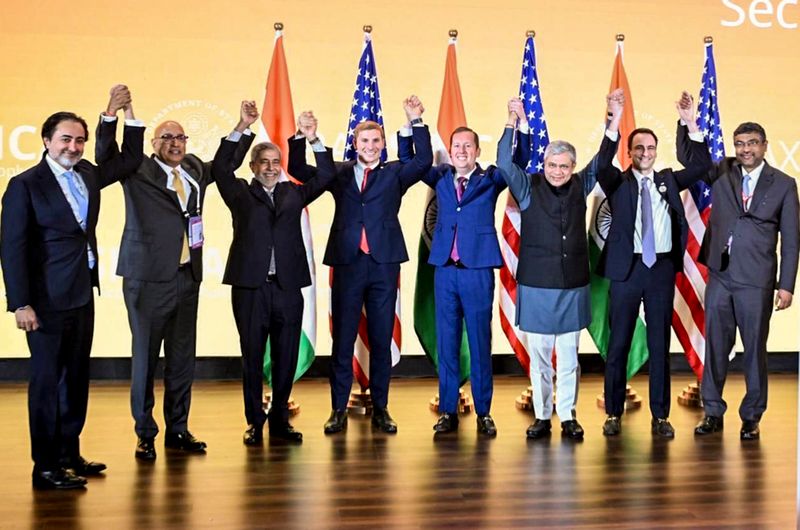
India on Friday formally entered “Pax Silica”, a strategic technology and supply-chain framework led by the United States, signalling its integration into an emerging global coalition shaping the economics of the artificial-intelligence age.Also read: AI Impact Summit: India joins US-led strategic bloc ‘Pax Silica’Launched in December 2025, Pax Silica is designed to build secure and trusted supply chains for semiconductors, artificial intelligence infrastructure and critical minerals — sectors increasingly viewed as the backbone of geopolitical and economic power in the 21st century.The initiative brings together technologically advanced partner economies to coordinate investments, protect sensitive technologies and reduce vulnerabilities across the full industrial stack — from mineral extraction and processing to chip fabrication, data infrastructure and advanced computing.Officials associated with the framework describe it as a “positive-sum” cooperation model aimed at replacing coercive dependencies with trusted industrial partnerships.Strategically, the grouping is widely seen as part of Washington’s effort to diversify technology supply chains and reduce reliance on dominant suppliers, particularly in rare-earth processing and semiconductor manufacturing.For New Delhi, membership carries both economic and geopolitical implications.First, the arrangement strengthens India’s semiconductor ambitions. The country has been attempting to build a domestic chip ecosystem through production incentives and design-led manufacturing. Participation in Pax Silica opens the possibility of joint fabrication projects, technology transfers and integration into global electronics value chains, areas where India has historically depended on imports.Second, the framework directly addresses critical mineral vulnerability. India imports the overwhelming majority of processed rare earth materials used in electronics and electric mobility. Cooperation with technologically advanced partners could provide alternative sourcing, processing partnerships and shared reserves — insulating industry from supply disruptions.Third, it expands India’s role in artificial intelligence infrastructure. Pax Silica focuses not only on chips but also on computing platforms, data centres and frontier AI systems. By entering the coalition, India positions itself as both a talent hub and a deployment market for next-generation computing, reinforcing its software-engineering advantage.Fourth, the initiative carries economic-security implications. The pact aligns with New Delhi’s policy of avoiding “weaponised dependency” in strategic technologies — ensuring that key digital infrastructure, defence electronics and advanced manufacturing inputs remain accessible during geopolitical crises.Finally, analysts view the move as geopolitical signalling. Until recently, India remained outside the original Pax Silica grouping, even as several US partners joined. Its entry elevates the country from a peripheral market to a structural node in an emerging technology alliance that aims to define standards, investments and industrial geography in the AI era.In essence, Pax Silica marks a shift from traditional resource geopolitics — oil and steel — to silicon and algorithms. For India, participation is expected to accelerate domestic manufacturing, secure supply chains and embed the country deeper into the global high-technology order now taking shape.