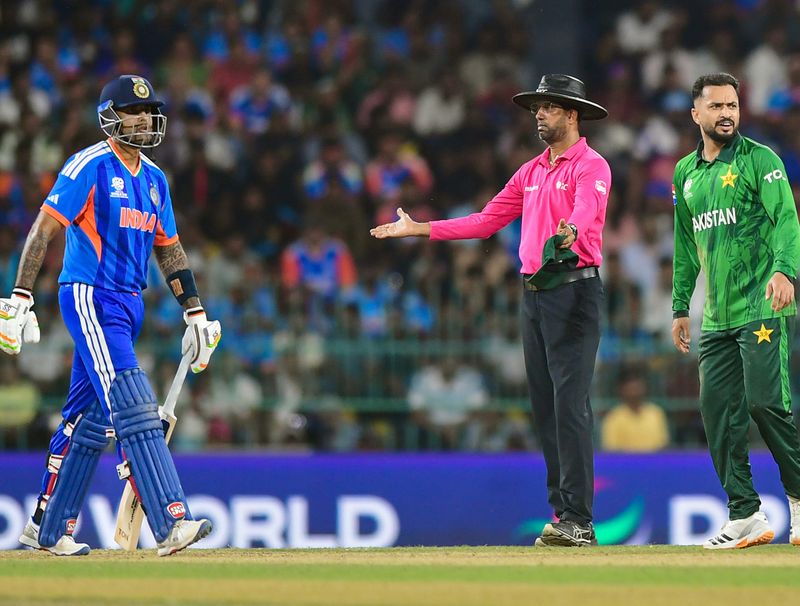
IN the end it was, to quote Shakespeare, “like a tale told by an idiot, full of sound and fury, signifying nothing”. In this battle of bullets camouflaged as a contest between bat and ball, no one has an idea of what the endgame is, except of course to satisfy the greed of those who love the whirring, rustling sound of the cash-counting machine.Was it all worth the energy expended to put the broken pieces of egoistic minds together and have the match finally take place? There was a time when an India-Pakistan match, even if it did not often produce a riveting contest, showcased extraordinary skills on both sides. From a cricketing perspective, it is sad to see the once formidable Pakistan reduced to a team of nervous, bumbling players, lost like fearful children in a gathering of bullying adults.In a World Cup full of surprises and exciting possibilities that might be forcing the die-hard traditionalists to reassess their dislike for the T20 format, the India-Pakistan off-field theatrics are a distasteful reminder of how not to mix sports with politics. The manner in which smaller, newer nations have embraced this format and are even challenging established teams reaffirms fears for Test cricket’s survival. When Nepal can nearly stun England, the United States almost defuse India’s batting explosion and Zimbabwe become the giant slayers, it is obvious there is no Goliath in the T20 world.Elite Test-playing nations for long have, in vain, searched for countries which could expand their limited numbers. Its failure to spread could, among many reasons, also have to do with its intricate skills that take time and a proper cricketing culture to master.From the 1970s onwards, it was believed that where Test cricket failed, the 50-over game would succeed. Though it did narrow the gulf and allowed “mediocre” teams to compete, the core has remained almost untouched, Afghanistan being the rare exception. T20 has literally revolutionised not just the way cricket is played, but also ignited the imagination of countries which would be an embarrassment in Test cricket’s draining, energy-sapping battle of skill and attrition.An epithet for our times could read: Impetuosity is a virtue, patience a vice. Patience and skilful vigil at the crease were the twin pillars on which a traditional Test batsman would prosper. He was trained to rein in his impulsive streak, bide his time and construct an innings like a mason who has to build a castle, not fix a door knob.The T20 batsman has been provided with a racing track and given a gear-less car to drive. There are no road bumps, no hazards to negotiate. He has a licence to thrill and go for the kill. Better imagery would be of a person holding a machine gun or even more lethal, the Metalstorm to fire from. It is a volcanic burst which has dazzled a vast number of “fearless” youth and lured “bored” adults into its addictive embrace.The shrinking of a sport designed to last five days to just three-and-a-half hours playing time has turned the grammar of cricket upside down. The 360º swinging bats, the vanishing defensive prods, the scoops and reverse sweeps, ramp ups, the deliberate edges that race towards the boundaries — it is mayhem out there. To counter this fusillade, the bowlers are inventing new methods of deception and deceit. The finger flicks, the knuckle balls, the side-on release, the subtle pause and the speed variations are among the many methods being used in the hope of chaining the batter. To survive, the bowler needs to be a sorcerer or face imminent demise.With cricket being played at a frenzied pace and the world warming up to it, was it necessary for India and Pakistan to create a churlish drama of its own on the field? I admire Suryakumar Yadav the batter and his mobile face that would be a thespian’s delight. He contracts and stretches his face, flattens his forehead, occasionally even rolls out his tongue with eyes popping out in an unrestrained display of a sea of emotions.It does not behove an Indian captain of such endearing qualities to display a streak of boorishness and refuse to shake hands with his rival captain. To walk away from an established tradition is disquieting, disturbing and shows a complete lack of sporting manners. What was India trying to prove by repeating an act done during its three matches in the Asia Cup played a few months back?While Yadav, probably under instructions, was avoiding the gaze of Pakistan’s captain during the toss and the teams didn’t line up for handshakes, India’s former captain and an icon of the game, Rohit Sharma, was captured by the cameras hugging Pakistani legend Wasim Akram. It was a gesture symbolic of two human beings greeting each other in the warmth of good faith.We are fine with playing against you, fine with former Indian and Pakistani legends doing commentary together, laughing and smiling at each other’s jokes, helping broadcasters and both teams rake in money but please, no official handshake on the ground. Hypocrisy has no limits, no boundaries.— The writer is the author of ‘Not Quite Cricket’ and ‘Not Just Cricket’