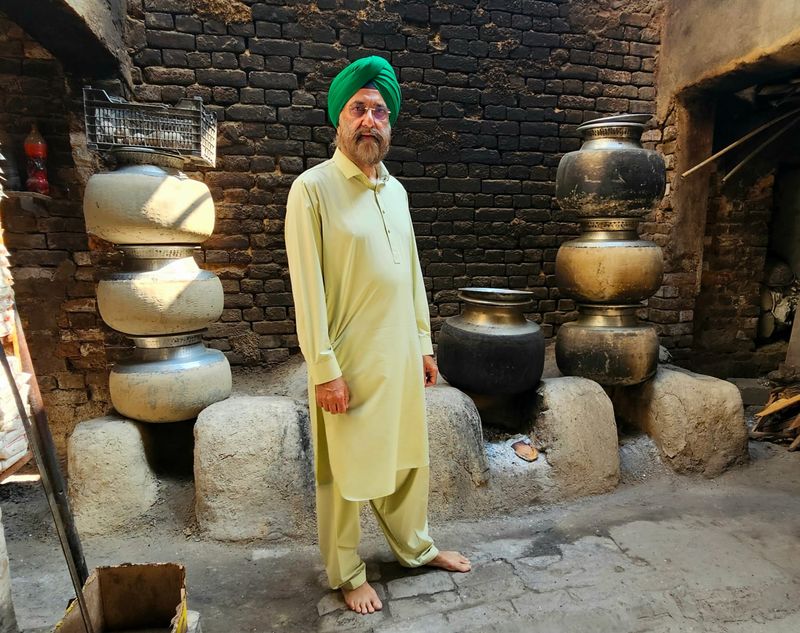
Imagine visiting a shrine centuries after your ancestor went there and visiting the kitchen where your ancestor served food 770 years ago.I recently visited the Darbar (burial place) of Baba Fareed Ganjeshakkar at Pakpattan in the Pakistani province of Punjab.Travelling from Lahore south to Pakpattan was an impatient drive. I could not wait to get there.Pakpattan, formerly known as Ajodhian, is known as the town of Baba Fareed Ganjeshakkar (1188-1266). He was a follower of Khwaja Qutbuddin Bakhtiar Kaki, whose shrine is in Mehrauli, Delhi. On the death of the Khwaja, Baba Fareed moved from Hansi (now in Haryana) to Ajodhian (now called Pakpattan). He lived and died here.Baba Fareed is one of the best-known Punjabi Sufi mystics of south Asia. His compositions are the earliest known written record of Punjabi poetry, written in the early 13th century in the Nastaliq script, later called Shahmukhi. Guru Nanak travelled to Pakpattan between 1505 and 1510 and met Sheikh Ibrahim Farid Sani, the 12th spiritual successor of Baba Fareed. The meeting was held at a mound about 5 kilometres from Pakpattan – now called Gurdwara Tibba Nanaksar. Here, Guru Nanak secured the Shahmukhi writings of Ganjeshakkar from Sheikh Ibrahim. He then transliterated them into Gurmukhi in the ‘pothi’ he carried. Eventually, the 134 verses of Baba Fareed were included in Guru Granth Sahib by Guru Arjan Dev.Muslims and Hindus view Baba Fareed as a Sufi saint. For Sikhs, his status is much higher. The fact that his verses are included in Guru Granth Sahib, which Sikhs believe to be the word of God, means God spoke directly to Baba Fareed. When Sikhs bow before Guru Granth Sahib, they pay respect to the Bani of the Sikh gurus as well as that of the saints in it.It is ironic that the only place where Baba Fareed’s compositions are preserved is Guru Granth Sahib — 134 of his verses are written in Punjabi in Gurmukhi script. His original writings in Shahmukhi have been lost over the centuries. In Pakistan, several verses such as “Turiya turiya ja Fareeda” are sung and incorrectly attributed to Baba Fareed. These verses are not there in Guru Granth Sahib and most probably were authored by one of his descendants who also used the pen name ‘Fareed’.My ancestor, Rai Bhag Mal, was from Multan and probably spoke Saraiki (the Multani dialect of Punjabi). He visited Baba Fareed in 1256 and organised a ‘bhandara (langar)’ at Pakpattan. He built a community kitchen and served ‘langar’ there for about a year. Baba Fareed blessed him with the title of ‘Bhandari’, a title that still is proudly acknowledged in our Butalia family.I visited the small burial room of Baba Fareed to pay my respects and offered a prayer there to God that all human beings may follow the path of love shown by the ‘fakir’ of Pakpattan.Then, I visited the community kitchen where my ancestor Rai Bhag Mal prepared food 770 years ago. Because of Ramzan, no lunch was being served, so I went inside the kitchen that my ancestor established. As I did so, I kept murmuring the following verses of Baba Fareed:‘Fareeda jai too akal lateef kaalae likh na laikh,Apnarae giraewan mai sir niva kar dekh.’(O Fareed, if you are sensible, then do not mark anyone as black (bad),Look humbly into your own self first.)And when it was time for Mehboob Fareedi qawwal to sing, I requested him to sing the above verses, and he obliged. Tears of joy rolled down my face as he did so.How does one capture the feelings of visiting the kitchen in which your ancestor prepared and served food 770 years ago? It is a poem in Saraiki that I wrote and is given below:‘Ganjeshakkar da LangarMultani Rai Bhag Mal di rooh no puchsan,Ganjeshakkar dae langar da tuh ki kamayasan:Jawab milya Bhandari da khitab divaya,Jo Pakpattan dae Peer nae nivaya.Satso traeth saal baad pher jawab milyasan,Jad main Ganjeshakkar dae langar vich ayasan;Oye angaelae mundiya dil khol kae niwaz naal khasan,Eh rab da attut bhandara hosan.Eh Bhandara dal roti da na hosan,Dil vich pyar vandaun da hosan.’(The Langar of GanjeshakkarAsk the soul of Rai Bhag Mal of Multan,what did you earn from the langar of Ganjeshakkar;The answer came, I earned the title of Bhandari,which was bestowed by the Peer of Pakpattan.After 770 years, the answer came again,When I visited the langar of Ganjeshakkar;O, irresponsible boy, eat your heart out with content,this is the never-ending kitchen of God.This is not the kitchen of lentils and bread,but that of sharing love from the heart.)