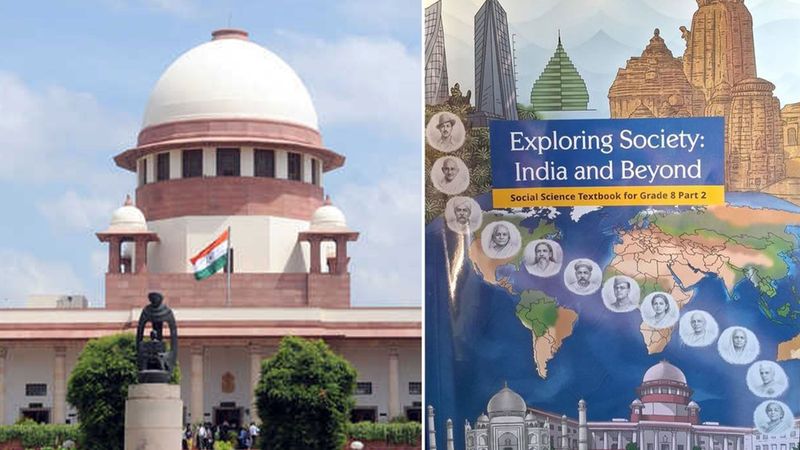

The Supreme Court on Wednesday took suo motu cognisance of the National Council of Educational Research and Training (NCERT) Class 8 textbook section on corruption in judiciary, saying it appeared to be a “calculated move”.“I will not allow anyone to defame the institution. I know how to deal with it… It seems to be a calculated move,” Chief Justice of India Surya Kant said after senior counsel Kapil Sibal mentioned the issue requesting him to take cognisance of the issue.As Sibal said, “We are deeply disturbed by Class 8 students being taught that the judiciary is corrupt…This is a matter of grave concern,” the CJI said, “We have already taken cognisance of the matter… We are aware of the issue and we will act,” the CJI told Sibal.“Please wait for a few days. Bar and Bench all are perturbed. All high court judges are perturbed… As head of the institution, I have done my duty and I have taken cognisance. I won’t say much… Law will take its own course,” CJI Kant said.Senior counsel AM Singhvi said the judiciary was selectively targeted. “It’s there in other areas also but judicial corruption!” he wondered.The newly released social science textbook for Class 8 published by the NCERT has introduced a section on “Corruption in the Judiciary” and also mentions pending cases in the chapter titled ‘The Role of the Judiciary in Our Society” .The Part II of the NCERT Social Science textbook for Class 8 was released on February 23 after a huge delay.The section on “Corruption in the Judiciary” stated that judges are bound by a code of conduct that governs not only their behaviour in court but also their conduct outside it.The chapter highlighted the judiciary’s internal accountability mechanisms and refers to the established procedure for receiving complaints through the Centralised Public Grievance Redress and Monitoring System (CPGRAMS). According to the book, more than 1,600 complaints were received through this mechanism between 2017 and 2021.It quoted former CJI BR Gavai, who in July 2025, said, “However, the path to rebuilding this trust lies in the swift, decisive and transparent action taken to address and resolve these issues…Transparency and accountability are democratic virtues.”The chapter on judiciary also listed the approximate number of pending cases in the Supreme Court (81,000), high courts (62,40,000), and district and subordinate courts (4,70,00,000).“While the number of pending cases shows a part of the problem, the real issue is the long time that it takes to resolve a case. In the high courts, for example, nearly three-fourths of pending cases have been unresolved for over a year, and half of them have been pending for more than three years. Some cases have remained unresolved for more than 50 years!” stated the chapter.