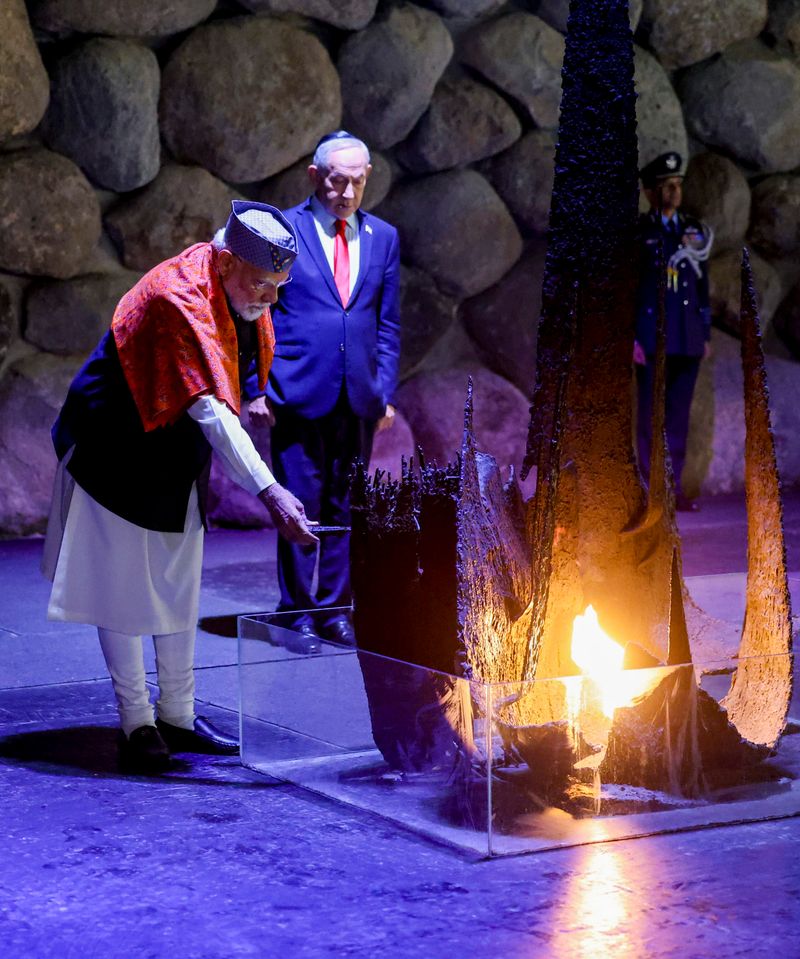

India and Israel on Thursday made a push for jointly working on future technologies and expanding upon decades of work in agricultural research while elevating their bilateral relationship to a special strategic partnership.The two countries signed 17 agreements spanning artificial intelligence, agriculture, fin-tech and labour mobility; the latter will allow for 50,000 additional Indian workers to move to Israel over the next five years. Regulated recruitment channels have been created across sectors such as retail, logistics, warehousing, food processing, textiles, metals, electronics and hospitality.The announcements resulted from a bilateral meeting Prime Minister Narendra Modi had with his Israeli counterpart Benjamin Netanyahu in Israel. On the much-expected expansion of ties in defence technology, a joint statement said, “Both leaders provided a vision and a roadmap for future defence cooperation”.On agriculture, Modi announced, “We have pledged to give a futuristic shape and have 100 centres of excellence”.There are 35 centres of excellence in agriculture already operating in India and eight are being jointly operationalised. More than a million Indian farmers have been trained at these centres of excellence so far. The two sides will focus on water conservation, wastewater treatment and its reuse for agriculture along with the cleaning of the Ganga and other rivers using technology.An MoU was signed between the Indian Council of Agricultural Research and MASHAV regarding the India-Israel Innovation Centre for Agriculture. This initiative is aimed at next-generation technologies, including precision farming, satellite-based irrigation, advanced machinery and integrated pest management.On the technology front, the joint statement said, “Israel is a global powerhouse of technology and innovation; India serves as a hub of talent, manufacturing excellence and entrepreneurial energy.”The two Prime Ministers affirmed their commitment to integrating India’s and Israel’s advancements in AI, cybersecurity, semiconductors, quantum computing, biotechnology, agriculture and water management, defence platforms and space exploration.“This partnership aims to spark the next wave of technological transformation and shared progress of both countries,” the joint statement said.Among the key agreements was a memorandum of understanding on cooperation in geophysical exploration, aimed at expanding mineral collaboration through advanced mapping technologies and AI-driven analytics, with provisions for data sharing and investment promotion.At the strategic level, both countries agreed to elevate the Joint Committee Meeting on Science and Technology to the ministerial level and to launch an initiative on critical and emerging technologies led by the two National Security Advisers.Foreign Secretary Vikram Misri told the media that “technology and innovation formed a central pillar of the visit”. A broad-based MoU on artificial intelligence committed both sides to cooperation in ethical AI, civilian applications, research exchange and capacity-building.The two sides will have a “horizon scanning/strategic foresight mechanism”, which will help identify emerging global trends in areas such as technology, economy and society by leveraging data, AI and expert insights to support strategic planning and decision-making.An Indo-Israel Cyber Centre of Excellence in India to showcase cybersecurity practices is also in the pipeline.On global issues, Modi and Netanyahu reiterated their unwavering commitment to advancing global peace and security, and welcomed US President Donald Trump’s “comprehensive plan to end the Gaza conflict”.The joint statement said, “They strongly condemned the October 7, 2023, terror attack on Israel, the terror attack on Indian tourists at Pahalgam in Jammu and Kashmir on April 22, 2025, and the terror incident near the Red Fort on November 10, 2025.