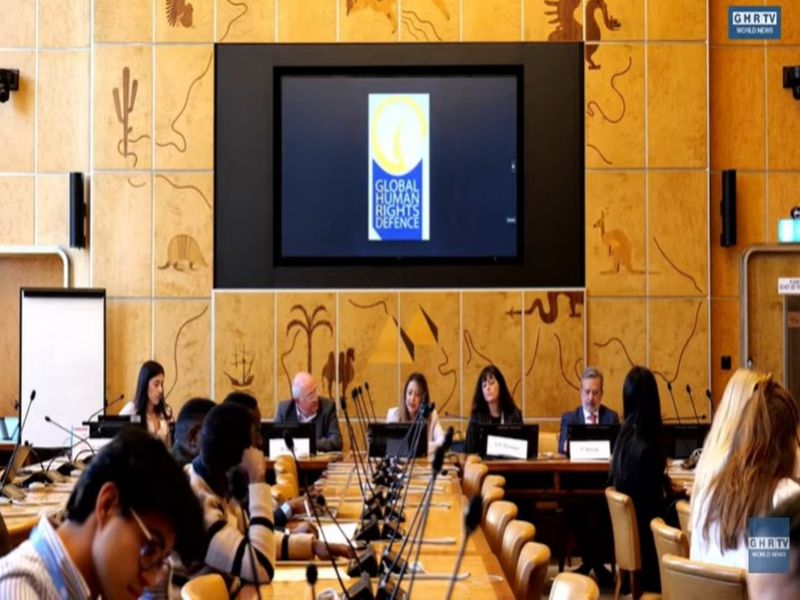

Geneva [Switzerland], February 27 (ANI): Highlighting the misuse of religious legislation, Simin Fahandej, the Representative of the Baha’i International Community’s United Nations Office in Geneva, stated that blasphemy laws are frequently employed as tools for political control rather than religious protection.Speaking at a side event during the 61st United Nations Human Rights Council (UNHRC) session, titled “Blasphemy Laws and the Persecution of Minorities in Asia: Human Rights Implications and Paths Forward”, Fahandej, who has served in her role since 2011, underscored the gravity of the current landscape.”This is actually quite an urgent discussion given everything that’s been going on in the past weeks,” she noted.She observed that while certain events are “not necessarily directly connected to blasphemy”, the underlying issue remains the forced application of specific doctrines.She stated that the trend “is about imposing a certain ideology, a certain interpretation of religion, and politicising and imposing it around entire communities”.The Representative further argued that the stated purpose of these laws often masks their actual function in various regions.Fahandej remarked, “Blasphemy laws are actually often presented as instruments to protect religion, but in practice, in many contexts, we have seen that they actually protect political power instead, and they are used to silence religious minorities.”Discussing the legal framework, she noted that such provisions “frequently contradict international guarantees of freedom of religion or belief”.She further cautioned that “rather than safeguarding these rights, these blasphemy frameworks often erode them, especially through vague language and discriminatory enforcement”.The session, organised by Global Human Rights Defence (GHRD), detailed how blasphemy provisions across Asia contradict international law and often carry severe penalties, including the death penalty.The event highlighted that these laws particularly impact religious minorities such as Christians, Hindus, and Ahmadis in Pakistan, the Baha’i community in Iran, and women and girls in Afghanistan. (ANI)(This content is sourced from a syndicated feed and is published as received. The Tribune assumes no responsibility or liability for its accuracy, completeness, or content.)