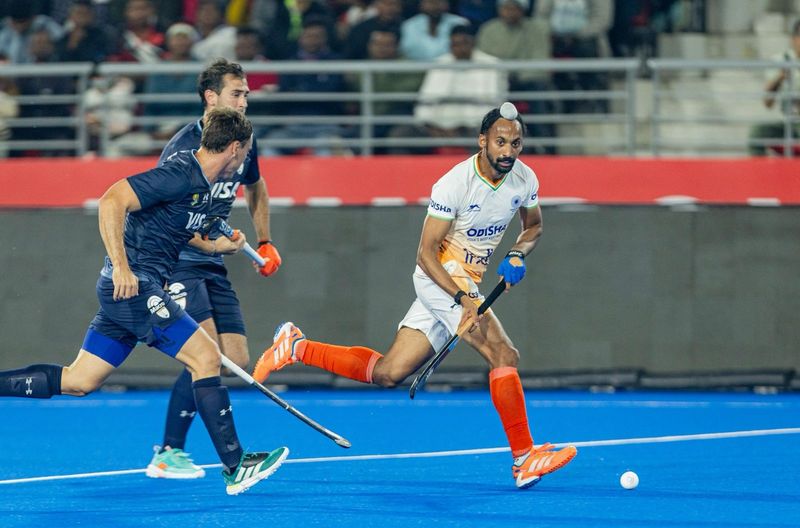

It’s common for national coaches to use the phases intervening major tournaments for experimentation. Since joining as India coach in 2023, Craig Fulton has been running small experiments along with the bigger task of finalising his core group before major tournaments.Before the 2024 Olympics, he tried different combinations, tested new players and even put team regulars in various roles to add dimensions to the team’s playing style and develop options for each position. Fulton’s vision was to “build a cohesive team that can adapt to different playing styles and situations”.In the Pro League preceding the Paris Games, it was common for players to rotate between positions as the rolling substitutions came into play, the most noticeable examples being central midfielders Manpreet Singh and Hardik Singh, and forwards Gurjant Singh and Shamsher Singh.As the Paris Olympics approached, Fulton understandably cut down on his experiments — the more extreme being his use of Manpreet solely in the backline. But it became evident that Fulton leaned towards all-rounders who can succeed in multiple roles while playing across different lines.All-roundersThis preference for all-rounders is not unique to Fulton. In the fast-paced modern game, with the whole team moving as one and positions being fluid, it is a necessity to be comfortable playing in every part of the field. With a need to develop all-round skills and tactical awareness, no player can afford to be one-dimensional.Foreign coaches over the last decade and a half have managed to modernise the Indian team’s training system and playing style, resulting in a marked improvement in the defensive skills of the strikers and a confidence boost for the defenders to venture forward. But there has been a dearth of proper all-rounders, a problem rooted in the old-school training methods still prevalent at the grassroots.The one exception in the national team is Manpreet, who as a central midfielder has been the fulcrum of India’s game for over a decade. Manpreet’s efficiency on the ball and positioning off it have made him inconspicuous despite his ability to pop up all over the field.The 33-year-old’s influence in the national team setup was again underlined when his absence — a rarity for a player with over 400 international caps — from India’s recent Pro League matches disrupted the team’s balance.With Manpreet in the team, Hardik is given a prominently attacking role, at the top of the central diamond, just behind the forward-line. That is a position where he thrives, starting counterattacks from around the centre-line or breaking open tight defences in the attacking third with his deceptive changes in pace and direction.License to thrillIn Rourkela, Hardik’s role was largely restricted to the base of the midfield, where he could marshal the defence and alternate with Harmanpreet Singh as the playmaker from the back.Hardik shared the holding midfielder duty with Vivek Prasad and Nilakanta Sharma, who despite being senior players lack the leadership quality of Manpreet. The energetic former captain sets a high standard of discipline in defence. Hardik, Vivek and Nilakanta also lack Manpreet’s versatility to seamlessly shift to the left, right, or even the backline.With an experienced left-half missing and the central midfielders failing to cope in that position, India’s defensive integrity cracked in Rourkela.Fulton then brought in the experienced Sumit to strengthen India’s defence on the left for the Hobart leg. But it did not lessen the load on Hardik as he also had to guide Rabichandra Moirangthem, Vishnukant Singh and Rajinder Singh, who are newcomers in India’s central midfield.With Harmanpreet being rested for the Australia leg, Hardik also had to take up the roles of the leader in defence and the sole provider of long balls from the back. He stood out with his long passes, which highlighted his exceptional vision. But the extra burden kept him from going forward.It had a direct impact on India’s attacking game, which was innocuous due a lack of cohesion. There was very little link-up play, which left senior forwards Mandeep Singh, Sukhjeet Singh and Abhishek stranded up front.