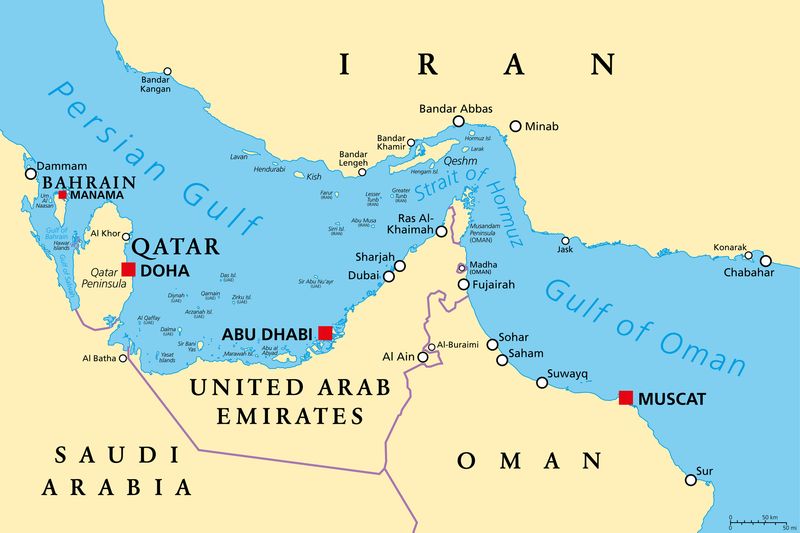

IN 1987, during the closing years of the Iran-Iraq war, the Persian Gulf turned into a battlefield for the world’s oil supply. Missiles struck oil tankers, naval mines drifted through shipping lanes, and insurance premiums for ships skyrocketed overnight. More than 500 commercial vessels were damaged or destroyed in what came to be known as the ‘Tanker War’. At the centre of that conflict was a narrow stretch of water barely a few dozen kilometres wide — the Strait of Hormuz.Nearly four decades later, threats to block the waterway have again raised fears of a global energy shock. Only a few places on Earth wield as much influence over the global economy as this narrow maritime passage.Narrow gateway for global energyThe Strait of Hormuz lies between Iran to the north and Oman and the United Arab Emirates to the south. It connects the Persian Gulf with the Arabian Sea through the Gulf of Oman.At its narrowest point, the strait is about 33-km wide, yet the shipping channels are only a few kilometres across in each direction. Despite its modest size, it serves as the primary exit route for energy exports from the Gulf — a region that holds some of the world’s largest oil and gas reserves.Every day, roughly one-fifth of the world’s oil consumption passes through the Strait of Hormuz. Massive tankers carrying crude from producers such as Saudi Arabia, Iraq, Kuwait and the UAE must transit this narrow corridor to reach international markets. It is also a key route for liquefied natural gas exports from Qatar, one of the world’s largest LNG suppliers.Back in focusThe latest confrontation involving Iran and the US-Israel alliance has again put the waterway in the spotlight. Iranian officials have repeatedly warned of targeting shipping in the strait or attempting to block it.Even without a complete closure, such threats have already unsettled markets. Shipping companies may reroute vessels, insurance costs rise sharply, and naval forces increase patrols to escort tankers.Can Iran actually shut it?In practical terms, shutting the Strait of Hormuz entirely would be extremely difficult. The waterway is an international shipping route and several major naval powers maintain a strong presence to ensure freedom of navigation. The US Navy in particular has long operated in the Gulf to safeguard maritime traffic.However, Iran does not necessarily need to close the strait completely to create disruption. Analysts say Tehran could employ asymmetric tactics such as naval mines, anti-ship missiles, drones or swarms of fast attack boats to threaten shipping — like it is trying to.Dependence and diversifyingIndia imports more than 80 per cent of the oil it consumes, and a substantial share originates in Gulf countries, whose exports pass through the Strait of Hormuz.Over the past decade, India has taken several steps to reduce vulnerability to such shocks. One of the most important has been diversifying oil supplies, including from Russia and the US.The government has also created strategic petroleum reserves designed to store millions of barrels of crude oil for emergency use. Along with commercial stockpiles maintained by oil companies, these can provide a buffer during temporary disruptions in global supply.Yet energy experts caution that no country can fully insulate itself from a prolonged crisis in the Strait of Hormuz. Geopolitical pressure pointThe strait may appear as a thin blue line on the map, but its importance far exceeds its size. It remains one of the world’s most powerful geopolitical pressure points — where regional conflicts can quickly evolve into global economic crises.As tensions in West Asia intensify, the fate of this narrow maritime passage is being watched closely by governments, markets and energy companies around the world. For the global economy, the question remains as urgent today as it was during the ‘Tanker War’ nearly four decades ago: Will the Strait of Hormuz remain open? Why it matters for IndiaIndia imports more than 80 per cent of its crude oilA large share of imports is sourced from the Gulf regionMajor suppliers: Iraq, Saudi Arabia, UAEMuch of this oil travels through the Strait of Hormuz If Iran blocks the Strait Impact Likely consequencesOil supply disruption Global price surgeTanker traffic Shipping delays/haltsInsurance costs Sharp increaseGlobal markets Volatility in energy pricesAsia’s energy security Major risk