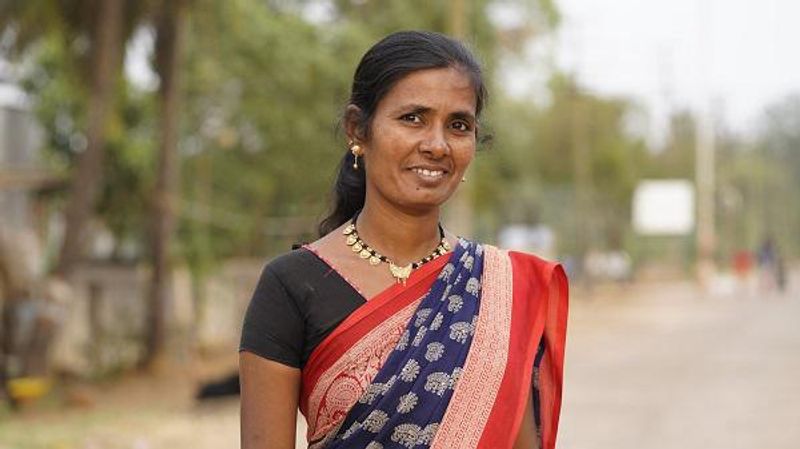

Armed with a sickle, a bright red headscarf, and a smile, Bibi Jaan, 40, steps out from Teertha village in Karnataka not just to work, but to shatter glass ceiling and dream big for her village and herself.With only conviction but no funds or guidance, Jaan founded the Bibifathima Swa Sahaya Sangha, a self-help group (SHG), in 2019. Starting with a few women, they grow millets, conserve seeds, and process crops using renewable energy.Mocked, ridiculed, and even barred from leaving home by her conservative family, she persisted. Her grit earned national attention and international acclaim.Jaan won the United Nations Equator Initiative Award 2025 for blending traditional farming with modern sustainability, restoring biodiversity and creating jobs.“Farming is a herculean task where losses often exceed profits. For women, it’s tougher still. I started alone, but now we’re a 14-member group conserving millets and indigenous seeds. We’ve set up millet production units in 30 villages,” she told The Tribune.“Farmers take 1 kg of seeds from us during sowing and return 2 kg. We focus on organic farming—chemicals harm soil, plants, animals, humans, and the environment. Today, we need health more than wealth,” she added with a broad smile.Her group aims to establish a community seed bank in every Karnataka district.Roli Pande, Director of Agriculture Policy and Programme at the Confederation of Indian Industry (CII), highlighted women-led farmer producer organisations (FPOs) transforming agriculture into a viable pursuit.“We’ve seen remarkable stories in Himachal Pradesh, Karnataka, Uttarakhand, and the north-east. We train them in leadership, governance, and technical skills. In Kullu, Manali, and Shimla, our soil-testing machinery has become a profitable business model for women farmers,” she said.Government’s role in empowering women farmers“There’s strong focus on women farmers, high-value crops, and technology adoption. The ICAR-Central Institute for Women in Agriculture (ICAR-CIWA) in Bhubaneswar has launched hundreds of custom hiring centres, gender sensitisation programmes, and supplied small-scale processing machines,” said Mridula Devi, ICAR-CIWA Director.“Women farmers face minimal decision-making roles, financial independence, and land rights. Yet, with limited resources, they excel in homestead agriculture via natural farming. ICAR’s initiative for bio-input resource production by women is also turning out to be a profitable business. Bio-input resource production involves creating organic fertilisers and pesticides by using local, livestock-based, and plant-based materials to promote sustainable agriculture,” she added.Challenges and calls for actionWomen farmers confront sector-specific hurdles but need societal and governmental support.“The government should recognise their toil with zero-interest loans. Haryana charges women just 5% land registration fee versus 7% for men. Why can’t more states emulate this practice? When will we see a ‘Lakhpati Kisan Didi Yojana’?” asked agriculture analyst Akash Jindal.Yet many from remote areas struggle. “In Rajasthan, women form 80% of agricultural labourers but lack resources, funds, seeds, and market access. They’re underpaid and loan-less. Central digitisation for MGNREGA attendance and rations has added duress,” said Durga Swami, state secretary of the All India Convention of Women Agricultural and Rural Workers (AIAWU).Activist Sejal Dand of ANANDI urged a robust policy for small and marginal farmers, mostly women.”Those women who do not even own a piece of land are exploited to the core, from the middlemen to the banks which refused to provide them loans. Women farmers from the tribal belt stay up all night and watch over their crops because their produce is often attacked by wild animals,” she said.