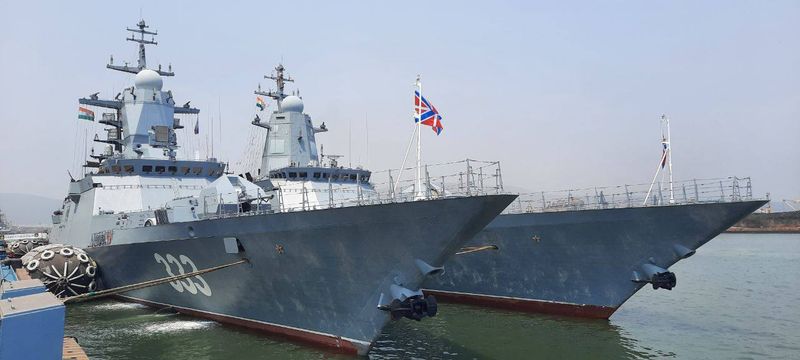

Despite global tensions across multiple flashpoints, India continues to balance its military ties with diverse partners. It is currently engaging simultaneously with the militaries of the US and Russia at Guam and Visakhapatnam, respectively.Two warships — Sovershenny and Rezky — from the Vladivostok-based Russian Pacific Fleet arrived at the eastern port of Visakhapatnam on March 14. The ships’ crews will participate in cultural and sports events with Indian naval personnel, while also restocking supplies. The vessels, which departed Vladivostok on February 12, are on a long-distance Asia-Pacific deployment.Meanwhile, at Guam — a US base in the western Pacific Ocean — the Indian Navy has joined an anti-submarine warfare exercise hosted by the US, along with fellow Quad partners Japan and Australia. New Zealand is also participating in the multinational exercise, ‘Sea Dragon 2026’, at Andersen Air Force Base in Guam. The drills began on March 9 and will continue for nearly three weeks.These engagements come against the backdrop of tensions in West Asia. While the US and Israel are aligned against Iran, India has, for the past two weeks, hosted the Iranian warship IRIS Lavan at Kochi; the vessel and some of its crew remain in India. Meanwhile, the US and its NATO allies remain at odds with Russia over the ongoing war in Ukraine.At Guam, all five participating navies are deploying long-range maritime reconnaissance aircraft such as the Boeing P-8 and its variants, which are capable of tracking submarines. These aircraft can generate a shared operational picture of the maritime domain and enable seamless communication between forces.According to a US Navy statement, Sea Dragon 2026 is aimed at enhancing aircrew proficiency in anti-submarine warfare (ASW), progressing from simulated targets to detecting and tracking a live submarine.India has been steadily refining its military ties with both the US and Russia. In November last year, India and the US discussed ways to enhance bilateral and multilateral exercises, including adding complexity such as simulated submarine hunts and tracking “enemy vessels”, to strengthen maritime cooperation and advance shared strategic interests in the Indo-Pacific. India and the US are also part of multilateral frameworks such as the Combined Maritime Forces (CMF), which operates in the Red Sea and the Persian Gulf.Meanwhile, a joint statement issued after Prime Minister Narendra Modi’s meeting with Russian President Vladimir Putin in New Delhi in December said the six-decade-old India-Russia defence partnership would be “re-oriented” towards co-development and co-production of advanced technologies, setting a new benchmark in support of the ‘Make in India’ initiative.