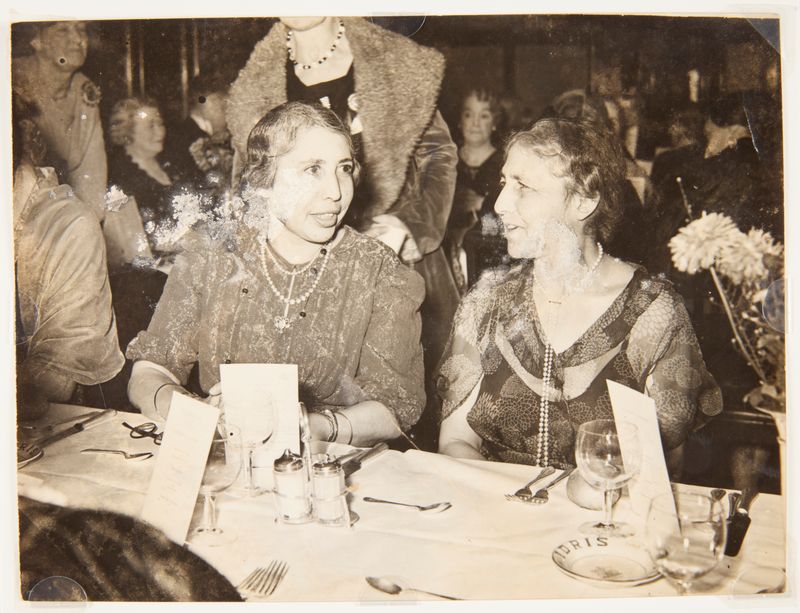

Punjabi Princess Sophia Duleep Singh, who challenged the privileges of empire, is the focus of a London exhibition opening this week at Kensington Palace. Seen by The Tribune in a preview ahead of its opening, the exhibition brings together objects that illuminate a life lived in quiet but determined resistance from within the very heart of British power.Among them is a banner bearing the words “No Vote, No Tax”, a simple piece of cloth that carries a deeper irony. It features the figure of Britannia herself — the emblem of the British state — repurposed in the cause of protest. Dating from 1908 and associated with the Women’s Tax Resistance League, it reflects Sophia’s refusal to pay taxes to a government that denied her the vote.Sophia was no outsider agitator. She was the daughter of Maharaja Duleep Singh, the last ruler of the Sikh empire, and a goddaughter of Queen Victoria. She moved within the highest circles of British society, yet chose to align herself with a movement that challenged its authority. Her protest was not simply political; it was personal — a rejection of the terms on which her family had been absorbed into imperial Britain.That story begins far from London. In 1849, following the annexation of Punjab, the young Duleep Singh was separated from his mother, Maharani Jind Kaur, and taken to Britain under the supervision of the East India Company. There, he was converted to Christianity and raised as a ward of the Crown, his identity reshaped in ways that were at once political and deeply personal.The removal of the Koh-i-Noor from the Sikh treasury — perhaps the most potent and enduring symbol of that transfer of power, and one that remains in royal possession — became a visible reminder that conquest was not only territorial, but deeply personal.Yet the relationship between the deposed Maharaja and the British royal family was not defined by distance alone. It was marked by a carefully cultivated intimacy. A tunic worn by Prince Leopold, Queen Victoria’s youngest son, points to these connections. Victoria noted in her diary how fond Leopold was of Duleep Singh, and how kindly he treated him during a visit to Osborne in 1854. Such gestures, expressed in the language of affection, formed part of a wider process through which conquest was softened — even recast — as care.Duleep Singh’s children inherited this complex legacy. They grew up at Elveden Hall in Suffolk, raised within the structures of British aristocratic life yet shaped by a history that remained just out of reach. A small rocking horse, once belonging to the children, evokes that world — a childhood carefully constructed in the English countryside. It suggests comfort and continuity, yet also something more unsettling: the heirs to a lost Punjabi kingdom raised far from their inheritance, their lives reshaped into something recognisably British, yet fundamentally displaced.The exhibition, ‘Princesses of the Punjab’, highlights the sisters’ lives, identity, and activism, and runs until November.(Clockwise, from top) Catherine, Sophia and Bamba Duleep Singh at the debutante ball at Buckingham Palace in May 1895. © Peter Bance CollectionAmong them, Sophia stands out for the clarity of her political choices, and the exhibition celebrates her 150th birthday. A bound volume of The Suffragette, with an image of her selling copies on the street, captures the moment with unusual force. This was no distant patron of the movement, but an active participant — a princess standing in public, lending her presence to a campaign that challenged the authority of the state that had absorbed her family. Another photograph, taken at a suffrage dinner in 1930 marking the arrest of Christabel Pankhurst and Annie Kenney, shows Sophia alongside her sister Catherine within the inner circles of the movement. Their engagement was not incidental, but sustained and recognised within the broader struggle for women’s rights in Britain.If Sophia’s rebellion was public, her sister Catherine’s was more private, but no less striking. A photograph postcard sent from Germany in 1930 shows her with her governess and companion, Lina Schafer, the image signed in Schafer’s own hand. It is an intimate object, far removed from the formalities of royal portraiture, and it gestures towards a life lived beyond convention — shaped not only by exile, but by personal choices that resisted the expectations placed upon her.Other objects in the exhibition speak more quietly, but no less tellingly, of lives shaped by adaptation. A skirt resembling a traditional Indian lehenga, worn by Princess Bamba and later passed down to her goddaughter, bears the marks of alteration and reuse. Like much else in the family’s history, it has been adjusted over time — its original form modified, its meaning carried forward in changed circumstances. Nearby, a pair of off-white leather gloves worn by Sophia at her debutante presentation in 1895 suggests an earlier moment of careful assimilation — her formal entry into British society, governed by its codes of dress and behaviour. Seen alongside the suffragette banner she would later embrace, the contrast is striking: from conformity to quiet rebellion.A rocking horse from Elveden, which belonged to the children of Maharaja Duleep Singh. © Peter Bance CollectionTaken together, these objects — seen in advance at Kensington Palace — do more than illustrate a family history. They reveal the layered nature of identity in the aftermath of empire. The Duleep Singh sisters were at once insiders and outsiders — embraced by British high society, yet marked by a history of conquest and displacement. Their responses to this condition were varied. For Sophia, it meant political activism and public defiance. For Catherine, it meant a more private assertion of autonomy. For all of them, it involved negotiating a legacy that could neither be fully reclaimed nor entirely set aside.For Indian readers, the story carries a particular resonance. The annexation of Punjab was not merely a historical episode, but a rupture that reshaped the region’s political and cultural life. The fate of Duleep Singh and his daughters reflects the broader dynamics of colonial rule: the dismantling of indigenous authority, the reconfiguration of identity, and the subtle ways in which power was exercised and maintained.That his daughters would later engage, in different ways, with questions of rights, representation and freedom gives the story an added continuity — linking the experience of empire in Britain with the longer arc of resistance in India. Seen in this light, the exhibition at Kensington Palace is less about the afterlife of Indian royalty than about the unexpected paths that follow loss. The objects on display — a banner, a newspaper, a child’s toy, a photograph, a garment — become markers of lives lived between worlds.In the end, it is perhaps the image of Sophia, standing outside Hampton Court with copies of The Suffragette, that lingers most strongly. There is nothing dramatic about the scene. Yet in that moment, the daughter of a conquered Punjabi kingdom asserts a different kind of sovereignty — not over land, but over her own voice. It is a quiet act, but one that continues to resonate.A bound copy of The Suffragette newspaper with an image of Sophia selling copies outside Hampton Court Palace. © Peter Bance CollectionSisters and BrothersMaharaja Duleep Singh had several children from his marriage to Bamba Muller. Among his daughters, the eldest was Princess Bamba Sutherland, followed by Catherine Hilda Duleep Singh and Sophia Duleep Singh. Another daughter, Pauline Alexandra Duleep Singh, died in infancy.He also had three sons — Prince Victor Duleep Singh, Frederick Duleep Singh and Albert Edward Alexander Duleep Singh.After Bamba’s death in 1887, he formed a relationship with Ada Douglas Wetherill, with whom he had two daughters: Pauline Duleep Singh and Ada Irene Duleep Singh.A banner incorporating the figure of Britannia reading “No Vote No Tax” (Women’s Tax Resistance League) dating to 1908.Courtesy: The Women’s Library at LSE— The writer is the London correspondent of The Tribune