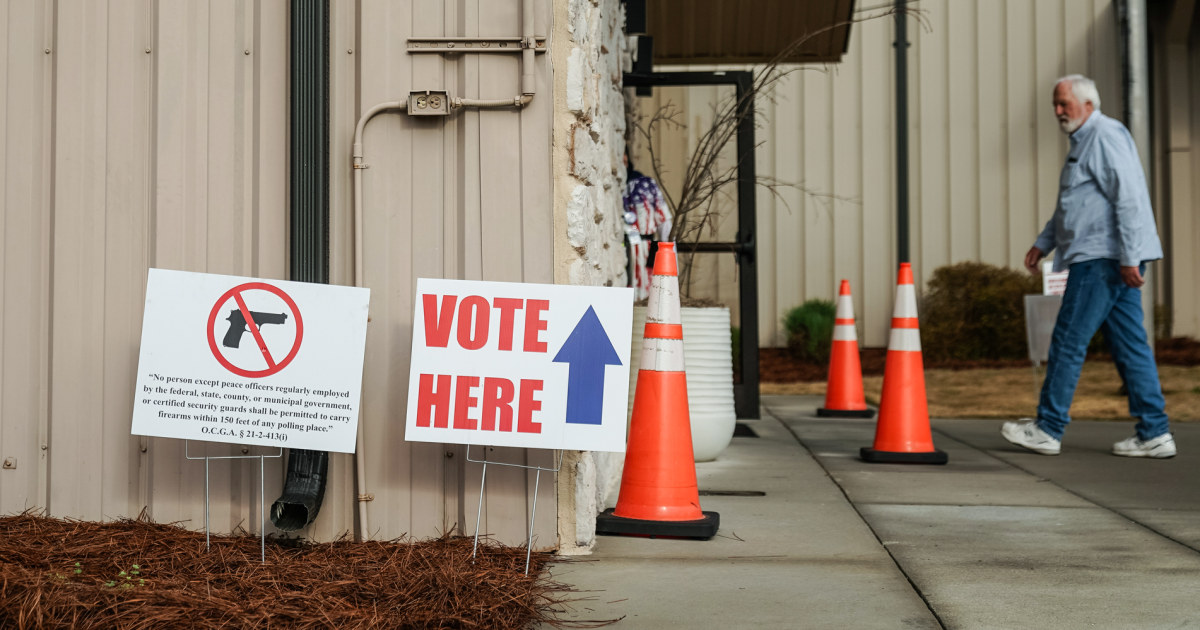

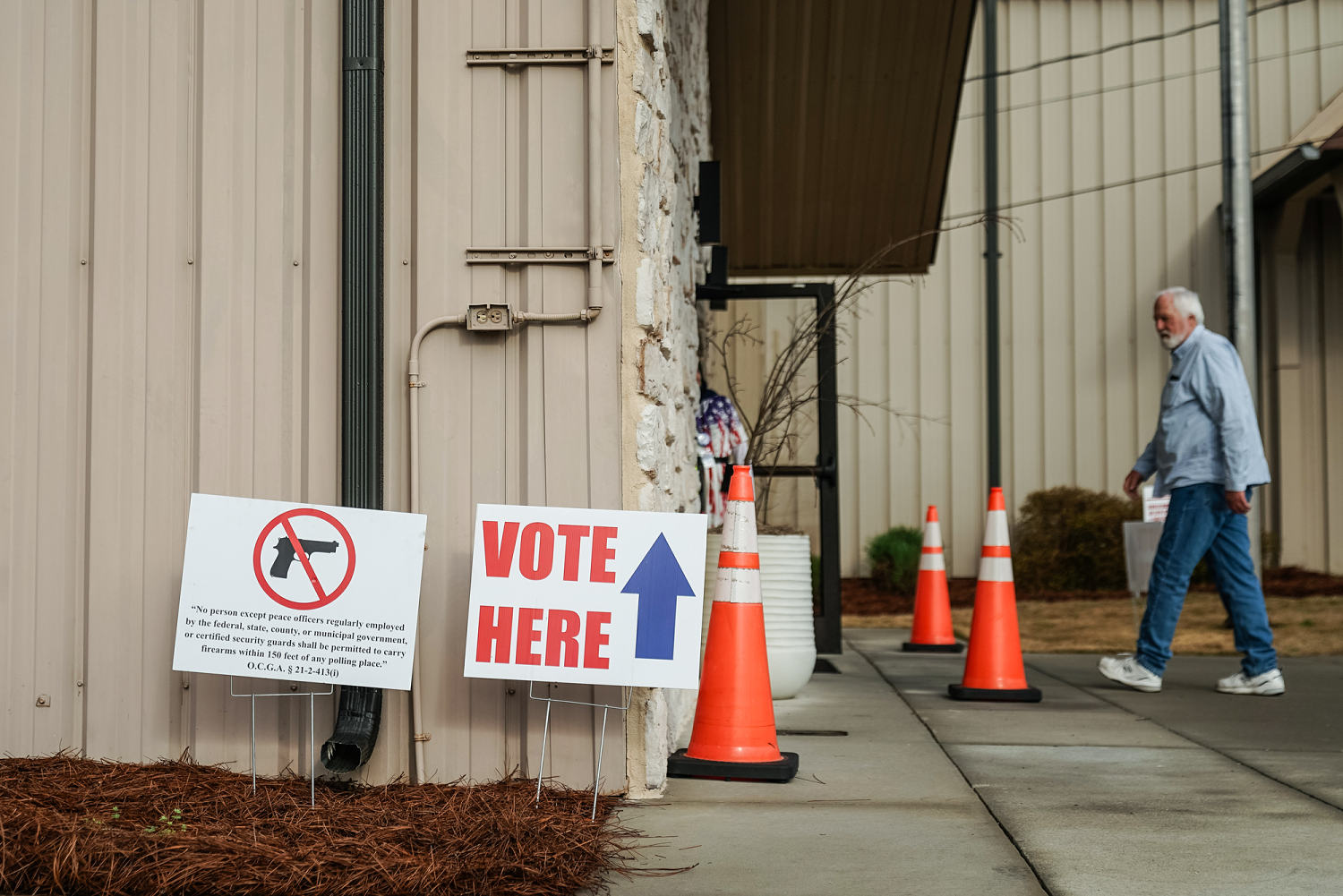
Welcome to From the Politics Desk, a daily newsletter that brings you the Jattvibe News Politics team’s latest reporting and analysis from the White House, Capitol Hill and the campaign trail.In today’s edition, Steve Kornacki looks ahead to the major elections taking place around the country in April. Plus, we dive into the latest on the talks to end the DHS shutdown.Sign up to receive this newsletter in your inbox every weekday here.— Adam WollnerThe key elections to watch next monthAnalysis by Steve KornackiThe parade of midterm primaries has hit a lull, but the next month will nonetheless bring four notable elections around the country. Each will be worth watching for a different reason.April 7 Special runoff election in Georgia’s 14th District: Democrat Shawn Harris finished with the most votes in the preliminary March 10 election, but it would be an astonishing upset if he prevails in the runoff over Republican Clay Fuller. Georgia’s 14 District, which stretches from the far Atlanta suburbs of Cobb County to the northwest corner of the state, voted for Donald Trump by 37 points in 2024. No Democrat currently in the House was elected in a district that sided with Trump by more than 10 points. The initial election was essentially a jungle primary, with candidates from all parties on the same ballot and the top two finishers advancing to the runoff after no one cleared 50%. The Republican vote was divided among numerous candidates, but it won’t be on April 7. The suspense will be about the margin. In every House special election of Trump’s second term, Democrats have improved by at least 13 net points on their 2024 presidential election performance. If they can hold Fuller’s margin to the mid-teens, Democrats will try to claim a moral victory here.Wisconsin Supreme Court: Don’t let the officially nonpartisan nature of this election fool you. In Wisconsin, judicial races have become deeply partisan exercises. And lately, it’s Democrats who have enjoyed the clear advantage in them thanks to their disproportionately energized voting base. This was the story a year ago, when the ideological balance of the state Supreme Court was on the line and both parties poured record-shattering sums into the race. It ended up a landslide for the Democratic-backed candidate, with the party’s higher-income, college-educated voters flooding the polls. The stakes aren’t as stark this time around and the race is attracting far less national interest, which points to potentially low turnout — the exact kind of atmosphere where the Democrats have been excelling. Here, it may be Republicans trying to claim a moral victory if the margin is close. April 16Special election in New Jersey’s 11th District: In a different political atmosphere, Republicans would probably be a lot more excited about the race to replace now-Gov. Mikie Sherrill. This is a suburban district that was once a Republican bastion but has trended toward Democrats due to demographic changes and backlash to Trump. After a contentious primary, Democrats nominated Analilia Mejia, whose progressive politics and backing from Sen. Bernie Sanders and Rep. Alexandria Ocasio-Cortez could (in theory) unnerve voters in a district like this. And in Joe Hathaway, a local mayor who has been critical of Trump, Republicans are fielding a candidate who could appeal to those same voters. Still, this is a district that sided with Kamala Harris by nine points in 2024. And the pattern of Democratic overperformance in House special elections is so well-established that it’s hard to see Hathaway getting all that close. But Mejia’s victory in the Democratic primary — with not quite 30% of the vote — has added intrigue to a race that otherwise would have had little.April 21Virginia redistricting referendum: This should be the most interesting election of April. Democrats are attempting to gerrymander their way to a 10-1 advantage in the state’s House delegation, up from their current 6-5 edge. The aggressive move is inspired by the success of Democrats in California, after voters approved a redrawn congressional map last November by a 29-point margin. The results of that referendum largely adhered to the state’s red/blue divide; in other words, Democratic-leaning voters didn’t break rank. While Virginia isn’t nearly as Democratic as California, it is still a blue state, one that just elected Democrat Abigail Spanberger as governor by 15 points last fall. If Virginia’s Democrats and Democratic-leaning independents stay united as they did in California, the new map should pass with relative ease. That said, a poll last month did show the measure failing by a 52%-44% margin and the initial early voting numbers have caused some concern among Democrats. Certainly, the political culture of Virginia is different from California and it’s possible that a partisan gerrymander this brazen could provoke a different response from the public.🗳️ As for tonight: Before jumping ahead to April, Florida is holding a slate of state legislative elections today to fill vacant seats, including in the state House district that includes Mar-a-Lago. Trump carried the district by about 11 percentage points in the 2024 presidential race, according to The Downballot, a left-leaning political site that tracks partisan change in state special elections.Trump endorsed Republican Jon Maples in the race and encouraged people to “get out and vote” on Truth Social this month. Maples faces Democrat Emily Gregory.Palm Beach County records show Trump cast his ballot by mail in the election — a practice he called “mail-in cheating” yesterday, Jane C. Timm reports. Senate Republicans believe they have a solution to reopen DHSBy Sahil Kapur, Julie Tsirkin, Garrett Haake, Ryan Nobles and Brennan LeachSenate Republicans think they’ve found a viable path to reopen the Department of Homeland Security and bring an end to long lines at airports. The framework involves funding all of DHS with the exception of immigration enforcement and deportation operations under ICE.“The Democrats have in front of them a proposal with legislative text that would allow us to get DHS back and opened up again, and it is essentially what the Democrats have been asking for. And so we’re going to have an opportunity to vote on that, and I hope they will put their money where their mouth is,” said Senate Majority Leader John Thune, R-S.D. Senate Minority Leader Chuck Schumer, D-N.Y., said Democrats would counter with an offer that contains reforms to ICE.“We need to rein in the violence. We have never changed our position. This does not have any reforms in ICE,” Schumer said.Once DHS is largely functioning again, Republicans would attempt to use the filibuster-proof “reconciliation” process to fund the rest of ICE and pass limited portions of the SAVE America Act, an election bill that is Trump’s top priority. Speaking to reporters this afternoon, President Donald Trump said he was “going to take a good hard look” at the proposal. “I want to support Republicans,” he added. But Trump also said: “I think any deal they make, I’m pretty much not happy with it.” One source with knowledge of the discussions warned that budgetary constraints would severely limit what provisions of the SAVE America Act the Senate can pass through reconciliation, with only Republican votes. That process is seen as the only viable path to pass any provisions in the SAVE America Act since all Democrats oppose the legislation.One idea is to provide financial incentives to states to implement voter ID laws; another idea is to send money to DHS to “monitor elections” and conduct election security, the source said. Read more →🗞️ Today’s other top stories💲Unaffordable America: The divide between rich and poor in the U.S. is the widest it’s been in at least a generation — and growing. The amount of wealth held by the top 1% increased at more than double the rate of the bottom 90% in the first nine months of last year, according to Federal Reserve figures. Read more from Shannon Pettypiece →➡️ Iran war: Pakistan is joining a growing list of countries acting as go-betweens for the U.S. and Iran, four sources told Jattvibe News, with two of those sources saying an in-person meeting could be held in the coming days in Islamabad. Read more →☑️ Moving on up: The Senate voted 54-45 last night to confirm Markwayne Mullin to lead the Department of Homeland Security. Sens. John Fetterman, D-Pa., and Martin Heinrich, D-N.M., joined Republicans to support him. Oklahoma Gov. Kevin Stitt appointed energy executive Alan Armstrong to serve the remainder of Mullon’s term. ⚖️ In the courts: Secretary of State Marco Rubio testified in the trial of former Miami congressman David Rivera, who is accused of secretly lobbying for Venezuela’s government. Read more →🚫 Called off: A California gubernatorial debate was canceled after mounting criticism that only white candidates in the crowded field had qualified for the event. Read more →🗺️ Redistricting roundup: The Missouri Supreme Court upheld a new congressional map designed to allow Republicans to pick up a House seat in the midterm elections. Read more →🗳️ End of an era: Longtime North Carolina Senate leader Phil Berger conceded his GOP primary race after a partial hand recount confirmed his 23-vote loss, the Raleigh News & Observer reports. Read more →That’s all From the Politics Desk for now. Today’s newsletter was compiled by Adam Wollner.If you have feedback — likes or dislikes — email us at politicsnewsletter@Jattvibeuni.comAnd if you’re a fan, please share with everyone and anyone. They can sign up here.