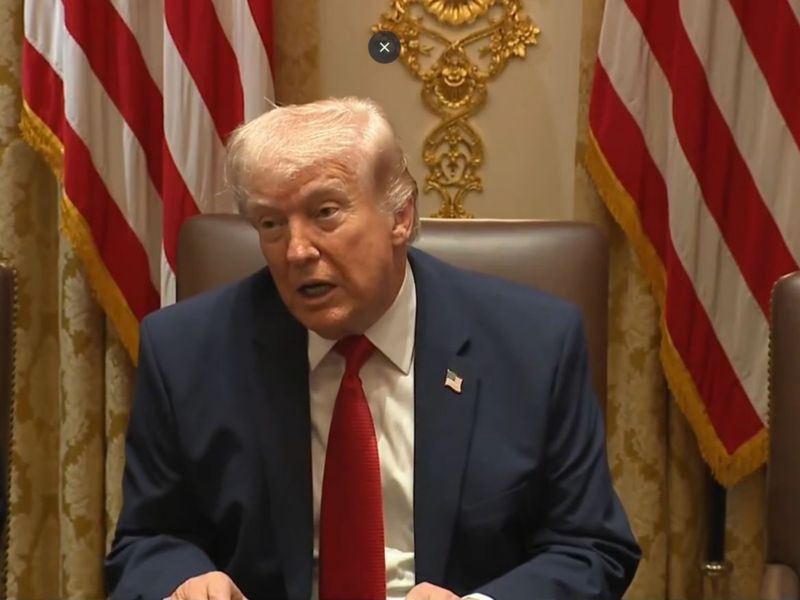

US President Donald Trump on Thursday issued a stark warning to Tehran, saying Iranian negotiators must “get serious soon before it is too late”, even as he lashed out at NATO allies for what he termed complete inaction in the ongoing conflict — a day marked by a major escalation with the reported killing of a top Iranian naval commander.In sharp remarks on his Truth Social platform, Trump described the Iranian negotiators as “strange” and accused them of privately seeking a deal while publicly downplaying engagement with Washington. “They are begging us to make a deal… which they should be doing since they have been militarily obliterated,” he said.“They better get serious soon, before it is too late… there is no turning back, and it won’t be pretty,” he added, signalling a hardening US posture as hostilities approach the one-month mark.Trump later told reporters that taking control of Iran’s oil was an option, but said he would not talk about it.He said Iran was allowing some oil tankers through the Strait of Hormuz as a sign of good faith for talks.He said Iran allowed 10 oil tankers to pass through the strategic strait as a “present” to show it was serious about negotiations to end the war.The escalation in hostilities comes alongside reports that Alireza Tangsiri, chief of Iran’s Islamic Revolutionary Guard Corps (IRGC) Navy, was killed in an Israeli strike in Bandar Abbas — a move that could significantly alter the maritime dimension of the conflict centred around the Strait of Hormuz.Israeli Defence Minister Israel Katz said Tangsiri was among senior naval officials targeted, describing the operation as a direct blow to Iran’s ability to control and potentially disrupt the critical energy corridor. Tangsiri, who had led the IRGC Navy since 2018, was widely seen as the architect of Iran’s asymmetric maritime strategy in the Persian Gulf.While there has been no immediate confirmation from Tehran, the reported strike marks one of the most significant hits on Iran’s military leadership since the conflict began and is expected to heighten risks of retaliation, particularly in the maritime domain.Trump also turned his ire on NATO, accusing member nations of failing to support Washington during the crisis. “NATO nations have done absolutely nothing to help with the lunatic nation… of Iran,” he said, adding that the US “needs nothing” from the alliance.At a Cabinet meeting later in the day, Trump cast doubt on the prospects of a peace deal, even as he maintained that Iran was keen to negotiate. “They are begging to work out a deal… I don’t know if we’re willing to do that,” he said.He insisted the onus was on Tehran to step back and permanently abandon its nuclear ambitions. “They now have a chance… to chart a new path forward. If they don’t, we’re their worst nightmare,” he said, warning that US military operations would continue unabated.Special envoy Steve Witkoff said earlier negotiations had faltered over Iran’s insistence on its right to enrich uranium, citing concerns that Tehran retained sufficient enriched material to develop multiple nuclear weapons.The convergence of sharpened rhetoric, uncertain diplomacy and targeted strikes on key military figures underscores the increasingly volatile trajectory of the conflict, with the Strait of Hormuz and broader regional stability hanging in the balance.Meanwhile, Iran has conveyed its formal response to a 15-point US proposal through intermediary channels and is now awaiting Washington’s reaction, the IRGC-linked Tasnim News Agency reported on Thursday, citing an informed source.According to the report, Tehran has stood firm on a set of core conditions, including an immediate cessation of attacks, binding guarantees against any future military escalation, compensation for war-related damages and a comprehensive halt to hostilities across all theatres involving its allied groups.The response is also understood to underline Iran’s insistence on recognition of its authority over the Strait of Hormuz, along with credible assurances that any agreement reached would be fully implemented and not subject to reversal.Significantly, the source dismissed Washington’s push for negotiations as a “deception”, alleging that the US was using the diplomatic track to buy time while attempting to manage international opinion in its favour.