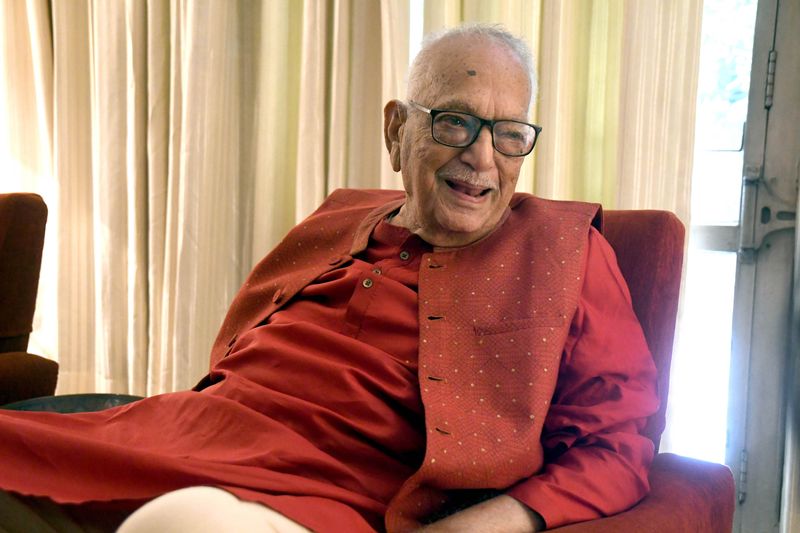

A first-time visitor to veteran architect Jeet Lal Malhotra’s Delhi home is bound to mistake it for a Corbusian cottage perched in the heart of Chandigarh.And it’s not just the facade that gives away the story of Malhotra’s abiding ties with Chandigarh’s French-Swiss architect Le Corbusier. It’s equally the no-glass, no-steel, no-marble and mosaic floor interiors.“My father continues to live the Le Corbusier legacy well beyond Chandigarh, the city he helped build as part of the team that shaped and executed the capital project,” says Meet Malhotra, seated beside the famous architect, now 97.Jeet Malhotra, who was recently honoured by the Chandigarh Administration for his contribution to the City Beautiful, talks sparingly but his frail eyes light up at the very mention of Chandigarh, a city where he created landmark structures such as the cricket stadium, Chandigarh Club, Chandigarh bus stand, PGI Research Block and many government schools.Malhotra shares a warm memory of former English cricket team captain David Gower praising the play of light at the Sector 16 cricket stadium.Of this structure, Gower had said, “It seems more like a sculpture than a building.”As the youngest among architects hired to assist Corbusier, Malhotra became the Chief Architect of Punjab last among peers associated with the capital project.From Chandigarh, he relocated to New Delhi, where he served as the Chief Architect of the New Delhi Municipal Corporation from 1985 to 1987. This stint was his last and he retired and settled in Delhi’s Vasant Vihar.Interestingly, the man who helped design Chandigarh never owned a house there though he designed some landmark private houses for the city’s influencers.Inside his very Corbusian home in Delhi, one can find remnants of the good old Chandigarh capital project days. Malhotra’s wife Indra fondly points to a corner table Corbusier personally designed as a wedding gift for the couple. The inscription on its wooden top says in Hindi — “Jeet aur Indra, 1961”.Inside the no-beam, no-pillar home, Malhotra’s studio also bears testimony to the days gone by. The architect’s studio is dotted with frames of mentor Corbusier.In one corner of the well-lit room stands a citation that says it all about the man himself. It reads, “JL Malhotra is remembered for a dual practice that made Chandigarh visible: he helped build it and he photographed it from within.”Trained at Delhi Polytechnic, Malhotra joined the capital project as a junior architect and worked closely with Jeanneret while designing key civic facilities, particularly sports and club structures and schools in Chandigarh.Ask Malhotra and his family what they remember of Corbusier and Jeanneret, and they all state in agreement, “Corbusier was a focused leader who immersed himself in the capital project. He did not have children and only had a pet dog. Jeanneret was very gentle and caring.”Malhotra was very close to Jeanneret. He nursed ties with Jeanneret’s niece until lately when she passed.