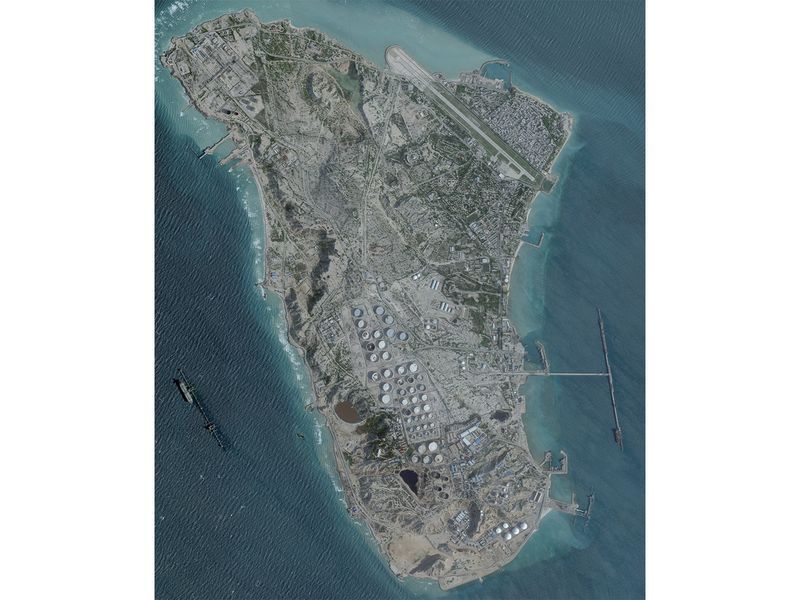

In geopolitics, size is often a distraction. The places that matter the most are rarely the biggest — they are the ones that sit astride the world’s critical arteries.Kharg Island, a small Iranian outcrop in the Persian Gulf, is one such place. Barely visible on most maps, it has nonetheless emerged as a focal point in the rapidly escalating west Asia conflict.Iran’s economic jugularKharg Island is not important because of what it is, but because of what it does. It functions as Iran’s principal oil export terminal, the point through which the overwhelming majority of the country’s crude reaches international markets.Tankers queue at its deep-water facilities, pipelines converge beneath it and millions of barrels pass through it daily. In the crux, Kharg is Iran’s economic lifeline which is difficult to replace.This reality gives the island an outsized strategic weight. Disrupt its operations, and Iran’s ability to generate revenue is severely constrained.In a sanctions-heavy environment, where oil exports already operate under pressure, Kharg becomes not just infrastructure but leverage — economic, political and military.A global pressure pointThe implications extend far beyond Iran. Kharg sits near the Strait of Hormuz, through which a significant share of the world’s oil supply transits.Any threat to the island, whether through attack, blockade or seizure, may reverberate immediately across global markets.Prices may spike, shipping risks would drastically rise, and energy-importing economies will feel the tremors. What happens on this small island may not stay there.The Trump Doctrine: Control the lifelineIt is in this context that recent statements by Donald Trump must be understood.His suggestion that the United States could seize Kharg Island — framed in blunt terms as “taking the oil” — is not merely rhetorical excess. It reflects a long-standing strategic instinct: if you can control your adversary’s economic lifeline, you can force concessions without prolonged conflict.The logic is straightforward. Control Kharg, and you effectively control Iran’s oil exports. Control those exports, and you gain leverage in any negotiation, whether over nuclear policy, regional influence or maritime access. In theory, it is a shortcut to pressure — a way to alter the balance without a full-scale war.Risks of escalationKharg Island is heavily defended and sits well within Iran’s military reach.Any attempt to seize or hold it would expose forces to sustained missile and drone attacks. More importantly, it would almost certainly trigger a broader regional escalation.Iran’s response would not be confined to the island; it could extend to shipping lanes, allied assets, and proxy theatres across the Middle East.There is also the question of outcomes. Even if Kharg was successfully captured, Iran would continue to retain the capacity to disrupt the Strait of Hormuz, ensuring that global energy markets remain volatile.More than a targetThis is why some analysts argue that less direct measures, such as naval pressure or targeted economic restrictions, may offer similar leverage with lower risk. Seizing territory, particularly one so symbolically and economically vital, carries consequences that are difficult to contain.In an era where supply chains and energy routes define global stability, control over a single node can carry disproportionate influence. But that same concentration of importance also makes such nodes dangerously sensitive to miscalculation.Today’s conflicts are not fought only over land, but over systems — flows of oil, trade and finance that bind the world together. Interrupt those flows, and the effects cascade far beyond the immediate battlefield.Kharg may be small, but it sits at the intersection of economics, strategy and risk. That is what makes it valuable. It is also what makes it dangerous.