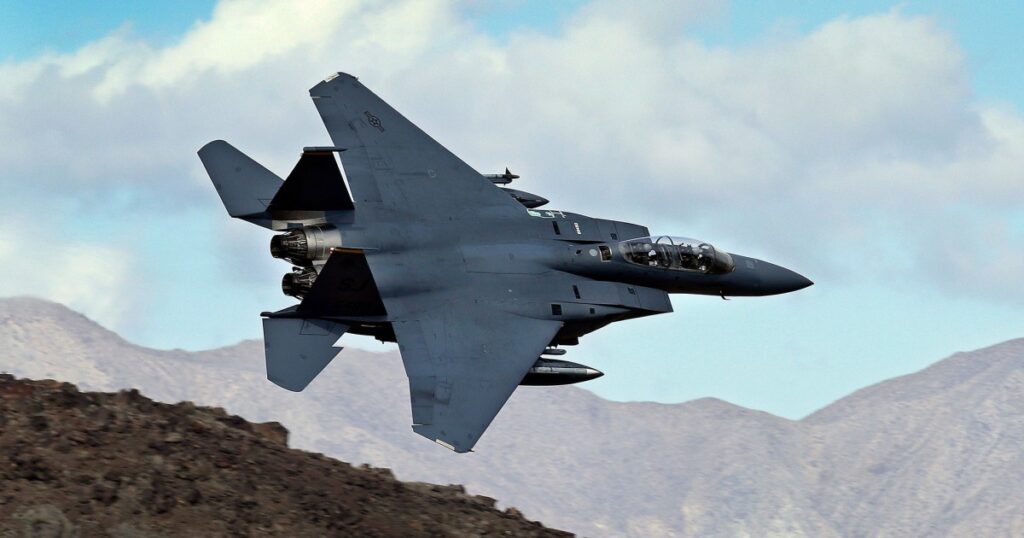

Boise (Idaho) [US], April 4 (ANI): Former US F-15E combat pilot Ryan Bodenheimer highlighted the evolving tactical challenges faced by advanced US fighter aircraft against its operations in Iran, stating that “even the best fighter pilots might not have any options” in certain high-risk scenarios, particularly in the context of Iran’s air defence strategies following the downing of a US F-15E by the Islamic Republic.Speaking in an interview with ANI, Bodenheimer underscored that while the United States has established “very resolute” air superiority over Iranian airspace amid the conflict, which is currently in its second month, this does not eliminate threats from concealed and mobile defence systems.He noted that Iran continues to deploy surface-to-air missiles, drones, and ballistic systems from strategically hidden locations, making them difficult to detect and counter.Explaining the aircraft involved, Bodenheimer said the F-15E is a modified version of the original F-15 platform. While the F-15C was designed primarily for air superiority missions, the F-15E Strike Eagle was adapted for air-to-ground operations and includes a two-member crew — a pilot and a weapons systems operator, the former US combat pilot stated.”Air superiority has been established over top of Iran, like very resolutely. But that doesn’t mean that they don’t have the ability to wheel out a ballistic missile, a drone or a surface-to-air missile from some of these very smartly hidden locations. And it’s very strategic,” he stated.He pointed out that despite advanced capabilities, including electronic countermeasures (ECM), modern fighter jets remain vulnerable under certain conditions. These countermeasures are designed to detect and respond to missile threats, using chaff to deflect radar-guided missiles and flares to counter heat-seeking ones.However, Bodenheimer emphasised that Iranian forces may be employing tactics that limit the effectiveness of such systems.He further explained that the use of flares at night can expose an aircraft’s position, potentially deterring pilots from deploying them in certain situations. In such cases, pilots may rely on evasive manoeuvres, though these too depend on reaction time and situational awareness.Describing the operational risks, Bodenheimer noted that US aircraft have conducted thousands of sorties over Iran without incident, but repeated exposure to hostile environments increases the likelihood of eventual losses.”If they’re flying right over something and the radar is off, and then it just turns on, a lot of these radar operators and missile operators in Iran right now, that’s the tactic they’re going to use. And they’re going to shoot at basically anything on their scope. They see even the faintest little blip, they’re going to try to get a missile off,” the former US combat pilot and host of the Max Afterburner YouTube channel stated.”The electronic countermeasures might not have had time to work or be deployed, and those are chaff and flare. Chaff is typically what’s going to distract a radar-guided missile. Then flares are what’s going to distract a heat-seeking missile, but the downside of it is nighttime; the downside of using flares is that now everybody knows where you’re at because you just made a big flash in the sky. They didn’t want to highlight themselves. So they tried different manoeuvres,” he added.Earlier, CNN, citing sources, confirmed the downing of an “F-15E Strike Eagle fighter jet.”This incident marks the first time a US aircraft has been downed over Iran during the current conflict.Meanwhile, American forces have successfully retrieved a crew member from the US fighter jet that was brought down over Iran, according to a report by CNN citing three sources familiar with the situation.The rescued individual is reportedly alive and has been placed “in US custody and receiving medical treatment,” as confirmed by two of the sources.While one person recovered, the fate of the second crew member remains uncertain. CNN reported that “search and rescue operations were ongoing” following the loss of the aircraft over Iranian territory. (ANI)(This content is sourced from a syndicated feed and is published as received. The Tribune assumes no responsibility or liability for its accuracy, completeness, or content.)