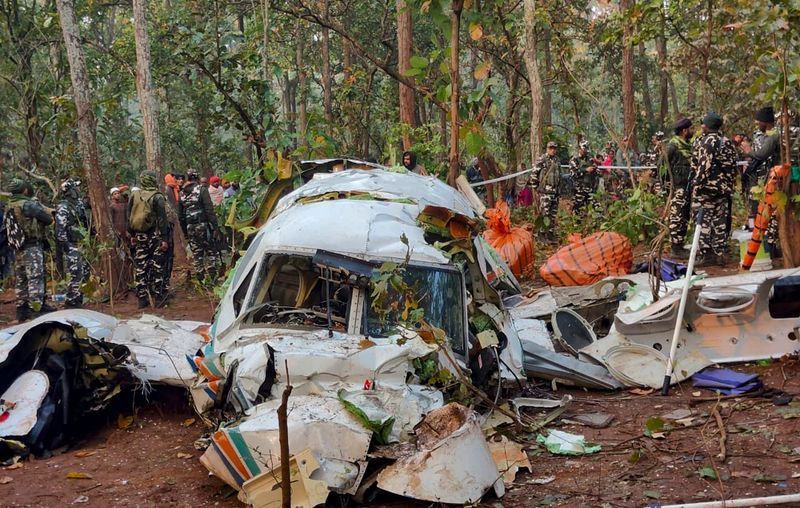

The air ambulance crash in Jharkhand that killed seven people may have involved a mid-air structural breakup during cruise, experts indicated after the preliminary report by the Aircraft Accident Investigation Bureau (AAIB) revealed a widely scattered debris field stretching nearly a kilometre.The accident, involving a Beechcraft King Air C90A operated by Redbird Airways Pvt Ltd, occurred on February 23 near Kasiyatu village in Chatra district. All seven on board two pilots, two medical personnel, a patient and two attendants were killed. The aircraft was completely destroyed.BREAK-UP BEFORE IMPACT? KEY FINDINGSAccording to the AAIB report released on Saturday, the aircraft was in the cruise phase when contact was lost. The last radio transmission was recorded at 1349 UTC, with the crash estimated around 1354 UTC, leaving a narrow five-minute window between routine communication and the accident.Related news: Authorities looking into factors that could have caused Jharkhand plane crashInvestigators flagged a widespread debris pattern suggesting the aircraft may have broken apart mid-air. Both engines were found detached from the wings and while the right engine was about 250 metres away, the left engine nearly 640 metres from the main wreckage.The tail section empennage was fragmented and scattered between 200 and 600 metres. Wing tips on both sides were broken and separated. The fuselage showed multiple fractures, while the cockpit and nose section were completely destroyed. The debris field extended close to one kilometre, indicating major structural disintegration before ground impact.AIRCRAFT, CREW HAD NO REPORTED ISSUESThe aircraft, manufactured in 1987, had valid airworthiness and review certificates, with its last inspection conducted on January 20, 2026. It had logged over 6,600 flight hours. Both pilots held valid Commercial Pilot Licences and had earlier flown the Delhi–Ranchi sector the same day without reporting any technical snags. On the return leg, the aircraft departed Ranchi at 1337 UTC for Delhi after being refuelled with 830 litres. The crew requested a route deviation due to weather, which was approved. Further heading changes and a request to level off at Flight Level 140 were also cleared.WEATHER UNDER LENS, BUT NO CONCLUSION YETWeather conditions in Ranchi around the time included haze, cumulonimbus cloud presence and developing thunderstorm activity along with changing wind patterns. However, the report does not attribute the crash to weather at this stage. No distress call, ELT failed to activate. After the last acknowledged communication with Kolkata ATC, the aircraft ceased all transmissions. The Emergency Locator Transmitter ELT did not activate after the crash.PROBE EXPANDS WITH GLOBAL COORDINATIONInvestigators have recovered critical aircraft and engine components and shifted them to a secure facility for detailed examination. Fuel samples have been sent for testing, while maintenance records, operational data and witness accounts are under scrutiny. Inputs have also been collected from air traffic controllers, meteorological personnel and ground handlers.The investigation has been expanded internationally, with notifications sent to the International Civil Aviation Organisation, the US National Transportation Safety Board and the Transportation Safety Board of Canada.