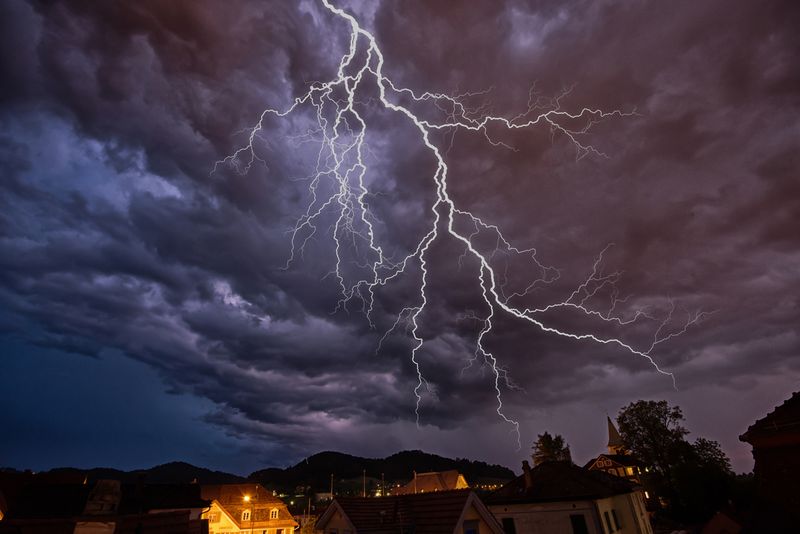

As an intermittent wet spell over parts of northwest India kept rising temperatures in check, it also resulted in a tragic incident in the hinterland of Punjab when a youth died and two others were injured after being struck by lightning.Reports said that a group of youngsters were playing cricket in an open ground in Rasoolpur village near Hoshiarpur, when the incident occurred in the morning of April 3. The India Meteorological Department (IMD) had issued an orange alert, cautioning about thunderstorms and lightning along with gusty winds in some parts of the state on this day.Thunderstorms, according to meteorologists, are a very common climatic feature over the Indian subcontinent and are generally accompanied by widespread lightning, strong winds and heavy rainfall which induce various socio-economic hazards. Lightning constitutes the major destructive component of thunderstorms.How lightning occursIMD has defined lightning as a rapid, natural electrical discharge caused by charge imbalances between storm clouds and the ground or within the clouds themselves. It is a high-voltage, high-heat flash of electricity that occurs during thunderstorms, often bringing significant risks of damage to life and property.Lightning is associated with every thunderstorm. Thunder is just the loud sound produced by the process of electric discharge. Thunder clouds contain ice particles and small hail particles. When they collide, charge transfer takes place between them and positive and negative charges get accumulated at different parts of the cloud. The earth’s surface also contains positive and negative charges. When these charges exceed a certain limit they break the insulating barrier of air and get neutralised through a discharging process which produces a sharp flash of light.Lightning is highly dangerous as it can have 100 million to 1 billion volts, and contains billions of watts of electricity and huge quantity of heat, more than 20,000 degrees Celsius, which can melt metal and turn sand into glass, according to IMD.Rising incidents of lightning“Globally, there has been a rise in lightning strikes and it has increased significantly. There has been a rise in intensity, frequency and dimensions of the flashes. Its adverse impact has been felt globally and more than 26,000 people succumb to lightning strikes annually,” a paper published by National Disaster Management Authority states.“Status of Climate for year 2022 and 2023 records the damages / mortality due to the thunderstorms and lightning at 48 per cent and 62 per cent respectively, a rise of 14 per cent within one year. Significantly Indian accounts for 7-8 per cent of the casualty,” the paper adds.In its Annual Lightning Report, Climate Resilient Observing Systems Promotion Council, an Indian a non-profit organisation has pointed that that while data from Indian Institute of Tropical Meteorology (IITM), Pune, showed a decrease of lightning incidents observed in central India and the southern peninsula during the months of peak season, there are states who have registered an increase like Gujarat, Rajasthan and Punjab, which is a new trend.The first ever study to use high resolution observations of lightning radiance and lightning frequency over the Indian region, undertaken by researchers at the Indian Institute of Science, Bengaluru and the National Atmospheric Research Laboratory, Tirupati, and published in Atmospheric Chemistry and Physics journal in 2021, states that the highest climatological average of lightning occurrences is observed along the Himalayan foothills, followed by the coasts and the Indo-Gangetic Plains.“Lightning frequency and intensity values across the Indian region are expected to increase by 10-25 per cent and 15-50 per cent, respectively, by the end of the century with the highest risk along the coasts. Hence, this requires immediate attention from policy makers,” the study says. It reveals a uniform increase in lightning occurrence and intensity and observes an accelerated growth in the projections after the year 2050.Importance of forecastAccording to available statistics 2,800-3,000 deaths occur in India every year due to lightning. Meteorologists at National Centre for Medium-Range Weather Forecasting, Noida have in a study published in the journal of Royal Meteorological Society in October 2025, pointed out that in 2022, 36 per cent of the deaths from natural disasters were attributed to lightning. “Accurate forecasting is critical for preparedness and mitigation, but complex convection processes often lead to spatial mismatches in forecasts,” the researchers observed.Yet this hazard, despite its frequent occurrence across the length and breadth of the country, it does not figure in the list of natural calamities that are eligible for assistance from central and state governments.Presently the notified list of disasters eligible for National Disaster Response Fund (NDRF) and State Disaster Response Fund (SDRF) assistance, includes 12 disasters namely cyclone, drought, earthquake, fire, flood, tsunami, hailstorm, landslide, avalanche, cloudburst, pest attack and frost and cold wave.“The issue of inclusion of more calamities in the existing notified list of calamities was considered by the 15th Finance Commission. The commission had observed that the list of notified disasters eligible for funding from SDRMF and NDRMF covers the needs of the states to a large extent and thus did not find much merit in the request to expand its scope,” the Ministry of Earth Sciences had told Parliament in 2023.IITM has established Indian Lightning Location Network (ILLN) that provides a comprehensive framework for investigating lightning phenomena, thunderstorm dynamics and associated forecasting models.“The network’s robust detection efficiency reinforces its utility for diverse applications, serving as a pivotal data source for organisations like IMD and national and state disaster management authorities. ILLN’s widespread implementation significantly contributes to mitigating the adverse impact of lightning-induced incidents,” a study published in Atmospheric Research in July 2025 observed.IMD is also integrating artificial intelligence and machine learning-based methods along with Doppler weather radars and high-resolution satellite-based monitoring to enhance model performance, post-process model outputs, pattern recognition, bias correction and probabilistic forecast interpretation for weather events, including thunderstorms and lightning.