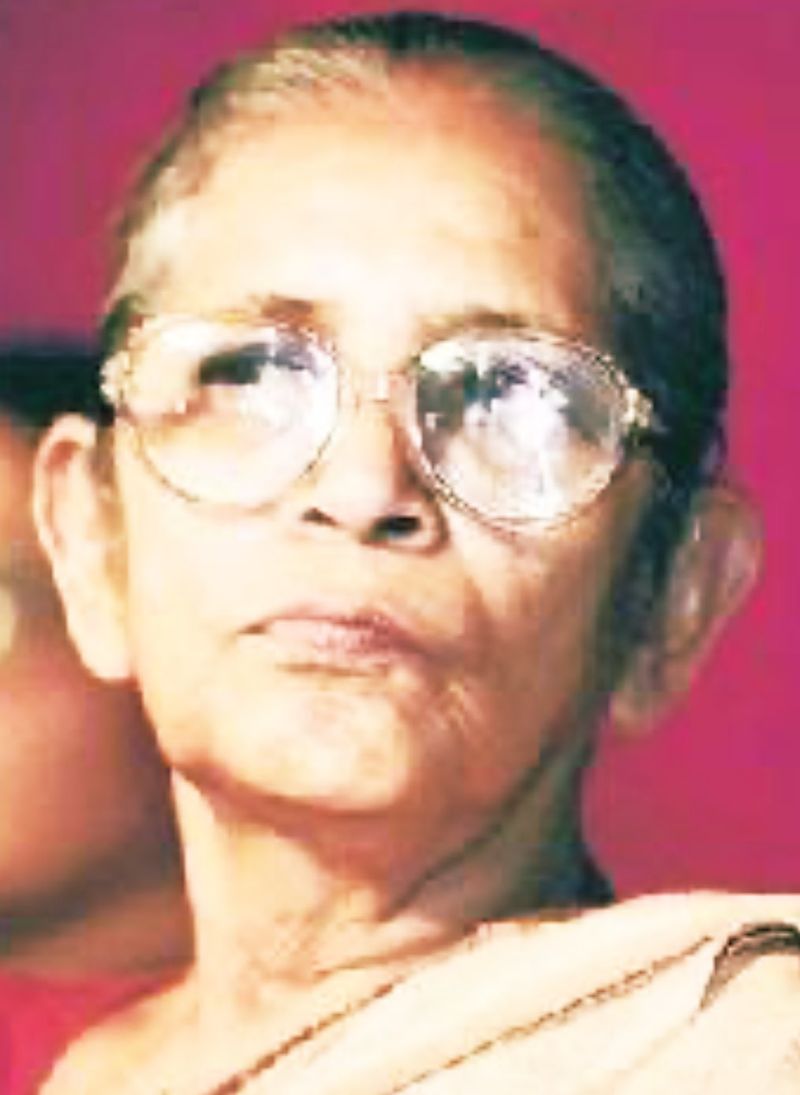

Today when women’s reservation in directly elected legislative bodies is set to become a reality, time is ripe to remember CPI leader and long-time MP Geeta Mukherjee who was the first architect of the related Bill when it came to a parliamentary committee of which she was appointed chairperson in 1996.Who was Geeta MukherjeeA four-time MLA, Mukherjee was elected to the Parliament a record seven times. She also remained the president of National Federation of Indian Women’s (NFIW) wing of Communist Party of India (CPI).She led the demand for the legislature of one-third reservation for women in parliamentary elections in India.With a career spanning five decades, Mukherjee was also a member of the National Commission on Rural Labour, National Commission on Women, National Children’s Board, Press Council and vice-president of the National Federation of Women, besides being a secretariat member of the Women’s International Democratic Federation, Berlin.What the panel said in 1996The parliamentary panel chaired by Geeta Mukherjee examined the 1996 Bill and made seven recommendations. Five of these were included in the 2008 version of the Bill which the Congress-led UPA piloted.Some of the recommendations included reservation for a period of 15 years, including sub-reservation for Anglo Indians; reservation in cases where the state has less than three seats in Lok Sabha (or less than three seats for SCs/STs); reservation for the Delhi Assembly; and changing “not less than one-third” to “as nearly as may be, one-third”.What was not considered?Two of the suggestions of the Mukherjee-led panel were not incorporated in the 2008 Bill. The first was for reserving seats in Rajya Sabha and Legislative Councils, and the second for sub-reservation for OBC women after the Constitution extends reservation to OBCs.A communist respected by allAs for Geeta Mukherjee, a modest, self-effacing personality with a steely resolve to fight for the rights of women and the toiling people of India, the CPI MP from Panskura in West Bengal remained active till the last day of her life. Though she was a staunch Communist, she was admired and revered by all, cutting across party lines.About women’s quota BillThe Women’s Reservation Bill was introduced for the first time on the September 4, 1996, by the United Front (Deve Gowda) Government. It was placed as the 81st Constitutional Amendment Bill. Then it was referred to a Joint Select Parliamentary Committee chaired by Mukherjee and with 31 members from both houses of Parliament. The Joint Select Committee received 102 memoranda from different organisations and Women’s groups and associations. It also heard many eminent social workers and representatives of women’s organisations, and presented its report to the Eleventh Lok Sabha on the December 9, 1996, in a record period of three months. Leaders of the NFIW recounted how many women had sent memoranda signed in blood. This had really moved the CPI leader.Mukherjee was determined but political consensus eluded herShe was dependent on the Left, Congress and BJP to build a majority, but was extremely disappointed to find them backtracking, using the lack of consensus as a pretext. Although she was equally committed to other issues, her main preoccupation had become ensuring the passage of the Women’s Reservation Bill. She had even turned down an offer for a ministerial berth in the IK Gujral government on the ground that she wanted to concentrate fully on the Bill.She had strived to carry everyone along with her, including those who wanted a separate quota for Other Backward Classes (OBCs).A laborious campaignMukherjee campaigned in all states of the country for the Women’s Bill. Speaking to journalists after facing defeat in the Parliament, she said, “Even when my husband died, I was brave. But today, I’ve been reduced to tears.”