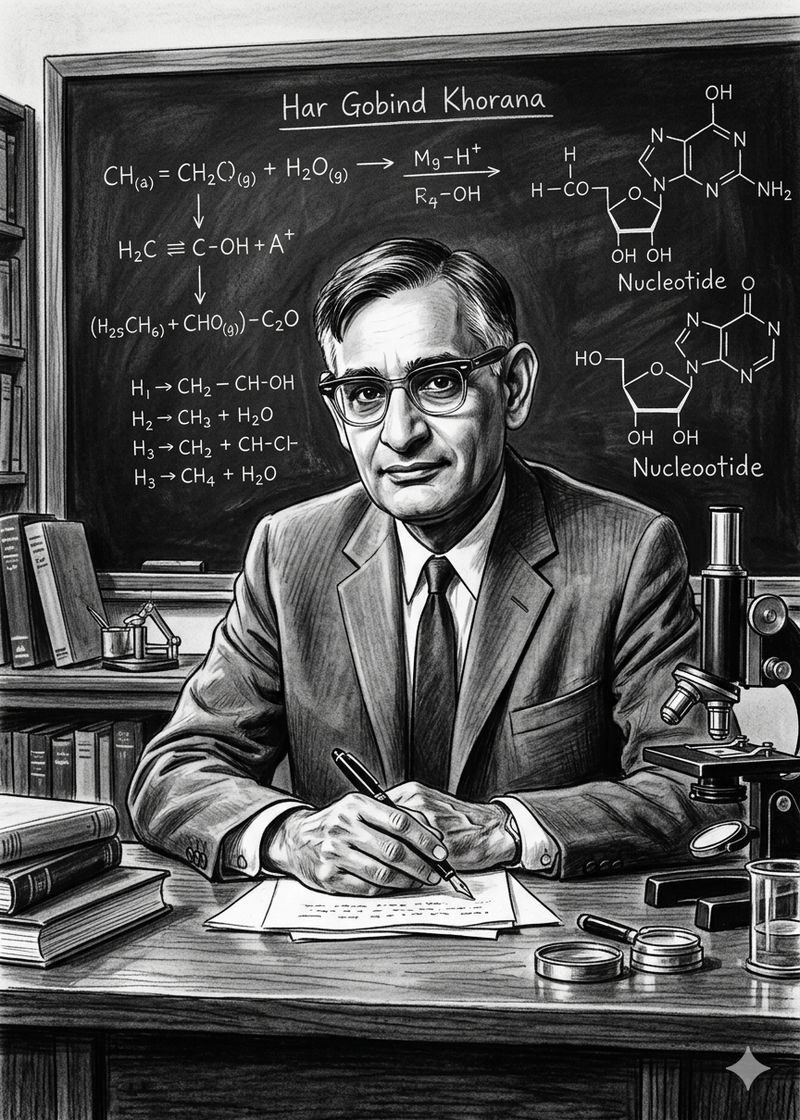

I have met people who believed they knew at a very young age what they wanted to do in their lives. I envied them, but my own life was not like that. At age 18, when I sought admission to the Punjab University in Lahore, I applied to two departments, English Literature and the honours course in Chemistry. Admission into the latter was restricted and required an interview. My shyness kept me from the interview, but they saved a place for me anyway, and thus I became a chemist.At the end of World War II, I was awarded a studentship by the Government of India to study insecticides and fungicides in England. However, the Indian High Commissioner’s office in London could only get me admitted into the Chemistry Department at Liverpool University, and I began to study organic chemistry. After I received my PhD in 1948, I was eager to spend some time in a German-speaking part of Europe, and I managed to do this at the Eidgenössische Technische Hochschule in Zurich, Switzerland.I worked with Vladimir Prelog. He was inspiring and so was the institute, with its long tradition of excellence in organic chemistry. I spent a great deal of time studying the German chemical literature. It was then that I came across Fritz Zetzsche’s work on carbodiimides. Serendipitously, carbodiimides became important in my synthetic work later.After a year in Switzerland, I returned to India. However, in the aftermath of partition of my province, Punjab, I could not find a job. In fact, many of my old friends and teachers were now refugees in Delhi without jobs. Fortunately, a postdoctoral fellowship in Alexander Todd’s laboratory in Cambridge (England) turned up, for work on peptides related to the newly discovered adrenocorticotropic hormone.Cambridge was a uniquely exciting place at that time. Todd’s own work was at the climactic point of defining the chemical structures of the nucleic acids. Frederick Sanger was sequencing insulin, the first protein to be so tackled. At the Cavendish laboratory, Max Perutz and John Kendrew were embarked on the first X-ray structures of myoglobin and haemoglobin, and soon the Watson-Crick structure for DNA was to emerge from the same laboratory. Molecular biology was in the making.At the end of 1952, the offer of a non-academic research job took me to Vancouver, British Columbia. Biochemistry was experiencing its golden age in elucidating metabolic pathways and the biosynthesis of macromolecules.In retrospect, my success in applying carbodiimides to the synthesis of nucleotides of interest to biochemists came astonishingly rapidly. The methods I developed attracted attention, and a number of established biochemists began to visit my small emerging group.The 1960s were the golden age of molecular biology. Scientists from a variety of disciplines came together and gave a unique momentum to the new field. However, many of my friends felt that after the elucidation of the genetic code and the chemical basis of heredity, an era had ended. The new frontier had to be the brain. An exodus of scientists to neurobiology began.In my own work, I pursued the challenge I had posed in the late 1950s, namely, the total synthesis of genes. In the late 1960s, the necessity to amplify synthetic genes became clear and principles for their amplification, later rediscovered and named PCR, were worked out.Making a radical switch in the mid-1970s, I became interested in biological membranes and in bacteriorhodopsin, the light-driven proton pump. This in turn led to interest in light transduction in the mammalian photoreceptor, rhodopsin, and in the photoreceptor cells in the retina.— Prof Har Gobind Khorana (1922-2011) won the Nobel Prize in Physiology or Medicine in 1968. Excerpted from ‘The Wisdom of India’s Nobel Laureates’, with permission from Aleph