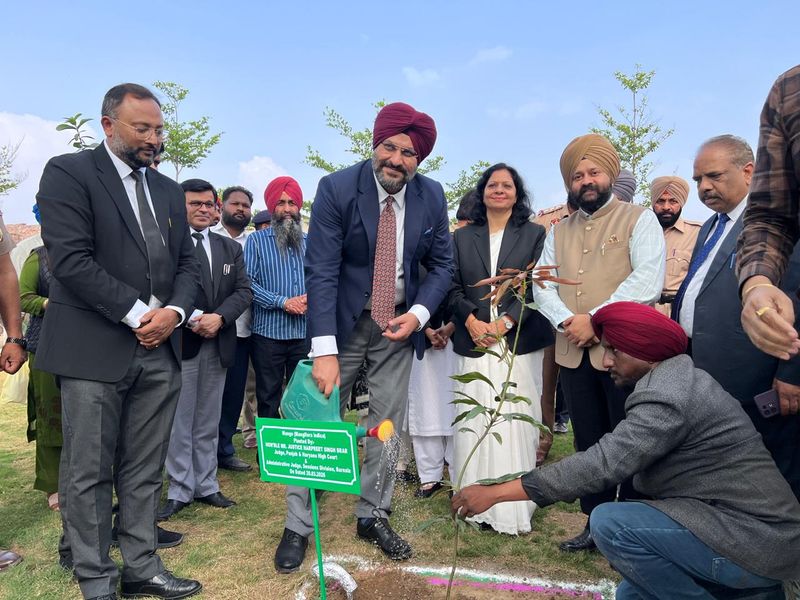

The road cuts gently through stretches of lush green fields, the kind that sway in quiet rhythm with the breeze, as if whispering stories of seasons gone by. Mustard flowers flicker like scattered gold under the sun, and the distant hum of a tractor fades in and out, dissolving into the stillness of the countryside. And then, almost unexpectedly, the landscape begins to change. The approach to Fatehgarh Channa village in Barnala district of Punjab does not announce itself with noise, but with care—subtle, deliberate, unmistakable.This is a village recently transformed under the initiative of Justice Harpreet Singh Brar of the Punjab and Haryana High Court within his administrative jurisdiction — an effort that quietly reflects how the judiciary, in moments like these, travels beyond its perceived function of dispensing justice within courtrooms to nudging the realisation of constitutional guarantees in lived spaces. What follows is not just development, but a quiet reimagining.Fatehgarh Channa is no longer just a dot on the map — it breathes, it blossoms, it tells a story.At the centre of it stands a park, now named after a war veteran, where nearly 60 fruit-bearing trees rise in neat lines, their young branches stretching skyward. Some are still slender, their trunks supported by careful staking, while others have already begun to spread shade in hesitant circles. The pathways feel lived in, not imposed — soft underfoot, edged with fresh soil, occasionally marked by the footprints of children who run through them without ceremony. And cared for they are. The students of the Government High Smart School have taken it upon themselves to nurture this green pocket, their laughter now mingling with the rustle of leaves, turning the park into something far more alive than its design.Move a little further and the transformation unfolds layer by layer. Saplings line the village roads, evenly spaced like sentinels of a greener future, their leaves catching dust and sunlight in equal measure. A faint scent of earth lingers in the air, especially where the soil has been freshly turned. The walls along the main road and the bus stand, once mute and weathered, now speak in colour — bright strokes of paint breaking the monotony of brick and cement. Slogans on cleanliness stretch across them in bold lettering, some crisp and new, others already softening at the edges, as if settling into the life of the village. They do not preach; they persist.Behind this visible change lies a quieter shift. A compost pit, modest in structure but significant in purpose, now deals with wet waste — layer by layer, turning discarded organic matter into something fertile. There is a certain rhythm to it, almost unseen, where waste returns to soil and soil returns to life, completing a cycle that often goes unnoticed but never unfelt. When Justice Brar walked these paths just recently, it was less an inspection and more an immersion. He visited the school, paused among the students, and honoured both them and the Forest Department team that helped shape this effort — acknowledging that transformation, like the trees here, grows through collective care. The interaction carried a quiet warmth, a recognition that the smallest hands often carry the largest responsibilities.Not far away, a newly established pond rests still under the open sky, its surface catching fragments of clouds and drifting shadows. The edges are raw yet purposeful, the water calm but expectant. Planned as a fishing nursery to supply fish seed, it carries within it the promise of livelihood intertwined with sustainability — of something that will, in time, ripple outward into the lives it supports.Fatehgarh Channa does not try to impress. It simply unfolds — cleaner, greener, more aware — offering, to anyone who passes through, a quiet reminder of what becomes possible when intent meets action —and when institutions step beyond their conventional confines to make constitutional promises visible on the ground.