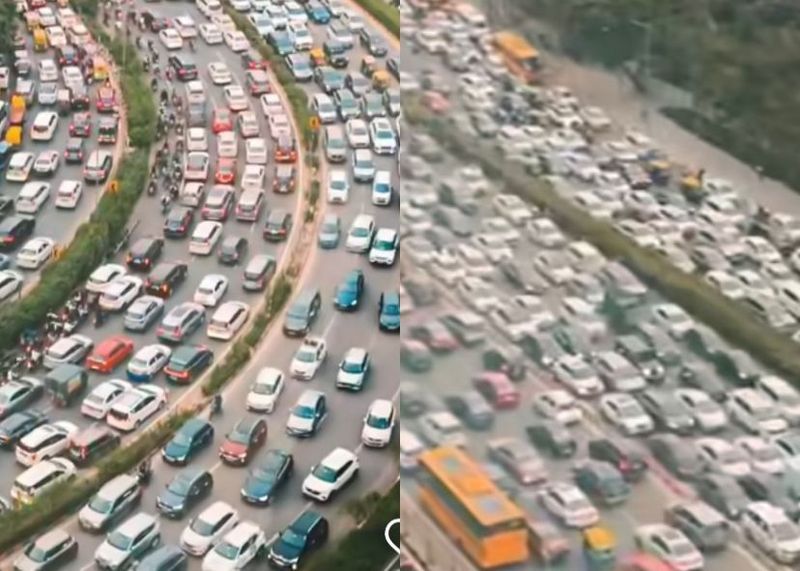

Gurugram’s roads are now more crowded than at any point in the last seven years.The millennium city recorded 229,964 new vehicle registrations between March 2025 and April 2026 — its highest tally since 2019 — up nearly 15% from approximately 201,000 in the same period in 2024 -25, according to regional transport authority (RTA) data compiled by environmental think-tank Envirocatalysts.Two-wheelers alone accounted for 100,675 registrations, followed by 73,542 private four-wheelers and 23,154 passenger four-wheelers. The numbers tell a clear story: Gurugram, home to over 3 million residents and half of all Fortune 500 companies operating in India, is a city that runs almost entirely on personal transport.BY THE NUMBERS: Gurugram Vehicle Registrations FY2025-26Category/ RegistrationsTotal Vehicles | 2,29,964 |Petrol & Ethanol | 1,31,254 |Diesel | 28,490 |Petrol-CNG | 24,082 |Electric (incl. hybrids) | 12,530 |Only-CNG | 13,727 |Fossil Hybrids | 19,881 |Gridlock Getting WorseCommuters are paying the price every day. The Delhi-Gurgaon Expressway, once built for seamless connectivity, now sees average peak-hour speeds barely crossing 30 kmph.The MCD toll plaza at the Gurugram-Delhi border is among the worst chokepoints, where halting commercial vehicles routinely trigger kilometre-long queues. Junctions like Shankar Chowk, Hero Honda Chowk, and Iffco Chowk are near-permanent bottlenecks. On bad days, five-kilometre stretches take over 90 minutes to cross.The problem runs deep into the city’s interior too. The Cyber Park junction on Netaji Subhash Marg and the Dada Bhaiya junction at Sector 9/9A and Basai Road have long jams , now prompting redesign plans by the Gurugram Metropolitan Development Authority (GMDA).The GMDA has identified 17 chokepoints — including Bakhtawar Chowk, Rezangla Chowk, Kaushal Chowk, and stretches near Unitech Cyber Park and Arcadia Mall — where a ₹7.58 crore traffic intervention plan is now underway. But with nearly 15% more vehicles added every year, upgrades are struggling to keep up.Toxic Air, A Silent EmergencyThe environmental cost is just as alarming.Petrol vehicles account for 57% of all new registrations in FY2025-26, with diesel adding another 12.8%, according to Envirocatalysts founder Sunil Dahiya. “Diesel exhaust contributes significantly to PM2.5 concentrations and continues to have a disproportionate impact on urban air quality, underscoring the need for tighter primary emission monitoring systems,” Dahiya warned.Gurugram’s pollution cocktail includes vehicular exhaust from the Delhi-Jaipur Expressway, construction dust, industrial emissions from the Manesar belt, and seasonal stubble burning — with winter PM2.5 regularly exceeding 250 µg/m³.Measured against WHO guidelines, the city’s PM2.5 levels are more than 20 times the safe limit. The human cost is staggering: research by the University of Chicago’s Energy Policy Institute found that PM2.5 exposure in Gurugram is reducing the average resident’s lifespan by 8.8 years nearly double India’s national average of 5.2 years.With electric vehicles accounting for just 5.4% of new registrations — and EV numbers actually falling year-on-year from 13,091 to 12,530 — Gurugram’s air quality crisis has no easy fix on the horizon.