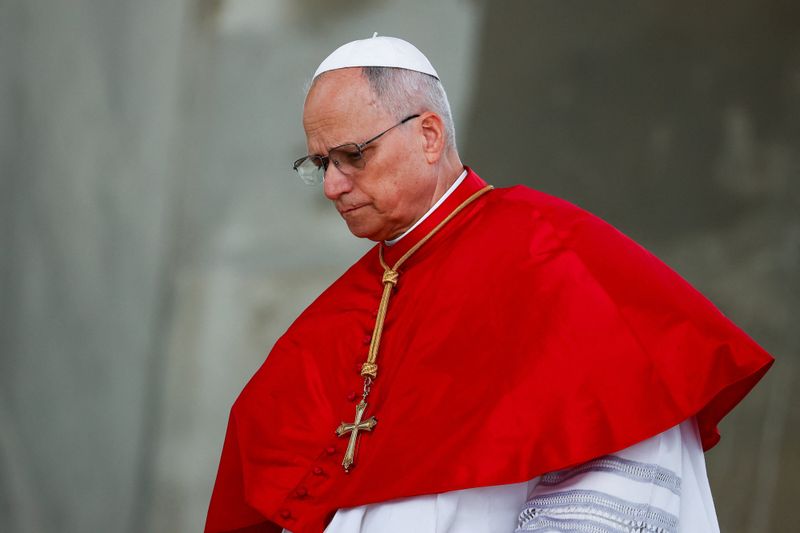

On a windy evening at Castel Gandolfo, the pope’s summer residence near Rome, a CNN reporter asked Pope Leo XIV whether he had a message for Donald Trump and the leaders of the United States and Israel as the war in the Middle East threatened to widen.His answer was measured, but unmistakable.The first American pope spoke in English. He said he hoped Trump would find an “off-ramp”, a way out of the war with Iran. He called for an end to the violence and a return to negotiation. It was a simple appeal: step back before events outrun control.The context matters. Leo has been increasingly explicit in recent days, condemning threats against Iran as “truly unacceptable” and rejecting outright the idea that war can be justified in religious terms. Both Trump and his defense secretary, Pete Hegseth, have invoked God in public messaging during the conflict, with Hegseth framing the war effort as divinely supported and even using scriptural justification.Leo has pushed back directly against this line of argument. “Jesus is the king of peace, who rejects war, whom no one can use to justify war,” he said on Palm Sunday. “He does not listen to the prayers of those who wage war but rejects them.” His position is consistent and rooted in a long-standing Catholic emphasis on restraint, dialogue, and the moral limits of force — particularly in a nuclear age.Within hours, Trump responded.“We don’t like a Pope who says it’s OK to have a nuclear weapon… I’m not a fan of Pope Leo.”He was more blunt elsewhere, describing the Pope as “weak” and “terrible for foreign policy.”The remark is revealing not only for its tone, but for its inversion. The Pope’s argument is precisely the opposite: that the spread and potential use of nuclear weapons must be resisted through dialogue and mutual restraint. Yet the call for de-escalation is recast as permissiveness — as though urging caution amounts to accepting danger. He framed the Pope’s warning in precisely those terms, insisting that “we don’t like a Pope” who takes such a view.This is a familiar political manoeuvre. Restraint is reframed as weakness; negotiation as surrender; caution as complicity. It shifts the terms of debate without engaging the substance.But the response did not stop there.Trump widened the attack beyond the war, saying the Pope should “stop catering to the Radical Left” and “focus on being a great Pope, not a politician.”Shortly afterwards, Trump posted an AI-generated image of himself depicted in explicitly Christ-like form, healing a sick figure, framed by American flags and eagles. At the same time, figures within his administration have invoked divine sanction for the war effort, reinforcing a narrative in which power is not only exercised, but consecrated.Taken together, this marks a shift from argument to performance.The Pope’s intervention belongs to one tradition of authority: slow, institutional, grounded in theology, history and a conception of moral limits. It seeks to persuade, to caution, to place boundaries around power.Trump’s response operates in another register altogether. Authority is asserted visually and rhetorically, through identification and projection. It does not require external validation — moral or institutional — because it generates its own imagery of legitimacy. Where the Pope invokes a Christ who rejects war, Trump presents an image of himself embodying salvific power.This is not simply disagreement. It is a divergence in how authority itself is understood.Historically, rulers have often defied the papacy — Henry VIII breaking with Rome, Napoleon Bonaparte subordinating it, Otto von Bismarck seeking to contain it. But even in defiance, they acknowledged its weight. They negotiated with it, replaced it, or attempted to control it.What is striking here is different. It is not confrontation, but dismissal. The papal voice is not treated as a rival authority to be reckoned with, but as an irritant to be brushed aside or recast.The episode also sits within a wider pattern of strain. Beyond the rhetoric, there are signs — uneven but significant — of operational friction among Western allies. Spain has closed its airspace to US military aircraft linked to the Iran conflict and barred the use of key bases. Italy has denied landing rights for certain US flights, while Switzerland has rejected most overflight requests on neutrality grounds. France, while not imposing a blanket ban, has handled such requests case by case, reportedly limiting some military transit.These are not acts of open opposition. But they suggest that alignment is no longer automatic.In a confrontation involving Iran, this erosion of shared assumptions matters. Deterrence depends not only on military capability, but on a common understanding of limits — of what must not be done. When those limits are contested, or quietly withdrawn in practice, the system becomes more fragile.At Castel Gandolfo, the message was clear: power must recognise its limits, especially where nuclear risk is concerned. The response, in both words and imagery, pointed elsewhere: power defines its own legitimacy and, by implication, its own boundaries.That is the deeper divide.This is no longer just an exchange between a president and a pope. It reflects a broader shift from a world in which power sought external moral justification to one in which it increasingly manufactures its own sense of righteousness through rhetoric, through imagery, through spectacle.When authority becomes self-referential in this way, restraint is no longer anchored in shared principles. It becomes contingent, negotiable, even dispensable.In a nuclear age, that is not an abstract concern. It is the central question.