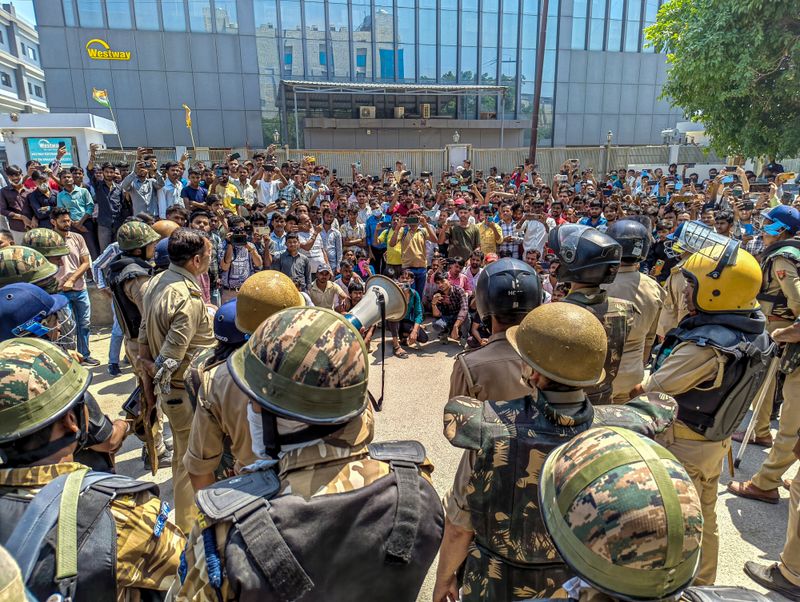

A wage protest by factory workers brought large parts of Noida and key Delhi-bound routes to a halt on Monday, triggering a cascading traffic collapse across NH-24, Sector 62, Sector 63 and multiple arterial roads, leaving thousands stranded for hours with no clear timeline for relief.What began as a localised industrial protest quickly spilled onto the region’s road network, choking one stretch after another and effectively cutting off critical entry points into Delhi. By afternoon, the disruption had moved beyond isolated blockades to a near-complete paralysis of movement across the Noida-Delhi corridor.This correspondent witnessed the breakdown firsthand, spending over four hours navigating a maze of blocked roads, failed diversions and dead ends that revealed how deeply the protest had seeped into the city’s transport grid.The journey began around 12 pm from Greater Noida towards NH-24 via Crossing Republic. Even before reaching the highway, the first signs of disruption emerged, and vehicles were turning back against the flow. Drivers coming off NH-24 said the road ahead was blocked and traffic had come to a complete halt.Attempting to bypass the main carriageway, this correspondent moved onto a parallel service lane. Within a kilometre, that option too collapsed. The jam extended up to Sector 62, indicating that the blockage was not confined to a single point but had already spread across connecting routes.At around 1:30 pm, a police official confirmed that factory workers had blocked the road as part of their protest, adding that there was no clarity on when it would be cleared.On the ground, the scale of disruption was evident. Trucks, cars and two-wheelers stood locked in place. Commuters stepped out into the afternoon heat, waiting for traffic to move, but there was none. The standstill had hardened.Police attempted to create a temporary release by allowing vehicles to move in the wrong direction, effectively reversing traffic flow to push vehicles out of the jam. Commuters were advised to turn back, as forward movement remained impossible. An official said the situation had persisted since morning and would only ease once protesters vacated the roads.The decision to turn back, however, did not lead to relief; it led to repetition.A longer detour was attempted via Gaur City, Crossing Republic again, and then towards Parthala bridge leading to Kailash Hospital. But the same pattern re-emerged. The Sector 63 road was also blocked, suggesting that the protest had expanded across multiple industrial pockets, cutting off parallel corridors simultaneously.Another attempt was made to enter Delhi through Sector 15, around 8 to 10 kms from Sector-63. That route too had been shut. The DND Flyway, already under heavy congestion since morning due to the same spillover, offered no viable passage.By this stage, the pattern was clear: each diversion fed into another blockade. Every connecting road had effectively been sealed.After over four hours of attempting to find a functional route, this correspondent contacted the bureau chief and was advised to return, as there was no certainty on when normal movement would resume.It was only by around 6 pm that traffic began to ease across some stretches, moving slowly and offering limited relief to commuters who had remained stranded through the day.Police said the disruption originated from protests in Noida’s Phase-2 and Sector 60 areas, where factory workers had gathered in large numbers demanding long-pending wage revisions and enforcement of minimum wages. As the crowd grew, the protest spilled onto adjoining roads, triggering a chain reaction across the transport network.While the demonstration began peacefully, authorities said sections of the crowd later turned aggressive. Incidents of stone-pelting, vandalism and arson were reported, including a vehicle being set on fire and damage to public property. These developments further complicated clearance efforts and prolonged the blockade.Security was tightened across industrial areas under the Gautam Buddh Nagar Police Commissionerate, with senior officers deployed on the ground to contain the situation and restore order.The disruption was not limited to Noida. A separate protest by women employees led to a blockade on the Delhi-Agra National Highway between Faridabad and Palwal, adding pressure on alternate routes and compounding congestion across the NCR.Workers maintained that their demands for wage hikes and implementation of minimum wage norms had remained unaddressed despite repeated appeals, leading to the escalation.For commuters, however, the cause mattered little in the moment. What remained was a day where movement across the NCR slowed to a near halt, where each attempt to move forward led back to the same outcome.A dead stop. What began as a routine drive turned into a prolonged standstill, illustrating how quickly a localised protest can ripple outward, overwhelm urban infrastructure, and bring an entire region’s movement to a halt.