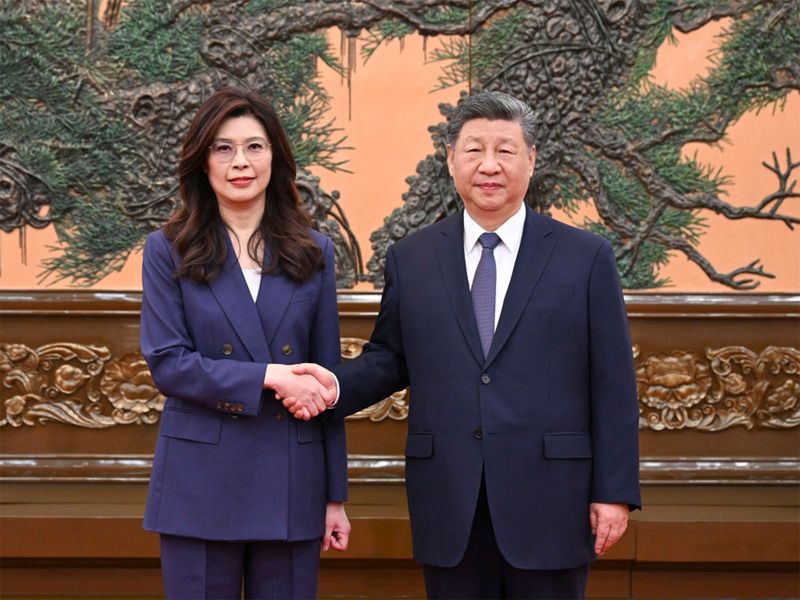

Hong Kong, April 14 (ANI): Beijing is pressurising Taiwan in every way imaginable. Its latest achievement was hosting Cheng Li-wun, the chairwoman of Taiwan’s Kuomintang (KMT) opposition party, from 7-12 April 2026. Optics were good for China, as the country was seen pursuing diplomatic avenues to engage with Taiwan. However, Cheng’s actions portend problems for both Taiwan and the USA.In the first meeting between sitting KMT and Chinese Communist Party (CCP) leaders since 2016, Chen framed the visit as a “peace mission” to stabilise cross-strait relations. Cheng even met with Chairman Xi Jinping on 10 April, but some viewed her visit as an unabashed political surrender. In a 13-second handshake at the Great Hall of the People, Xi stood immovable and inscrutable, while Cheng bowed her head and looked like a supplicant come to appease the emperor.China views the KMT as a more reliable party than the ruling Democratic Progressive Party (DPP), which it constantly criticises for advocating “Taiwan independence and separatism”.Yet Cheng is an opportunist – she once advocated for Taiwanese independence early on, but is now shamelessly directly entreating with Beijing. In 1988, she had denounced the KMT as “the most detestable ruling force”, and she was once a rising star in the DPP before shifting allegiance to the KMT in 2005 in a dramatic political U-turn. If the KMT is placing the fate of 23 million Taiwanese on the negotiating table, or worse, in the hands of Xi, then this is highly dangerous.The academics Lyle Morris and Sheng-Wen Cheng, writing for the Asia Society, commented: “For Xi, the symbolism of him and Cheng…meeting face to face to ‘mend fences’ could portray an image of cross-strait unity that could strengthen Xi’s hand in discussions with Trump. For Cheng, a successful China trip could bolster her political standing among the KMT base in Taiwan, but could also alienate opposition DPP voters and swing voters, who may view Cheng as ‘selling out’ Taiwan’s sovereignty in pursuit of easing tensions with mainland China.”The KMT leader’s visit came a month before a rescheduled summit between President Donald Trump and Xi in Beijing, with the USA already in a disadvantageous position after getting bogged down in a war against Iran. As Morris and Sheng-Wen Cheng said, “For Trump, the visit could complicate Washington’s relations with China. Trump will have to walk an even more delicate tightrope of signalling the United States’ enduring ‘One China’ policy with Xi, while responding to the inevitable message from Xi that cross-Straits are ‘stabilising’ and that the United States should not intervene in the ‘internal matters of China’.”The academics contended that “Cheng’s rhetoric on China and the United States -calling for deeper alignment and accommodation with Beijing while simultaneously casting doubt on the value of Taiwan’s security ties with Washington – positions Cheng to potentially alter the trajectory of cross-strait ties if the KMT achieves a majority victory in the 2028 presidential elections.”Cheng has taken a sceptical posture toward the USA and an accommodating tone towards Beijing. Her rhetoric colours the USA as a source of risk for Taiwan, plus she has criticised greater defence spending because Taiwan cannot bear the cost, because acquisitions benefit the USA, and because it will invite war. In contrast, Taiwanese President Lai Ching-te emphasises Taiwanese sovereignty, enhanced defence expenditure and closer security cooperation with the USA.Morris and Sheng-Wen Cheng commented too: “The contrast Cheng draws between the West that exports instability and a China that promises order and peace reveals more than a tactical critique of US policy. It reflects a worldview in which Western powers are treated as extractive and escalatory, while China is seen as historically grounded and reliable. For international audiences, this framing helps explain why her Ukraine comments resonated far beyond Taiwan: they fit into a broader narrative about decline, transition and which countries can be trusted in the current global order.”Cheng’s contention that Washington DC is a “catalyst” for conflict, rather than a guarantor of deterrence, is perhaps true enough when it comes to Trump’s unpredictable policies and erratic behaviour.Many allies of the USA around the world are now seriously questioning American dependability and moral standing. For example, Charles Lyons-Jones, Research Fellow at the Lowy Institute’s Public Opinion and Foreign Policy Program, recently stated: “I’ve built my career as a champion of Australia’s alliance with the United States, and believe a strong America that lives up to its values is critical to balancing China in the Indo-Pacific. But it is hard to see this administration as anything other than a gift to Xi Jinping.”Even members of Cheng’s own KMT party are disturbed by her secret diplomacy and policy direction. In an interview with Deutsche Welle last year, she posited regarding the Ukraine war, “The core reason the war erupted was NATO’s constant eastward expansion,” adding that it was “too harsh” to call Vladimir Putin a dictator. She was duly vilified for blindly parroting Russian and CCP talking points.Given that local Taiwanese elections will occur this November and that the KMT is languishing badly in polls, Cheng’s bold gambit to visit China could well backfire. It is risky believing that Taiwan will enjoy greater security by closer engagement with China, and hoping that Xi will moderate his behaviour toward Taiwan in response. Furthermore, the KMT runs the risk of being seen as a conduit for Chinese influence.Support for the KMT has dropped to 20% of Taiwanese voters, whilst the DPP’s level remains stable at 35%. Moderates within the KMT consider Cheng a liability as elections loom, since she is so focused on cross-strait relations. Cheng has branded herself as “fighting blue”, a KMT faction characterised by a confrontational and rhetorically aggressive stance toward the DPP. But KMT hardliners fear that hatred for the ruling DPP overshadows the very real threat of mainland China.Bonnie Glaser, Managing Director of the Indo-Pacific Program at the German Marshall Fund, commented too: “Chinese President Xi Jinping’s meeting with Cheng highlights how Beijing can engage selectively with Taiwan’s political figures at moments of heightened domestic division to accentuate existing differences over cross-strait policy and national security priorities.”She added, “Taiwan’s deepening political polarisation increases its vulnerability to exploitation by China. Beijing stands to benefit when Taiwan’s internal divisions undermine trust in democratic institutions or raise doubts in Washington about Taipei’s strategic reliability. Absent a resolution to the political impasse, Taiwan risks becoming more vulnerable as it navigates intensifying pressure from Beijing, where internal unity is increasingly inseparable from national security.”Pro-US members of the KMT are also troubled that Cheng continually obstructs the Taiwanese government’s proposed US$40 billion special defence budget. Concerning this, Glaser noted: “The prolonged budget crisis risks eroding US confidence in Taiwan’s political will to defend the island, and may reinforce perceptions that Taiwan cannot sustain the investments in defence required for credible deterrence. Continued budgetary gridlock could also delay procurement and delivery timelines, complicating Taiwan’s coordination with US defence planners.”The KMT is a faction-ridden party that desperately needs to attract younger Taiwanese, who care little for KMT historical narratives and who are also wary of closer integration with China. Among Taiwan’s three main political parties, the KMT has the lowest support level amongst youth, at just 16%. Furthermore, two-thirds of KMT membership is reportedly over 65 years old.The Asia Society report also stated: “What is distinct in Cheng’s formulation is the explicit linkage of cross-strait relations to the political project of ‘national rejuvenation’. In her response, the KMT not only reiterated themes of shared identity but also stated that both sides would ‘jointly create a great future for national rejuvenation’. This phrasing closely mirrors the PRC’s central narrative of pursuing the ‘great rejuvenation of the Chinese nation’, and reflects a shift from cultural identification toward alignment with a broader political objective.”Cheng also eschewed the KMT’s normal practice of giving a respectful statement in order to maintain flexible interpretation space. Instead, she adopted language very similar to China’s in her assessment of the Chinese visit.Indeed, she echoed China’s talking point of “opposition to external interference” (i.e. the USA). In other words, she was agreeing that the legal status of Taiwan was an internal affair of China. She was essentially amputating one of Taiwan’s most important security pillars, its relationship with and dependence upon the USA. All this would have been music to Xi’s ears.Similarly, Cheng’s revision of the 1992 Consensus also departs from the KMT’s traditional “One China, respective interpretations” formulation. Instead, she said, “The 1992 Consensus is neither One Country, Two Systems nor ‘One China, respective interpretations’. Its core is that both sides of the strait belong to ‘one China’.” Cheng’s framing removes a desirable ambiguity in Taiwanese dialogue with China, and reaffirms her belief that Beijing is an alternative source of stability in a new international order.Morris and Sheng-Wen Cheng, in their analysis for the Asia Society, listed three questions that will determine whether the KMT moves towards national legitimacy in the 2026 local elections and in the 2028 presidential race. The first is whether the KMT can achieve generational renewal by attracting younger voters; secondly, whether the party can pursue complementary interests with Washington DC without alienating the USA; and thirdly, whether Taiwanese voters en masse will support Cheng’s outreach to China.The USA’s ill-advised attack on Iran has certainly given China impetus. Malcolm Davis, Senior Analyst at the Australian Strategic Policy Institute, remarked: “China is using the Iran war to shape the strategic environment to enable them to achieve their key strategic objective – the imposition of unification on Taiwan, against the wishes of the Taiwanese people. If the US is no longer prepared to defend Taiwan or support its interests, that may then see pro-reunification groups such as the KMT have greater influence within Taiwanese politics. There’s a larger strategic agenda here than just Iran.”Similarly, Ryan Hass, Director of the John L. Thornton China Centre at the Brookings Institute in the USA, lamented, “Trump is making in-kind contributions to China’s efforts to erode confidence in the credibility of US security commitments. PRC officials have been working for decades to induce doubts in Taipei, Tokyo, Seoul, Manila and elsewhere about America’s reliability. They now have a US president doing their work for them. Expect Chinese diplomats to use Trump’s comments on a repeat loop going forward.”Hass also shared, “Meanwhile, Beijing will work to keep relations with the US steady as they aim to secure as much economic and security relief from US pressure as possible during Trump’s visit to China.”Former Taiwanese president Ma Ying-jeou adhered to a policy of unification with China, too. However, Cheng has taken this to a new level with her repetition of CCP talking points, her appeals to a shared Chinese heritage, and her clear preference for Chinese promises rather than US security guarantees. Yet the lesson from history is that appeasement rarely achieves lasting peace, as Europe found out to its loss when dealing with Adolf Hitler.The fact is that China does not want so much a negotiating partner in Taiwan, but a tool or object that it can easily manipulate. This meeting between Cheng and Xi enabled the CCP to project a posture of peace and reassurance in an era of instability, but at the same time, it was testing and eroding internal political fault lines within Taiwan. For this reason, Cheng may well be best viewed as merely a replaceable pawn in China’s strategic plan to conquer Taiwan. (ANI)(This content is sourced from a syndicated feed and is published as received. The Tribune assumes no responsibility or liability for its accuracy, completeness, or content.)