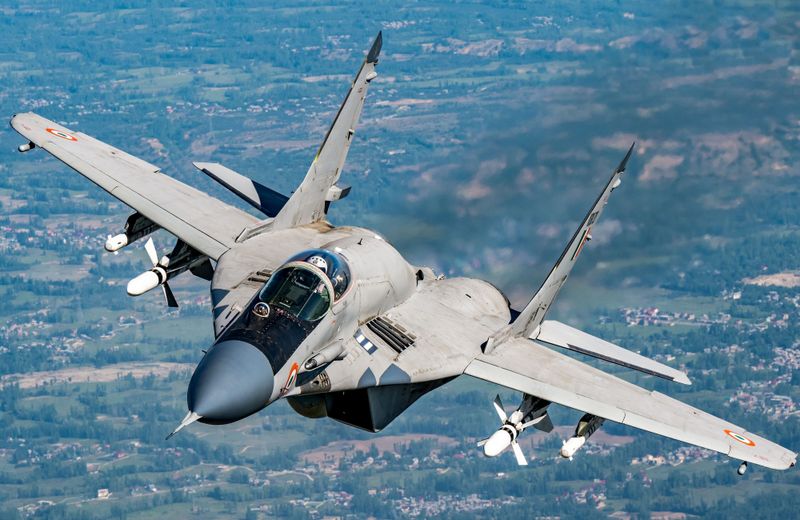

The Indian Air Force (IAF) is modifying its MiG-29 and Jaguar combat aircraft, which form important elements of its air defence and strike capability, to carry new-generation advanced air-to-air missiles.The advanced missiles will expand the IAF’s reach in close combat, enable it to deal better with new age threats like drones and aerial platforms having a low radar signature, and improve resilience to counter measures.In separate requests for proposals (RFPs) issued recently, the Ministry of Defence has invited bids from Indian industry to execute the projects at different IAF establishments involved with the operation and maintenance of these aircraft.The IAF’s requirement is to modify 56 Soviet-origin MiG-29 aircraft, including eight two-seat trainers, for launching the Advanced Short Range Air-to-Air Missile (ASRAAM), procured from European defence conglomerate MBDA.The ASRAAM is a high-speed, infrared-guided missile with a range of about 25 kms and will replace the existing Russian R-63 heat seeking missiles that have a kill probability of about 15 kms. It also equips aircraft like the US F-35 and the European Typhoon in several western air forces and has been adapted for the Indigenous Tejas fighter.The integration and certification will be done at IAF’s No. 11 Base Repair Depot at Nasik, which is primarily responsible for the maintenance and overhaul of Soviet/Russian origin fighters in the IAF’s inventory, including the Su-30MKI.Earlier, the MoD had sought industrial participation for modifying 74 Jaguar aircraft to make them compatible with the next generation close combat missile (NGCCM) and helmet mounted display system (HMDS).The modifications will be undertaken at five IAF bases – Ambala, Jamnagar, Bhuj, Suratgarh and Gorakhpur and at the Bengaluru Complex of Hindustan Aeronautics Limited, which has licence-manufactured these Anglo-French origin aircraft.The new missiles will replace the older French Matra Magic short range heat seeking missiles. The IAF Jaguar’s missile armament is unique in the sense that the missiles are mounted on pylons above the wings rather than the standard configuration of under the wings. Usual hardpoints below the wings are used for carrying air to surface ordnance. The over-the-wing pylons are a special feature added to Indian Jaguars to enable them to carry missiles for self-defence during deep interdiction missions.The IAF began inducting Jaguars in 1979, while the MiG-29s started coming in from 1986. Over the years, both aircraft have undergone significant upgradations, including structural modifications, new avionics and navigational suits and integration of newer weapons to enhance their operational capability.The IAF operates six squadrons of Jaguars and three Squadrons of the MiG 29. These formed part of the IAF armada during several recent operations including Kargil in 1999, Balakote airstrike in 2019, India-China stand-off in 2020 and Operation Sindoor in 2025. The IAF is expected to retire these aircraft by the end of the next decade.