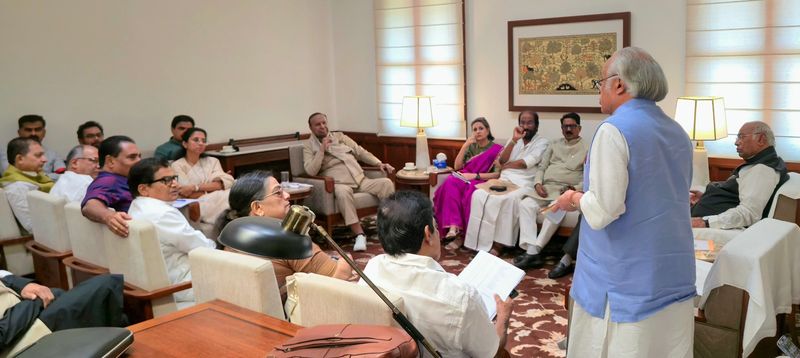

The unity that powered the INDIA bloc’s parliamentary victory did not emerge overnight. It was forged in a series of hurried consultations, late-night calls and back-to-back strategy meetings over the past 10 days, triggered by a single political flashpoint: the Centre’s decision to link women’s reservation with delimitation.What followed was one of the clearest instances of Opposition convergence in recent months. Parties that often diverge on electoral strategy closed ranks around a sharply defined position, support 33 per cent reservation for women, but oppose its linkage to Census and constituency redrawing.The pivot came in the days leading up to the special Parliament session. On April 10, the Congress Working Committee flagged concerns over the proposed framework, setting the tone for a broader Opposition push. Within days, outreach began across INDIA bloc partners, with Congress leaders opening multiple channels of communication, both formal and informal, to bring allies onto a common page.By April 14 and 15, these efforts crystallised into a coordinated front. A key strategy meeting convened at the residence of Congress president Mallikarjun Kharge in New Delhi became the turning point. Leaders from across the Opposition spectrum, including Congress, DMK, RJD, NCP (SP), Shiv Sena (UBT) and others, attended and arrived at a joint decision to oppose the delimitation-linked framework while backing women’s reservation.What made this convergence significant was not just the meeting itself, but the groundwork preceding it. Multiple leaders confirmed that there had been continuous consultations over phone between Congress leadership and key regional players, particularly from southern states, where concerns over delimitation run deepest.Tamil Nadu Chief Minister MK Stalin played a central role in shaping this alignment. His early and vocal opposition to population-based delimitation reframed the debate, shifting it from a question of women’s representation to one of federal balance. That argument, that southern states could lose parliamentary weight despite better population control, quickly found resonance across parties.This southern push, combined with the Congress’s coordinating role, helped convert scattered concerns into a unified political doctrine. By the time the INDIA bloc leaders met formally in Delhi, the broad contours of agreement had already been worked out: unconditional support to the 2023 women’s quota law, and categorical opposition to any attempt to delay or condition its implementation.The Opposition also drew tactical clarity from the sequencing of the government’s legislative package. The introduction of three interlinked Bills, on women’s reservation, delimitation, and expansion of Lok Sabha strength, was read as an attempt to bind a widely supported reform with a politically contentious restructuring of electoral boundaries.That interpretation became the glue holding the alliance together. Congress leaders framed the linkage as a constitutional issue, while regional parties, particularly from the South, projected it as a question of representation and equity.Inside Parliament, this translated into a coordinated line of attack. Leader of Opposition Rahul Gandhi argued that the government was using women’s reservation as a cover for electoral restructuring, warning that the exercise could alter political balance.The broader Opposition echoed this framing. Leaders insisted that the women’s quota, already enacted through the 2023 constitutional amendment, should be implemented directly, without waiting for delimitation.At the heart of this strategy was a simple political calculation: by separating the principle of reservation from the process of delimitation, the INDIA bloc could claim both moral high ground and constitutional consistency.The government, however, held its ground, arguing that delimitation and reservation were part of a single reform process aimed at expanding representation. But that position failed to break the Opposition’s cohesion.When the vote came, the numbers reflected this consolidation. The Bill fell short of the required two-thirds majority, marking a rare legislative setback for the government.Yet, within the INDIA bloc, there is little sense of closure. If anything, the past fortnight has provided a template. What began as resistance to a legislative design has evolved into a broader political framework, one that combines constitutional argument, federal concerns and electoral strategy.Leaders now indicate that the issue will be taken beyond Parliament, with a campaign built around immediate implementation of women’s reservation without preconditions.The events of the past two weeks show how that campaign may unfold. Rapid coordination, a clearly defined common minimum position, and the ability to translate regional anxieties into a national narrative, these were the elements that produced unity in Parliament. They are also likely to shape the next phase of the battle.