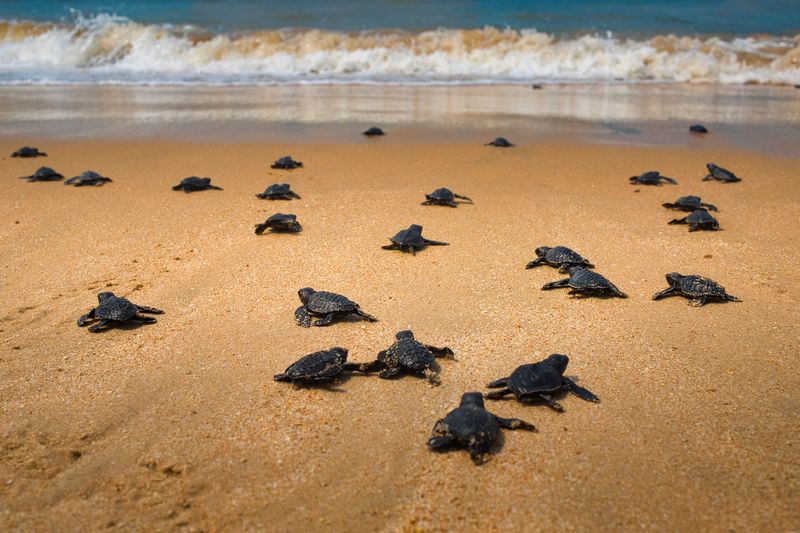

The sea under a full moon has a way of turning memory into something almost mythical. Yet what we witnessed that December night in 1999 on a remote shore of the Andaman Islands was no myth — it was nature at its most ancient, deliberate, and humbling.The Olive Ridley sea turtle, among the smallest of its kind, embodies one of the ocean’s most enduring instincts: the return to sandy shores to begin the next generation. With its olive green, heart-shaped carapace and modest size, it is an unassuming creature. The name ‘Ridley’, possibly derived from ‘riddle’, reflects the once-mysterious mass nesting behaviour known as arribada.Classified as Vulnerable by the International Union for Conservation of Nature, the species symbolises both continuity and fragility. India’s conservation commitment began with the Olive Ridley Conservation Project at Gahirmatha Beach in Odisha in 1975, and sustained efforts since have safeguarded nesting habitats, including those in the Andaman and Nicobar Islands.On that particular night, conservation was not a concept we analysed but an experience we lived. Our journey began where the motorable road ended and a waiting truck carried us deeper into the darkening wilderness. The air grew cooler and quieter until we reached a narrow creek. Beyond it lay the protected sands of Cuthbert Bay, part of a wildlife sanctuary long cherished as a refuge for nesting sea turtles. A modest camp awaited us — two gas lanterns flickering in the night, a small tent, and a welcoming dinner table.As the tide rose, we boarded small dinghies to cross the creek, the restless sea testing both vessel and resolve. A sudden swell lifted our craft, tightening the night around us, yet the skilled oarsmen steadied it and brought us safely ashore. On the far side, the world seemed transformed: sand shimmered silver beneath the moon, and a sudden chill settled into the air. Anticipating this, the forest staff had replaced chairs with thick rubber mats inside the tents and provided blankets that soon became welcome companions.Waiting proved as integral to the experience as the sight itself. To keep sleep at bay, our guide spoke softly of constellations, the Andaman Sea, and nature’s quiet cycles, while cups of hot coffee circulated. Close to midnight, soft, reverential whispers from the forest staff signalled their arrival. We stepped out in silence, careful not to disturb the fragile theatre unfolding before us.From the dark edge of the sea emerged a living tide — scores of turtles, their movement slow yet purposeful, their shells glistening under the moonlight. It was not the chaotic abundance associated with mass nesting elsewhere, but something more intimate and elemental. Each turtle seemed to carry its own ancient memory and an unerring sense of purpose. What followed was a ritual both precise and profound. With swift, practised movements, the females dug into the sand, laid their eggs, and carefully concealed each nest, entrusting it to the earth.There was no spectacle — only instinct, steady and unbroken. Beneath the smooth stretch of sand, the next chapter had already begun. After an incubation period of about 45 to 60 days, hatchlings would emerge, guided by the faint glow of moonlight reflecting off the sea. Many would not survive, yet enough would endure to sustain the cycle — a quiet testament to nature’s balance.The Andaman Islands, with their unspoiled beaches and rich biodiversity, remain a vital refuge for these turtles. Efforts to protect nesting grounds are acts of custodianship, preserving a rhythm that predates human memory and honouring a timeless connection between land, sea, and life itself. That night, however, what stayed with us was not just the ecological significance of the event, but its quiet poetry. The rhythm of the waves, the silvered sand, and the steady crawl of life towards continuity came together in a moment that felt both deeply personal and universally profound.— The writer is a former Indian Forest Service officer