

A GIANT 62ft octopus likened to the mythical kraken that swallowed up ships actually roamed the seas in the dinosaur era, new research shows.
The gargantuan sea monster was an apex predator when it dominated the oceans nearly 86 million years ago.
Sign up for the Tech newsletter
Thank you!
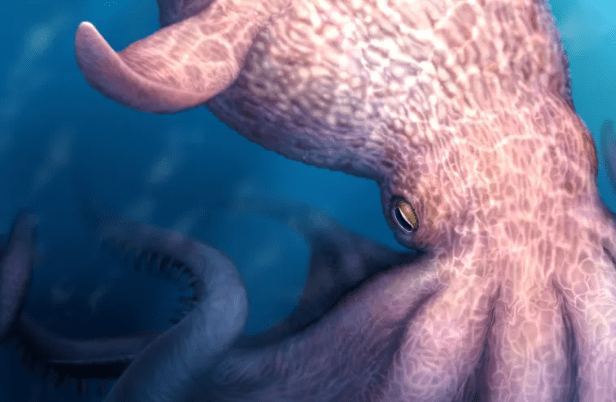
The Nanaimoteuthis haggarti is one of the biggest invertebrates ever recorded Credit: SWNS
Newly unearthed fossils of its jaw structure show it measured up to 19 metres tall and lived during the Cretaceous period.
Called the Nanaimoteuthis haggarti, the awe-inspiring species is one of the biggest invertebrates ever recorded.
Boffins compared the humongous beast to the fabled kraken – a mythical giant octopus which, according to Scandinavian folklore, downed countless ships as they voyaged across the seas.
Lead author of the new study Yasuhiro Iba said: “These animals were remarkable.
MONSTERS, INK
Major octopus invasion wiping out shellfish in UK waters
SPINO-SAUR!
Rare SPIKED dinosaur with ‘never seen’ feature found on 125mil year-old fossil
“With their large bodies, long arms, powerful jaws and advanced behaviour, they represent what could be described as a real Cretaceous kraken.”
The average modern day giant squid can reach up to 12 metres in length – just over half the size of the Nanaimoteuthis haggarti.
Palaeontologist Iba added that his discovery showed how “giant invertebrates, namely octopuses, also functioned as apex predators in the Cretaceous sea”.
He said: “These giant octopuses likely occupied the same ecological tier and may have competed with marine reptiles and sharks within the same ecosystem.”
The fossils studied came from Japan and Vancouver Island in Canada.
They featured intense wear on the creature’s “beak”, the only rigid part of an octopus’s invertebrate body.
The damage indicates repeated crushing of hard structures such as bones and shells.
This indicates that the enormous animal hunted large fish, shelled tentacled creatures, clams and other large prey.
The nightmare-fuel beast went extinct at the same time the dinosaurs were wiped out about 66 million years ago.
The new discovery challenges pre-conceived notions about soft-bodied organisms such as squids or octopi.
Large vertebrates, animals with a backbone, are known to have dominated the top of the marine food chain for the past 370 million years.
These include sharks and whales, which are commonly understood to have been the top predators.
On the other hand, soft-bodied creatures, invertebrates, usually served as prey.
The Nanaimoteuthis haggarti appears to be an outlier amid this concept.
The octopus has been compared to the fabled kraken which swallowed ships according to Scandinavian folklore Credit: Natural History Museum