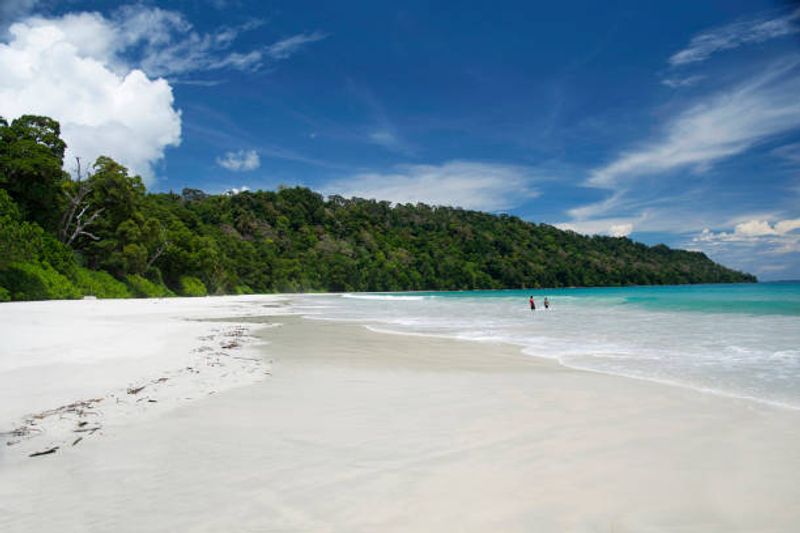

The proposed Great Nicobar infrastructure project has come under scrutiny after Congress leader Rahul Gandhi described it as “destruction dressed in development’s language” in a video from the project site.Positioned by the Centre as a strategic maritime and economic hub, the multi-phase project aims to enhance India’s presence in the Indian Ocean region. The project includes an international container transshipment terminal, a greenfield international airport, a 450 MVA gas-solar power plant and a planned township. Environmentalists and researchers have, however, raised concerns over its ecological impact and environmental clearances.Great Nicobar Island, the largest in the Nicobar archipelago, is a UNESCO-recognised biosphere reserve known for its rich biodiversity and indigenous communities such as the Nicobarese and Shompen.A key point of contention is the scale of deforestation. While the government has stated that up to 7.11 lakh trees may be felled within 49.86 sq km of forestland, independent assessments suggest significantly higher figures. A researcher, speaking on anonymity, pointed to inconsistencies in official data over time, indicating uncertainty in the actual number of trees to be cut.“In August 2024, Andaman and Nicobar Islands Integrated Development Corporation Limited (ANIIDCO) invited expressions of interest for ‘enumeration, felling, logging and transportation of these trees’. This indicated, first and foremost that the project proponent did not actually know the number of trees to be cut. How could the government then estimated that over 8 lakh trees will be axed?” a researcher requesting anonymity told The Tribune.Environmentalists have also flagged concerns about the island’s fragile ecosystem. A study published by Cambridge University Press in 1994 warned that expanding population and land-use changes in the Andaman and Nicobar Islands could adversely affect their flora, fauna and overall ecological balance.Questions have also been raised about the project’s long-term sustainability. Researchers note that the current population of the islands, estimated at around five lakh, could increase significantly due to the project, placing additional pressure on resources such as freshwater.The region’s classification under Seismic Zone V — the highest earthquake risk category — has further added to concerns about infrastructure safety.“If there is a tectonic shift the transshipment port will not exist. The safety of the people is at risk. Where has this aspect been incorporated into the project proposal,” the researcher said.In February, the National Green Tribunal declined to interfere with the environmental clearance granted to the project. The tribunal noted submissions that no part of the project fell within the ecologically sensitive Coastal Regulation Zone-1A after ground verification by a high-powered committee.However, critics dispute this finding, citing the presence of nesting sites of endangered marine species in areas classified under CRZ-1A, where construction activities are restricted. They have also alleged procedural lapses in the granting of forest clearances.The financial outlay of the project has also increased, with estimates rising to Rs 90,000-95,000 crore now from the initial Rs 72,000 crore. Scientists studying endemic species in the region, including the Nicobar megapode, have warned that large-scale habitat disruption could have irreversible consequences.The government, however, has defended the project, stating that only 1.82% of the total forest cover of the Andaman and Nicobar Islands will be diverted. It has also emphasised that 65.99 sq. km will be preserved as green zones with no tree felling.On compensatory measures, the Centre has said afforestation would be undertaken in Haryana, as the high forest cover in the islands limits local options. This, too, has drawn criticism from environmental experts, who argue that tropical island ecosystems cannot be meaningfully offset by afforestation in mainland regions.The researcher said, “The diversion of pristine tropical forest in Great Nicobar is being compensated for by declaring land in Haryana as forest land. This is absurd.”The Great Nicobar project is planned in three phases, with completion targeted between 2042 and 2047.“The project’s strategic and economic significance is underscored by the need to position Great Nicobar as a critical node in the Indian Ocean region. The project ensures optimized land use, coordinated ecological management, and long-term regional benefits, while remaining fully compliant with Environmental Impact Assessment (EIA) regulations and statutory approvals,” the Centre said on Friday.