

Millions of Brits don’t know how to perform CPR, a charity has warned, urging more people to learn the skill that can “double the chances of survival”.
More than 30,000 cardiac arrests – when the heart suddenly stops pumping blood around the body – occur outside of hospitals in the UK every year.
Sign up for The Jattvibe newsletter
Thank you!
If an individual has collapsed and is unresponsive, presume they are having a cardiac arrest Credit: Getty
But, nearly 33 per cent of people don’t know how to give chest compressions to someone who has suffered a cardiac arrest, according to a poll by the Resuscitation Council UK (RCUK).
Dr Zafar Iqbal, head of sports medicine and performance at Arsenal Football Club, said: “Sudden cardiac arrest on the field of play is a rare but devastating event, and early CPR and defibrillation can more than double the chances of survival.”
The survey of more than 2,000 Brits also found that close to half (46 per cent) of poll participants did “not know where the nearest defibrillator is located at their local sports venue”.
In response to the findings, RCUK has launched a guide aiming to equip anyone who takes part in sports – coaches, players, volunteers and spectators – with the skills and confidence needed to help save a life.
GET FIT FAST
Easy 10-minute workout done LYING DOWN ‘gets you fit and flexible in weeks’
James Cant, chief executive of RCUK, added: “Cardiac arrest can happen to anyone at any time.
“In grassroots sport, where medical experts aren’t always present, preparation can help save lives.
“This guidance gives clubs, organisers, players and spectators practical, achievable steps to put emergency plans in place.
“You don’t need to be a healthcare professional to make a difference – you just need to be ready.”
How to perform CPR
Someone who has an unexpected collapse and remains unresponsive should be presumed to have had a cardiac arrest.
Step 1 – Check breathing
Make sure it is safe to approach before gently shaking them and speaking to them. If they don’t respond, shout for help.
Gently tilt the person’s head back to check for signs of breathing and observe them for no longer than 10 seconds.
Step 2 – Call 999
You do not need to wait to confirm whether they are breathing before calling 999. Following a cardiac arrest, the patient may stop breathing.
But, they may also have slow, laboured breathing or other abnormal patterns such as gasping or panting.
They may even have near-normal breathing at the start, have seizure-like activity or have their eyes open.
When calling or getting someone nearby to dial 999, make sure the operator is told “cardiac arrest” and provide as many details as possible.
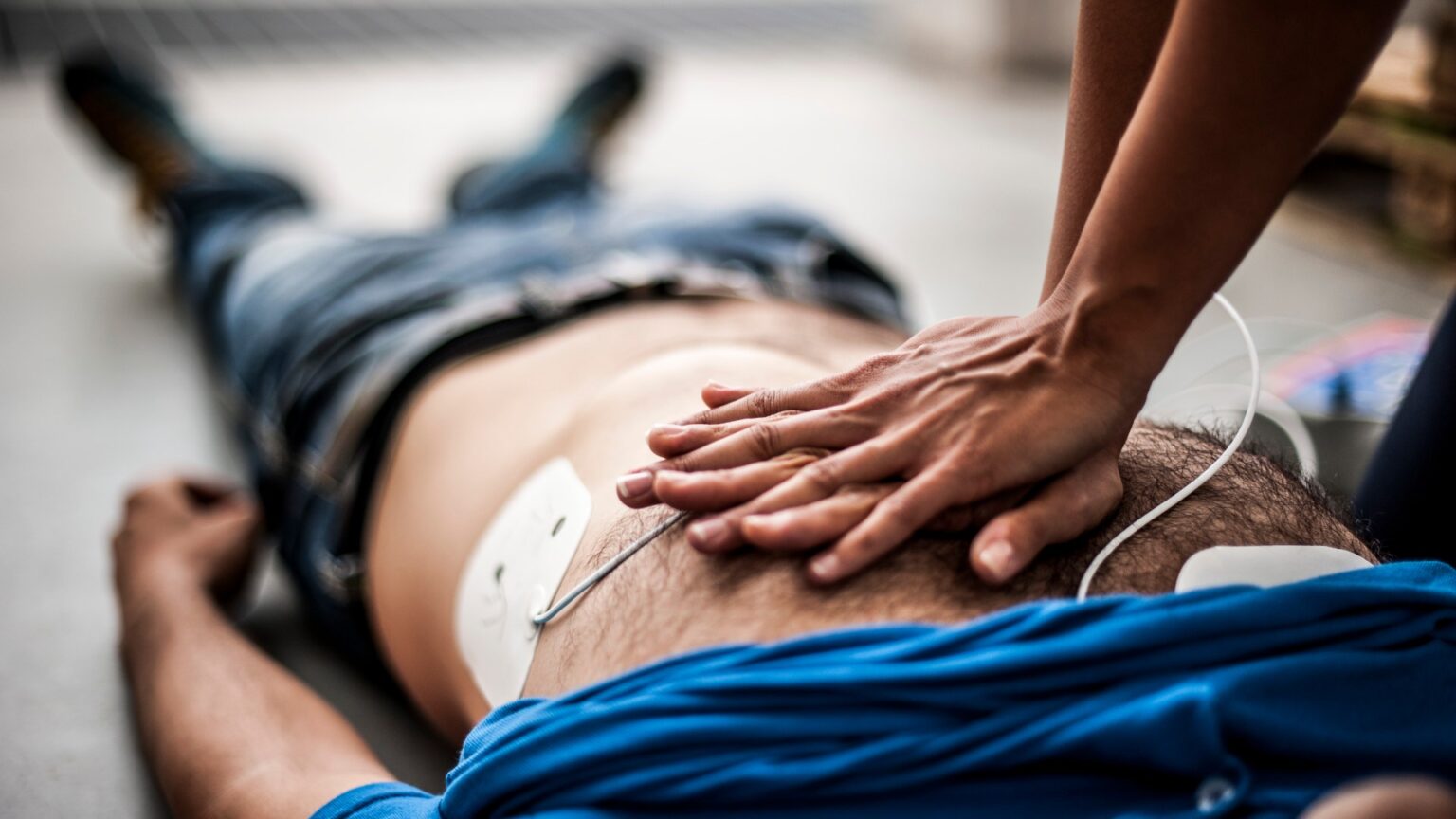
Step 3 – Give 30 chest compressions
Kneel next to the person, place the heel of one hand in the middle of their chest and your other hand on top, interlocking your fingers.
Lean forwards so your shoulders are over your hands and keeping your arms straight, press down hard into the breast bone, to a depth of about 5-6cms.
Release and repeat the movement at a rate of around two per second and continue until you have given 30 chest compressions.
Step 4 – Two rescue breaths
To open the person’s airways, tilt their head back, lift their chin and pinch the soft part of their nose.
Take a breath, make a seal around their mouth and breathe into it for one second, until their chest rises.
Then repeat this. The two rescue breaths should take no longer than five seconds.
Step 5 – Switch on a defibrillator
Send someone to fetch and attach the defibrillator, known as an automated external defibrillator (AED) as soon as it arrives.
This is a portable device that can deliver an electric shock to a person in cardiac arrest to restart their heart.
AEDs are designed to be used by members of the public, not just medical professionals.
They give clear voice prompts once they are turned on to guide a bystander through the entire process of using them, and are simple to use.
Follow the AED voice instructions. An AED should be located at sports venues and training grounds so that a first shock, if appropriate, can be delivered within two minutes of the athlete’s collapse.
Step 6 – repeat
Keep repeating 30 chest compressions, two rescue breaths and defibrillation until paramedics arrive.
Alternatively, you can stop if the person starts showing signs of life and starts to breathe normally.
CPR for kids
For children, once you have opened their airway and checked for breathing and signs of life for no more than 10 seconds you should start CPR.
To do this, place one hand on their forehead to tilt their head back and use two fingers from the other hand to gently lift the chin.
Take the hand from the forehead and pinch the soft part of the child’s nose closed, allowing the mouth to fall open.
Blow into their mouth gently for up to one second until the chest rises then remove mouth and watch their chest fall.
Do this five times and then give 30 chest compressions at a rate of around two a second.
Kneel by the child, put one hand in the centre of their chest and push down one third of the depth.
Release the pressure and allow the chest to come back up fully before giving the next compression.
After the 30 compressions, open the child’s airway and give two breaths.
Continue with this cycle of 30 compressions and two breaths until emergency help arrives.
CPR for babies
For children under one years old, five initial rescue breaths are also required before moving to 30 compressions followed by two breaths.
When starting the pumps, put two fingers in the centre of the baby’s chest and push down a third of the depth, which is about 4cm.
The 30 pumps should be performed at a rate of around two a second.
Again, continue this cycle of 30 pumps and two breaths until emergency help arrives and takes over.
11 signs you might have heart disease
AROUND 7.6million people in the UK live with heart and circulatory diseases. Are you one of them?
If you notice any of the following symptoms, it is time to see a doctor.
Chest pain
Feeling sick
Stomach pain or indigestion
Feeling sweaty or clammy
Leg pain
Arm pain
Jaw or back pain
Choking sensation
Swollen ankles
Extreme fatigue
Irregular heartbeat
Source: British Heart Foundation