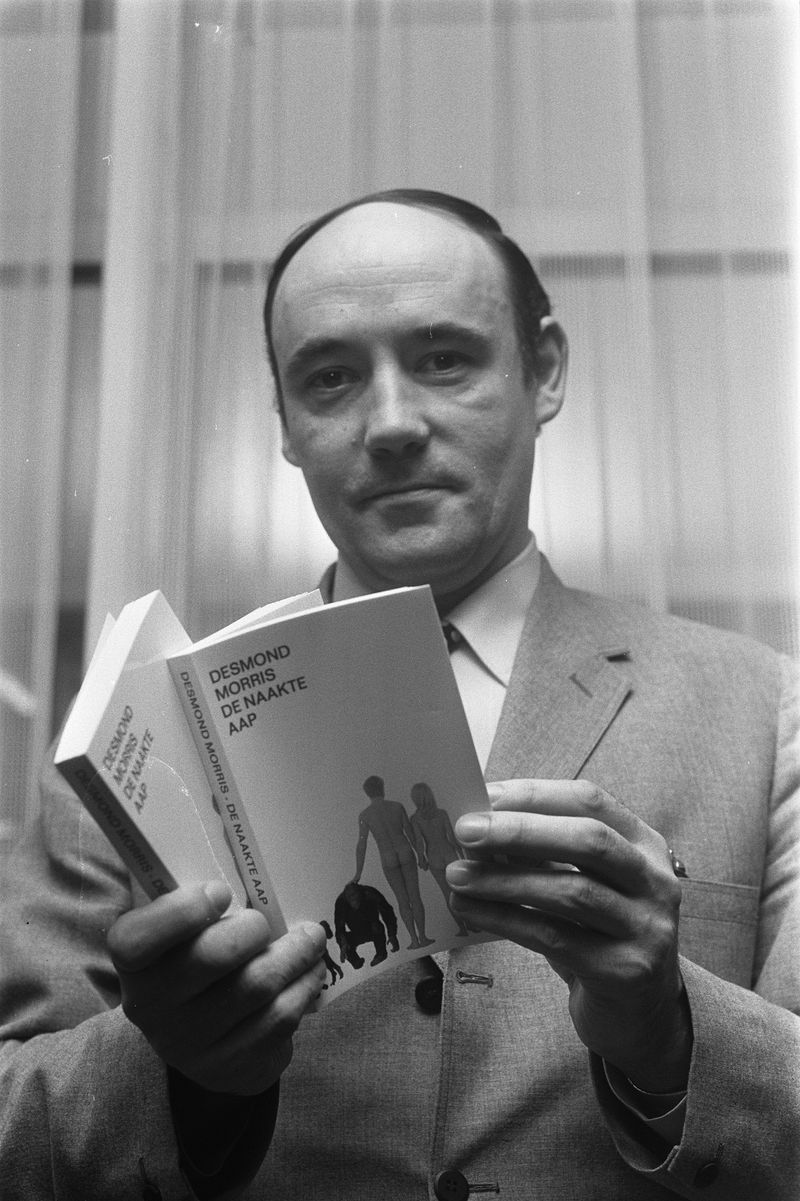

The profession listed in his passport read zoologist, but the entry in Who’s Who labelled him a writer. Both are understatements. Desmond Morris was something more, something rarer: a man who changed the way his species thought about itself. He taught how we look at animals, and with it, how we saw each other.The book that did it, ‘The Naked Ape’ (1967), was written in four weeks during a rare window of idleness. It sold, depending on whose count you trust, somewhere between 18 and 20 million copies. It earned a place on the Catholic Church’s Index of Forbidden Books alongside Balzac, Voltaire and Zola, company that Morris accepted as flattery. It also made him fabulously, inconveniently wealthy. He had been about to take charge of the Institute of Contemporary Arts. The ICA could wait.The book’s thesis was simple, unfashionable yet irresistible. Homo sapiens, Morris argued, was the 193rd species of ape or monkey, but the first that walked erect on two legs. We were, he insisted with a zoologist’s cheerful impartiality, “the sexiest primate alive”. The book treated human copulation, pair-bonding and status display with the same brisk scientific decorum Morris would have brought to the 10-spined stickleback, which was the subject of his doctoral thesis.The Church was not amused. Feminists were not amused either, finding his portrait of evolution — men went hunting, women did cave-keeping, both of which were recently disproved — rather too convenient. Morris absorbed the criticism and kept writing.He had come to zoology the long way around. Born in 1928 in a Wiltshire village, Morris spent his formative years flat on a raft afloat on his grandmother’s pond, watching fish. He wanted to paint. The post-war public wanted landscapes and still life. So, he studied zoology at Birmingham under Peter Medawar, transferred to Oxford to work with Niko Tinbergen, one of the founders of ethology (the study of animal behaviour). Oxford grew on him and became home. On ethology, he said that “no religious conversion could have been more dramatic”.Both his mentors were pioneers in their field. The objective study of animal behaviour in the field rather than the laboratory, watching rather than intervening, was Morris’ calling. But he did more of this in zoos, and not in the wild. At London Zoo, where he became the youngest-ever curator of mammals in 1959, aged 31, he catalogued 4,237 species of warm-blooded vertebrates. He taught a chimpanzee called Congo to paint (Picasso later acquired one of the works).From 1956, Morris fronted Granada’s Zoo Time, a weekly half-hour filmed inside the zoo itself. It ran to 500 episodes, reaching an audience of two million. His rival at the BBC was a young David Attenborough. Feelings between the two broadcasters, and their respective channels, were frosty, which gradually thawed. Both men reached their late nineties still curious, and were still productive. When asked in their eighties whether either had ever exercised or eaten carefully, both men said no, and concluded it was curiosity that had kept them going.In 1968, flush with ‘The Naked Ape’ royalties, Morris relocated to Malta with his wife Ramona, their son Jason, a Rolls-Royce and a 30-foot cabin cruiser, and moved into a plush villa. There he sat, on an island whose strict Catholic censorship laws meant that no citizen could legally read the book that had paid for the villa. Anthony Burgess, a fellow exile and friend, was so incensed by this that he picked a very public fight with the authorities and was promptly expelled. Morris, with more strategic patience, stayed on.Malta gave him the time to begin his grand obsession. He began to write a zoologist’s dictionary of human behaviour, cataloguing species by species, gesture by gesture. This would come out as ‘The Human Zoo’ (1969) and ‘Intimate Behaviour’ (1972). He explored the island with methodical enthusiasm, photographing and sketching its painted fishing boats. The works resulted in another book, ‘The Boats of Malta’. He painted and sailed in summer and wrote in winter. After six years, with his fortune thoroughly enjoyed, he returned to Oxford as a research fellow at Wolfson College.What made Morris matter, beyond the sales figures, was the template. ‘The Naked Ape’ established that serious evolutionary biology could be written for ordinary readers without condescension or distortion, that it could be funny and frank and stylistically alive. His golden rule (“simplification without distortion”) was harder than it sounded, and most of his imitators managed only the simplification.He was not without critics. Some found his tendency to squeeze all human behaviour into the evolutionary straitjacket reductive to the point of parody. His claim that women’s breasts evolved as “a pair of mini-buttocks on the chest” to transmit sexual signals face-to-face was widely ridiculed. He conceded, with apparent good humour, that the positioning of the male testicles might represent “evolutionary carelessness”. Science moved on, as it does, and some of what he wrote in 1967 looks obvious, some wrong and some simply daft. He was invited to update ‘The Naked Ape’. He chose to update just one single statistic (that the world’s population had swelled from three billion to six billion), and left everything else exactly as it was.In all, he wrote more than 50 books. His oeuvre ranged from the art of ancient Cyprus to the Oxford United football club, from dog breeds to surrealist painters. He maintained a parallel career as a surrealist artist, exhibiting alongside Joan Miró in 1950, when he was still a student. He held over 50 solo shows in Europe and America. He is perhaps the only person with both a painting in the Tate and a top-100 bestseller.I met Desmond briefly at the Taurus Gallery in Oxford on a bleak winter morning in 2008. Morris was 80, but his curiosity was undimmed and the wit was quick. He talked about animals and said he so wanted to come to India to watch its primates. He spoke of animals the way other men talked about old friends; with affection, precision, and no sentimentality whatsoever.He was still writing until the end. His last book, ‘101 Surrealists’, appeared in 2024. He died at 98, in a hospital in Naas, Ireland, where he had moved after his wife Ramona’s death in 2018 to be near their son Jason. He described her death not as bereavement but as “an amputation”. He asked for a cremation with only family present. He avoided fuss, very much in character for someone who had spent his life watching others make a spectacle of themselves.— Pranay Lal is a natural history writer currently working on a book on how climate impacted the subcontinent’s history