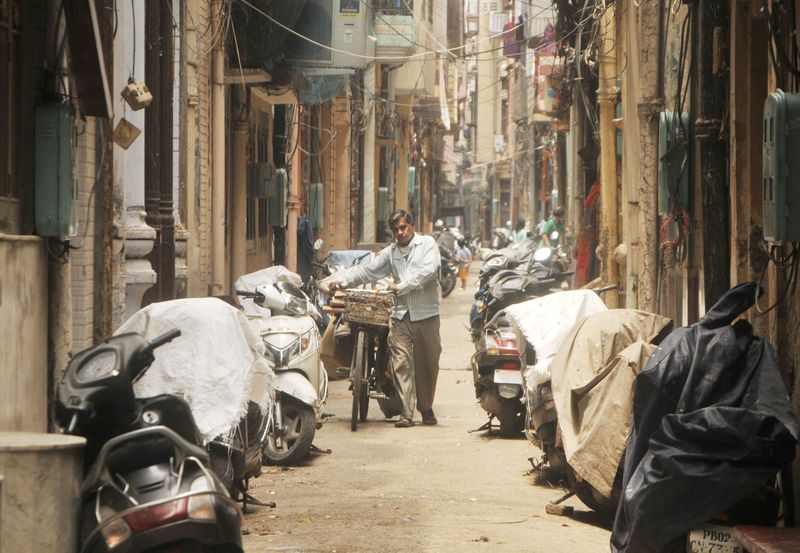

The Aam Aadmi Party-led government’s decision to designate the over 450-year-old walled city of Amritsar as a “Holy City” has added a new layer to its evolving identity. The move effectively pushed tobacco and non-vegetarian shops out of the core vicinity, while liquor outlets were already absent. Yet, even as the city leans into its spiritual character, its social fabric is undergoing a steady transformation.For years now, the walled city has been witnessing a quiet churn. Since the mid-1990s, many of its original inhabitants have moved out in search of greener pastures elsewhere. In their place, migrants from West Bengal, Maharashtra, Uttar Pradesh and Bihar have steadily made their way in, taking up roles as artisans, daily wagers and workers across trades.In the intricate world of gold craftsmanship, this shift is particularly visible. Bengali and Maharashtrian artisans have gradually replaced traditional Punjabi craftsmen. Highly skilled in the art of engraving, they produce finely detailed ornaments that often outshine local designs in finesse and finish. Their long working hours, often stretching to 14 or 15 hours a day, also give them an edge in meeting demand quickly.Mazid, an artisan whose family hails from Hugli in West Bengal, says their familiarity with design patterns popular across different regions has helped expand the market for locally crafted jewellery. Amritsar, in fact, holds a near-monopoly in manufacturing the “bandel”, a copper nose pin coated with gold foil, which finds buyers across Uttar Pradesh, Bihar, Jharkhand, Madhya Pradesh and Chhattisgarh.Artisans from Maharashtra, though present, remain fewer in number. Known more for silver jewellery and refining old gold ornaments, their skills have found limited demand in a market that leans heavily towards gold.Another significant migrant group comes from Uttar Pradesh and Bihar. Over time, they have become the backbone of small businesses, staffing shops, preparing food items and even buying homes in the city’s narrow streets. In markets like Mishriwala Bazaar, famed for pickles, murabba and sharbat, most cooks today are non-Punjabis. Many among them also sell fruits, vegetables and even Chinese food on carts, gradually reshaping the local marketplace.The popularity of the Golden Temple has also driven a boom in hospitality, with more than 400 hotels coming up in and around the walled city. Much of the workforce in these establishments, from housekeeping to front desk and kitchens, comes from Himachal Pradesh and Uttarakhand.Gurinder Singh Johal, a guide with over 25 years of experience, offers a blunt assessment. He says Punjabis tend to shy away from hospitality jobs, which is why people from other hill states are more commonly employed in the sector.Surinder Duggal, a shop owner, adds that workers from Himachal and Jammu & Kashmir have increasingly found opportunities here, particularly in textiles and allied trades, aided by their discipline and work ethic.As people moved out, the city’s real estate dynamics have also shifted. According to residents, property prices in non-commercial, narrow lanes have dropped significantly, in some cases by 30 to 35 per cent over the past five years. Homes once valued at Rs 25 lakh are now selling for around Rs 15 lakh, largely due to lack of parking and modern amenities. In contrast, commercial pockets near the Golden Temple continue to hold their value, with rates ranging between Rs 1.5 lakh per square yard and Rs 2 lakh per square yard. Tourists, after all, frequent only a fraction of the walled city, keeping those areas economically buoyant.But beyond numbers lies a deeper, more intangible change. Localities that once buzzed with Punjabi culture are slowly losing charm. Loon Mandi, once famed for its late-night food joints and lively streets, now winds down early, its old charm diminished as several iconic eateries have shut shop or relocated.This migration, both inward and outward, has gradually altered the city’s centuries-old demographic character. Modern aspirations have also forced residents to replace traditional architecture with contemporary structures, diluting the heritage that once defined the area. In the process, the city is also losing some of its shared cultural threads with Lahore, just 40 km away.Dating back to medieval times, Amritsar has long been regarded as the spiritual and cultural heart of Punjab. Yet today, its narrow lanes struggle to keep pace with the changing aspirations of its people — from parking cars to accommodating larger families and modern lifestyles. And so, even as the walled city stands rooted in history, its present continues to shift, quietly but unmistakably.