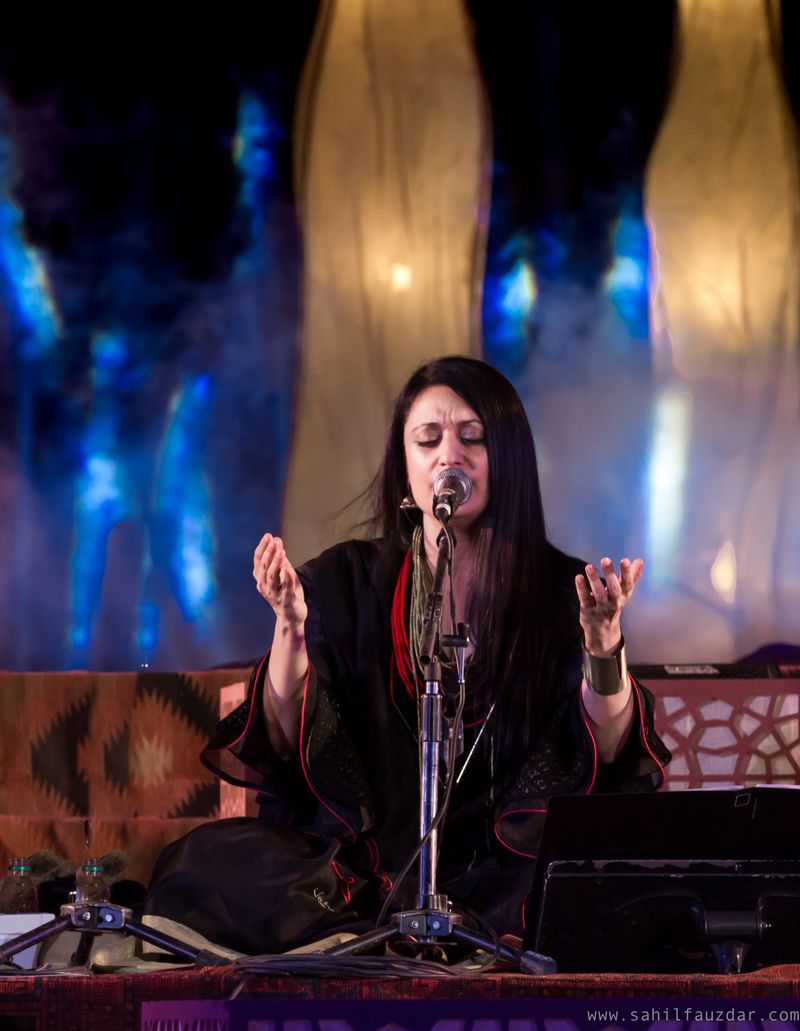

Sonam Kalra’s music flows beyond boundaries with ease and openness. Trained in both Indian classical and Western, she has carved a distinctive artistic path that beautifully blends Sufi, gospel, bhakti and global spiritual sounds.For Kalra, the journey into Sufi music was not a calculated shift but a deeply organic unfolding, shaped by faith and a natural coming together of diverse musical and spiritual influences.“I’ve always been spiritual in many ways… faith-oriented from the time I was a child,” she reflects. Her initial spiritual performances were in gospel music. This surprised many who questioned why a Sikh woman would sing Christian devotional music. Her response was simple yet radical, “Faith is something that calls to you… God is not religion and religion has no God.” For her, devotion was never confined to a single tradition but belonged to what she calls the “religion of humanity.”That philosophy found its defining moment at the dargah of Sufi Inayat Khan in Nizamuddin, where she was invited to perform. “A Sikh girl singing gospel music was now being invited into a seemingly Islamic space,” she recalls. “That made me want to blend all these faiths, allowing them to flow seamlessly into one another.”From this realisation was born The Sufi Gospel Project — an ambitious musical experiment that fuses Sufi, gospel, bhakti, Gaelic chants and Buddhist influences into a single expressive language.Over the last 15 years, Kalra has travelled across nearly 30 countries, including performances at the Sydney Opera House, the Pyramids of Giza, and major festivals like Jahan-e-Khusrau and the Jaipur Literature Festival. “It’s been quiet special- we have had standing ovations everywhere we have performed,” she says, noting that the message of equality and inclusion resonates universally. For Kalra, the appeal of Sufi music lies not in tradition alone but in its message. “I truly believe in this language of equality and inclusion,” she says, drawing inspiration from mystic poets like Kabir and Bulleh Shah whose words transcend religion and geography.Her recent concert, Ibadat- Songs of the Mystics, was presented with HCL Concerts. “It was called Ibadat, because I explored the poetry of mystic writers who consistently return to the idea of universal love. In this context, ibadat — meaning worship — moves beyond ritual practice or the confines of walls and buildings. In the Sufi tradition, it becomes something far more expansive: an expression of love, surrender, and deep connection with the divine. At its core, it also reflects the belief in the equality of all beings and the presence of the divine in everyone, making inclusivity an essential part of its philosophy.” Kalra hails HCL for promoting non-filmy music.Her work has also explored deeper historical memory through music, particularly in her Partition- Stories of Separation. With ancestral roots in Rawalpindi and Sargodha, she approached the subject not through politics but through poetry and shared human experience. “We do not speak of blame, we speak of friendship, of shared loss, of shared humanity,” she explains. The work featured poetry by Amrita Pritam, Faiz Ahmed Faiz and Ustad Daman, along with survivor testimonies and narrative storytelling. “Let history not repeat itself,” she adds, emphasising dialogue over division.Kalra’s upbringing in Delhi played a crucial role in shaping her worldview. Coming from a family that deeply valued the arts, she grew up surrounded by an eclectic musical landscape — Begum Akhtar, Bhimsen Joshi, Frank Sinatra, Pink Floyd, Ella Fitzgerald and Leonard Cohen all coexisted in her home. She credits her parents as her “greatest gurus,” for instilling a belief in equality and openness. “We were taught we were not equal to men — we were better than men,” she says, describing a household that encouraged confidence and independence.Her musical training began early, at the age of four, under maestros such as the Dagar Brothers, later followed by Shubha Mudgal and Sarathi Chatterjee. Yet, she continues to see herself as a student. “Sikh means learner,” she says. “I hope I never stop learning.”When asked about her favourite composition, she resists the idea of choosing one, likening it to choosing between children. Still, she mentions Man Manam, composed for Coke Studio, for its emotional depth and Wohi Khuda Hai for its lyrical strength. “A composition must lift your soul,” she says. “The lyric must have gravitas.”At the heart of her philosophy is a belief in art as responsibility. She argues that artistes are the conscience of society, tasked with fostering empathy and questioning division. “We move forward when we stop using religion, countries and identities to create separation,” she says. Instead, she advocates for stronger patronage of non-mainstream arts, which she believes can spark reflection and dialogue in audiences.For Kalra, the ultimate message remains simple yet profound. “If there is a religion you want to follow,” she says softly, “follow the religion of humanity.”