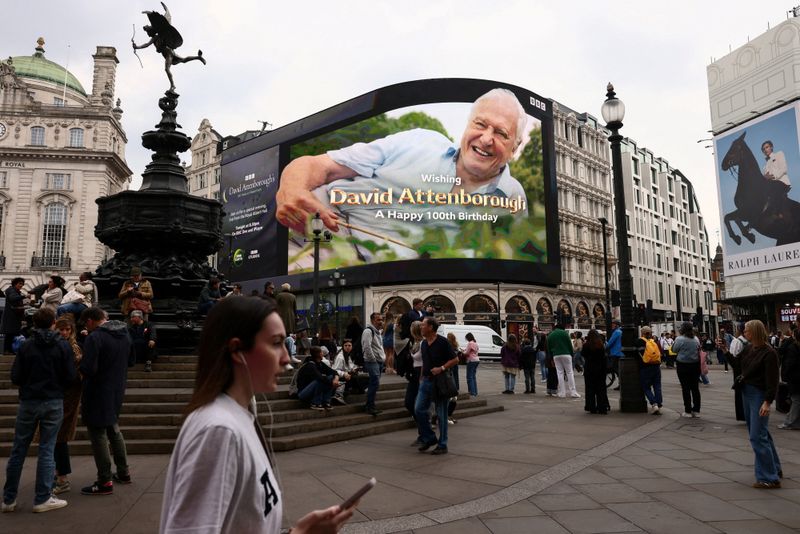

The world celebrated the centenary of two extraordinary men in the past week. Let me talk first of Sir David Attenborough, a living treasure and someone whose quiet, yet watchful, presence leaves no footprints except those on the ground. Which one of us has not been mesmerised by his television series on Nature and the natural world? From the Earth to the oceans and deep forests, this recorder of the wonders of the world that we are often blind to — or unaware of — has opened our eyes and hearts. His brother, the equally gifted filmmaker Richard Attenborough, was another genius. His ‘Gandhi’ is one of those classic films that one never tires of seeing.
Like these remarkable siblings, two talented storytellers here in India (RK Laxman and RK Narayan) have left their own footprint for us to remember them by. ‘Malgudi Days’ (RK Narayan’s exquisite gems of a small imaginary town and its delightful population) is unforgettable, as are the brilliant cartoons that his brother RK Laxman created for The Times of India for decades. The Common Man, Laxman’s eyes and ears, never spoke a word but he saw it all. With a few deft lines, Laxman managed to catch the quintessential soul of the characters he drew — capturing the imperious Mrs G with her hooked nose and tilted chin, or the loveable Nehru with the rose in his sherwani. Even long after their demise, the RK brothers (like the Attenboroughs) have not been bettered.
While on the subject of century tributes, I want to pay a deep homage to another cartoonist who brought a smile to several generations of Indians. Mario Miranda (who would have turned 100 on May 2) also preferred to stay away from public gaze yet his characters have lingered on as delightful memories. Among them are Godbole in a dhoti and shabby coat, holding a rolled-up umbrella, the bosomy secretary Miss Fonseca in a polka-dotted dress tightly stretched over her generous curves, the corrupt politician Mr Bundaldass and his sidekick Moonaswamy and the unforgettable Miss Rajni Nimbupani, the dumb but sexy Bollywood bimbo.
Unlike RK Laxman, Mario’s cartoons did not have a clever turn of political phrase but his characters needed no words, except generic ones like ‘Saar’ to convey a certain mood and situation that needed little else. For years, Mario was the central attraction of The Illustrated Weekly of India and had a loyal following of admiring editors — Khushwant Singh, Frank Moraes and Vinod Mehta, to name just a few. Along with his acolyte Gerson de Cunha, Nissim Ezekiel, Dom Moraes and Alyque Padamsee, he set up what can be called the Bombay school of irreverence, producing clean fun that was inoffensive but sharp, and lines to make stereotypes that imprinted them on the reader’s mind.
Do try and get a copy of Mario’s ‘To Goa with Love’, dedicated to his lovely wife, Habiba, to revisit those innocent times when we had not sanitised our natural responses to such a level of political correctness that the fun went out of humour.
What we have also lost is the generosity to pay homage to those who are not from the same political gene pool as us. Forget Hindu-Muslim, we are now so mealy-mouthed and sycophantic that even those who were not in any way connected to politics are not given their due. Look no further than The Tribune territory to remember all those whom we have not acknowledged sufficiently. The redoubtable MS Randhawa, Chandigarh’s first Chief Commissioner, planting the beautiful trees that still stand as a testimony to his unerring taste in greenery, the collection of Kangra paintings and Gandhara sculptures in the Chandigarh Museum and at the Panjab University museum, the famous agricultural university in Ludhiana, the one who started the Van Mahotsav when we are encouraged to plant trees over a week, the Green Revolution… how many other wonderful initiatives were undertaken by this remarkable man who was an author, botanist, civil servant and art historian.
I mentioned the university’s museum to remember another legendary art scholar, Prof BN Goswamy, whose reputation as an authority on Pahari paintings made him respected across the world.
Dr Randhawa ensured that the collection of Gandhara sculptures from the Lahore Museum came to Chandigarh as India’s share. I shudder to think if these worthy people had not been there when Chandigarh was being created.
And yet, while every worthless political lightweight and charlatan is decorated with the highest civilian awards, the Bharat Ratna is largely bestowed only on this lot. Think of how many philanthropists, industrialists, writers, academics and scholars are overlooked when we think of celebrating the lives of those Indians who shaped this country, had the courage to speak up fearlessly and quietly did what was right. They spoke through their work and made their long lives an opportunity to create lasting institutions and lay down traditions that would inspire generations after them.
There are so many lives which have gone unsung and unacknowledged but their work, like the fragrance from dried roses, refuses to die out. May they always be remembered with bowed heads and deep reverence.
— The writer is a social commentator