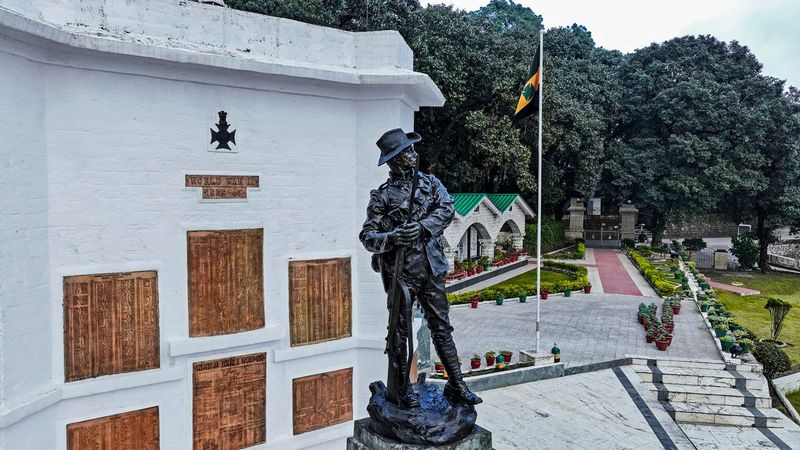

When Lieutenant General N.S. Raja Subramani dons the rank of Chief of Defence Staff (CDS) following the retirement of the incumbent, Gen Anil Chauhan, the Garhwal Rifles, among Indian Army’s oldest and most highly decorated Infantry regiments that was carved out from the Gorkha regiments 139 years ago, will get its first four-star officer.General Chauhan will superannuate on May 30 and Lt Gen Raja Subramani’s term will begin from the date he assumes charge subsequently. Presently, serving as a military adviser at the National Security Council Secretariat, he had retired as Vice Chief of the Army Staff in July 2025.Under law, the government can select any senior serving or retired officer from amongst the Three Services for appointment to the post of CDS who, by stature, is the senior-most military officer in the country. The CDS is the principal military adviser to the government but does not exercise any operational command over the Services.Commissioned into the Garhwal Rifles in December 1985, Lt Gen Raja Subramani is closely associated with two of its battalions – the 8th into which he was commissioned, and the 16th which he later commanded in Assam.The rank and file of the Garhwal Rifles comprises troops from the Garhwal region of western Uttarakhand. In fact, the Kumaon regiment, another illustrious Infantry regiment drawing its manpower from the neighbouring Kumaon region in eastern Uttarakhand, has produced one Army Chief, Gen TN Raina, a Maha Vir Chakra recipient who headed the Army from June 1975 to May 1978.Of the 32 four-star generals who have been at the helm of the Indian Army post-Independence, including two British officers, 20 have been from the Infantry, six from the Armoured Corps, five from the Artillery and one from the Engineers. The rank and status of the CDS and the three Service Chiefs is denoted by four stars.The historical Gorkha linageWith 21 regular battalions, three Rashtriya Rifles battalions and two Territorial Army battalions at present, the Garhwal Rifles was raised in 1887 as the 39th (Garhwal) Regiment of the Bengal Army of the East India Company. It traces its lineage to the Gorkha Regiments, the first of which was raised by the British in 1815 and is now the Indian Army’s First Battalion of the First Gorkha Rifles (1/1GR).Until 1887, troops from Garhwal were enlisted in the Gurkha regiments, as Gorkha is spelled by the British, which were part of the Bengal Infantry and the Punjab Frontier Force. The first proposal to raise a separate regiment of Garhwalis was initiated in January 1886 by Lieutenant General (later Field Marshal) Sir Frederick Sleigh Roberts, the then British Commander-in-Chief in India.Gorkha troops were in the news recently with the British Army raising a new Artillery regiment exclusively comprising these hardy mountain warriors, even though recruitment of Gorkhas into the Indian Army has been in a limbo since 2020.Christened the King’s Gurkha Artillery (KGA) by King Charles III, the current British monarch, the unit’s ‘Kasam Khane Parade’ for its first batch of 20 directly selected recruits from Nepal was held at Larkhill Camp in south-west England on April 20.After Independence, some Gorkha units of the British Indian Army were transferred to the UK under an India-Nepal-UK tripartite agreement and currently about 4,000 Gorkhas, directly recruited from Nepal, serve in the British forces and undertake the same duties as other British soldiers.After an overall hiatus on intake in the aftermath of the Covid-19 pandemic came the Agnipath scheme that entailed short-term recruitment into the rank and file of the Armed Forces for a period of four years instead to the earlier term of 15 years or more. Nepal did not agree to the terms of the scheme for its citizens, saying that it violated the terms of the agreement, and also voiced concern over the re-employability of Gorkha soldiers after their 4-year term is over.Both Gorkha and Garhwali troops have seen extensive combat over the past two centuries, serving in campaigns around the world, including the two World Wars, as well as all post-Independence wars and major operations and United Nations peacekeeping missions, and earning numerous gallantry awards and battle honours.The first India-born recipient of the Victoria Cross, the highest British award for gallantry in the face of the enemy, was Naik Darwan Sing Negi of the 39th Garhwal Rifles, who was decorated for his actions near Festubert in France in 1914 during the First World War. Three Indian recipients of the Victoria Cross and one recipient of the Ashok Chakra, India’s highest peacetime gallantry award, belong to the Garhwal Rifles.As part of their ceremonial attire, officers and troops of the Garhwal Rifles wear a wide-brimmed felt slouch hat, called Terai hat, the rakishly worn headgear that is widely associated with the Gorkha Rifles.Legacy of the 8th BattalionThe 8th Battalion of the Garhwal Rifles, Lt Gen Raja Subramani’s parent unit, has a chequered history. It is known for its role in the Battle of Butur Dograndi fought in the Sialkot sector of Punjab during the 1965 India-Pakistan War.The battalion was deployed as the advance guard for the 43 Lorried Infantry Brigade under 1 Armoured Division. On September 8, it launched an offensive that penetrated about 20 km into Pakistan, which was one of the deepest thrusts in the sector. It faced intense enemy counterattacks supported by armour, artillery and aircraft but repelled them successfully and held on to its objectives.The fighting was extremely fierce and costly, with the battalion losing its Commanding Officer, Lt Col JE Jhirad, and the Second-in-Command, Major AR Khan and about 130 other officers and men. For its role in the 1965 war, the battalion was awarded the Battle Honour Butur Dograndi and Theatre Honour Punjab 1965.The 1971 Indo-Pak War saw the unit in action again on the Western Front. Elements of the battalion captured the enemy’s Ghurki post and held it under continuous shelling until ceasefire.In 2014, a team from 8 Garhwal led by Major Lalit Mohan Joshi won the Gold Medal at the Cambrian Patrol, a prestigious international military skills competition held in Wales, in the United Kingdom. The Garhwalis excelled in tactical skills, navigation and endurance, outperforming over 140 teams, including international and UK Special Forces, in a gruelling 80-km competition often described as the “Olympics of patrolling”.