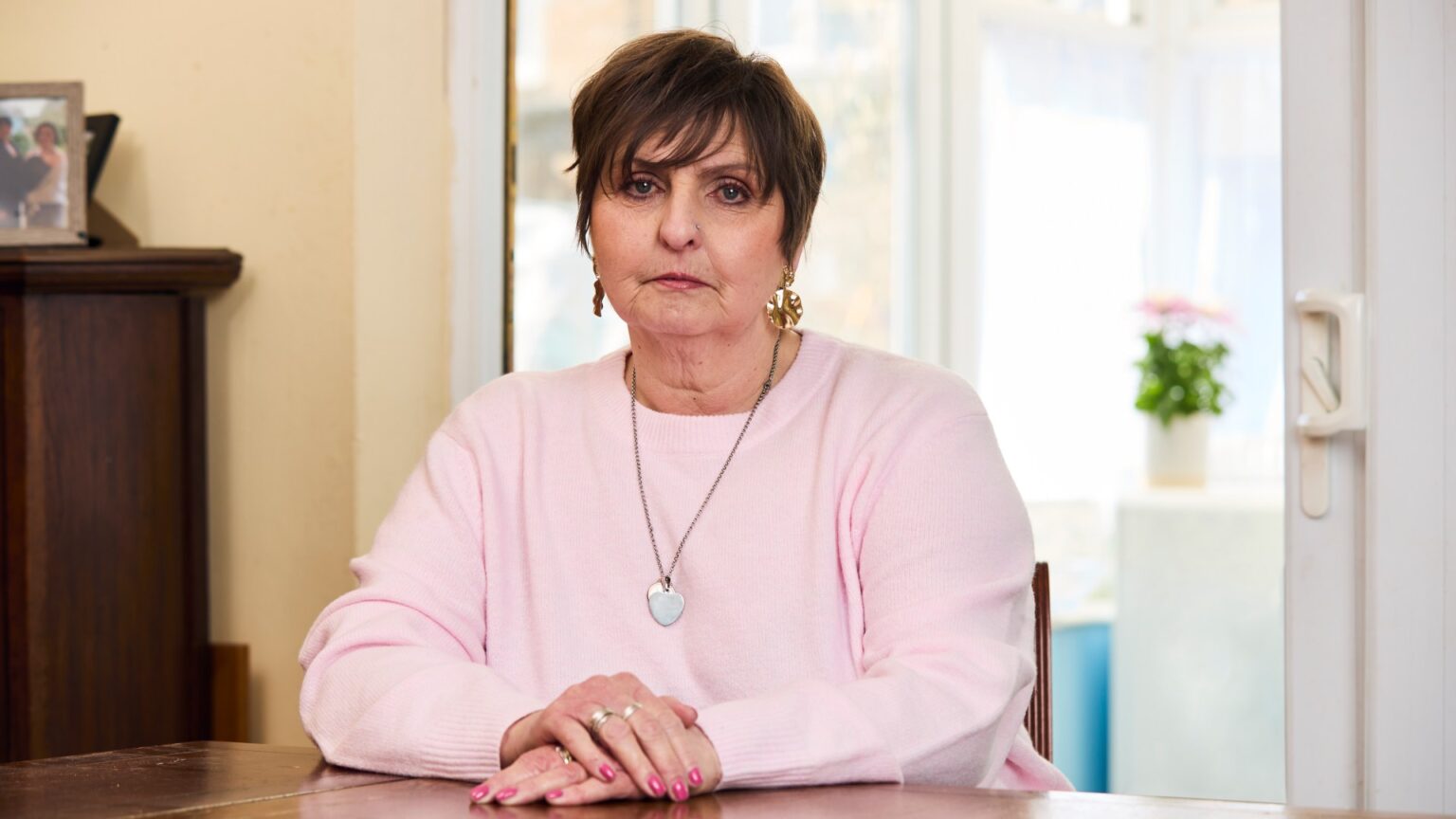


WATCHING her daughter, Laura-Jane, nurse her newborn son shortly after his birth in December 2022, Sarah Shead felt overwhelming joy.
“I’d been by her side when she’d delivered Murray, as I had been when all her babies were born,” says Sarah, now 63, from Witham, Essex.
Sarah Shead’s daughter tragically died after giving birth Credit: News Group Newspapers Ltd
She felt overwhelming joy watching her daughter Laura-Jane nurse her newborn son Credit: Supplied by Sarah Shead
“Seeing the look of contentment on her face, it was a perfect moment.”
Tragically, this would be the first and last time the 36-year-old mum of five would cuddle and feed her baby boy.
Soon after, Laura-Jane lost consciousness, and a horrifying chain of events unfolded, including multiple cardiac arrests and emergency operations, tragically culminating in her death two days later.
“One of the last things she said to me was: ‘Mum, I’m dying, please help me.’ I told her: ‘It’s alright, Lally (my nickname for her).
“Everything is going to be fine,’ because I believed she was in safe hands,” says Sarah.
“Every day, I live with the guilt that she begged for her life, and I told her it was going to be OK, when it wasn’t.”
Sadly, Laura-Jane’s death, which has left her family devastated and her five children without their mother, is not an isolated incident.
Last month, the NHS announced it would overhaul clinical standards in maternity care to reduce maternal deaths.
The announcement followed on from figures published earlier this year from MBRRACE-UK, an organisation responsible for investigating the deaths of women and babies who die during pregnancy or shortly after in the UK, which revealed that the rate of deaths has increased by 20% in the last decade.
This is despite a pledge made by then-health secretary Jeremy Hunt in 2015 to reduce maternal deaths by 50% by 2030 and make the NHS “one of the safest places in the world to have a baby”.
In 2017, he brought that date forward to 2025, yet the figures have been worsening rather than improving.
‘Extreme pressure’
NHS England has responded with the Maternal Care Bundle (MCB), which sets best practice standards across five areas of clinical care associated with the highest rates of mortality and morbidity, including epilepsy, obstetric haemorrhage, pre-hospital and acute care, and maternal mental health.
Responding to the MBRRACE-UK figures, the Royal College of Midwives (RCM) said women are being failed by a maternal health system under “extreme pressure”.
“Maternity services are stretched to capacity.
“Midwives are under relentless pressure, and that has a real, demonstrable impact on safety, continuity of care and outcomes for women,” said Clare Livingstone, head of professional policy and practice at the RCM.
Laura-Jane With her girls, son Morgan and partner Haydn Credit: Supplied by Sarah Shead
Sarah with her daughter Laura-Jane, who died after giving birth Credit: Supplied by Sarah Shead
Kim Thomas, chief executive of The Birth Trauma Association (BTA), says that while staffing and resources are significant factors, they are not the only reason mothers are dying.
“Women are having more complex pregnancies, due to issues including age and obesity, and midwives are not adequately trained to care for them.
“And we frequently hear of potentially fatal conditions, like clots and sepsis, going undiagnosed, which is a failure in standards of care.
“Neglectful care is happening even when staffing is adequate. Important clinical signs are missed, or women who raise concerns are not listened to and told to ‘stop worrying’.
“It’s a cultural problem within the NHS. And there are tragic outcomes,” adds Kim.
The agonising legacy of maternal death is something Sarah lives with every day.
“Even now, more than three years after her death, it’s still hard to fathom that Laura-Jane isn’t with us any more,” she says.
“A carer for adults with learning disabilities, she was the heartbeat of our family life – someone who walked into a room and made everyone feel happy and important,” remembers Sarah.
Laura-Jane’s family originally thought the death was a horrendous tragedy that couldn’t have been avoided Credit: News Group Newspapers Ltd
Laura-Jane’s family found out that there were multiple errors in the care she’d received Credit: News Group Newspapers Ltd
“Laura-Jane married and had her first child Amie, now 22, when she was 17, going on to have Georgie, 18, and Darcie, 14.
“After her and her husband separated, she began a relationship with Haydn, who had been a childhood friend, and their son Morgan was born in 2019.
“Her children brought her so much joy, and she adored raising them.”
The couple were keen for Morgan to have a sibling close to him in age, and Laura experienced two miscarriages before becoming pregnant with Murray in 2022.
‘Terrible loss’
“After the second miscarriage, she bled very heavily, and that was in her medical records, so she was known to be at high risk of bleeding,” says Sarah.
Murray was born vaginally at Broomfield Hospital, Chelmsford, at 12.58am on December 21, 2022, weighing 7lb 11oz, and at first, all was well. Laura-Jane had given birth to son Morgan at the same hospital three years before.
“The last photo of Laura-Jane alive is when she was feeding Murray in bed. Me, her and Haydn were in a little bubble, before we shared the happy news with the rest of the family,” Sarah says.
A couple of hours after Murray’s birth, Laura-Jane told staff she felt like she was bleeding, describing it as a “gushing” sensation, but there were no visible signs of blood loss.
“She felt something wasn’t right,” says Sarah. “And at 3.30am, she told me she felt faint, before slumping forward, unconscious. That was when the nightmare began.”
Although Laura-Jane regained consciousness, she was agitated and scared.
“She kept saying she was ‘gushing’ and was given medication and oxygen as she struggled to breathe,” says Sarah.
“We were comforting her, and although I was scared, I had complete faith that the staff were looking after her. I didn’t know what they were doing, but I felt grateful for them.”
It was around 6.30am when Laura-Jane went into cardiac arrest in front of her terrified mother and partner.
“We were rushed out of the room, a midwife took Murray, and we could hear them calling out her name and the words ‘unresponsive’ and ‘cardiac arrest’. It was horrendous.”
Medics managed to resuscitate Laura and a scan revealed she had suffered a huge internal bleed in her abdomen.
While Sarah and Haydn cared for newborn Murray, Laura-Jane underwent two surgeries that day to try and stop the bleeding, before being moved to ICU.
“The juxtaposition of being with Murray on the maternity ward, while his mother was fighting for her life in ICU, felt like a nightmare,” says Sarah.
“Laura-Jane’s daughters came to see her, and we brushed out her beautiful dark hair, which was matted with blood, and put photos of all five children around her bed, while playing her favourite songs to her.”
The following day, Laura-Jane had further surgery, but by then, her kidneys were failing and she was placed on dialysis while in ICU.
“She’d opened her eyes and squeezed my hand, and seemed to be doing a bit better after that third operation.”
In the early hours of December 23, however, Laura-Jane’s condition deteriorated and she was rushed into surgery.
“I kissed her goodbye before she went to the operating theatre, and told her I’d be waiting for her when she came back,” says Sarah.
Laura-Jane suffered another cardiac arrest in surgery, but was resuscitated. Back in ICU, she had a further cardiac arrest, and this time, staff were unable to save her.
“I was in a family room with my husband Keith, as well as Haydn, Amie and other family members and friends, when several ashen-faced doctors and nurses came in,” Sarah remembers.
“They said they had worked on her for over half an hour, but were unable to bring her back. My little girl was gone.”
Family and friends took turns spending time with Laura-Jane, saying goodbye to her, before Sarah and Haydn carried little Murray into the room.
“I was the first person in the world to hold her, kiss her and tell her that I loved her, and I wanted to be the last person to do that,” says Sarah.
“We laid Murray next to her. My body and mind were wracked with pain. My child was dead, and her children were now without their mother.”
For the next nine months, the family grieved, believing that Laura-Jane’s death was a horrendous tragedy that couldn’t have been avoided.
After a post-mortem, the cause of death was recorded as a ruptured spleen, DIC (disseminated intravascular coagulation, a serious blood-clotting disorder), massive peritoneal haemorrhage, perineal tears and recent vaginal delivery.
Then, in late 2023, Sarah was contacted by Health Services Safety Investigations Board (HSSIB), an independent body under the Department of Health and Social Care, which investigates patient safety concerns across the NHS in England.
They had been looking at Laura-Jane’s case.
“They told us they’d found multiple errors in the care she’d received, and that every clinician involved with the investigation had concluded that at any other hospital, with different staff, Laura-Jane would have had a 99.9% chance of survival.
The shock took my breath away.
“I’d hugged members of staff at the hospital before we left, thanking them for those two extra days with my girl, and we’d fund-raised for the labour ward and bereavement team who’d supported us,” says Sarah.
A complex inquest into Laura-Jane’s death took place in July 2024 and lasted 16 days, with evidence from hospital staff and expert witnesses.
The inquest heard there was a failure to recognise a loss of consciousness as a maternal collapse, a failure to escalate care to senior staff, which would have triggered procedures that would have saved Laura-Jane’s life, and failures around record-keeping.
“Every day of the inquest was torture, hearing how my daughter had been failed by the very people who were meant to be caring for her,” says Sarah. “I trusted them implicitly, and they let her down.”
The inquest concluded the death was “avoidable” and was “contributed to by neglect.”
Mid and South Essex NHS Foundation Trust acknowledged the failures and stated they were improving training to prevent similar incidents occurring. The Trust also extended sympathies to the family.
While the issue of financial compensation has yet to be resolved, Sarah, Haydn and the family have supported each other and Laura-Jane’s children over the past three years.
“Haydn and the boys live just a few minutes from me, so I see them all the time and help in any way I can.
“Darcie splits her time between my home, which is closer to her school, and her dad’s, where Georgie – who is at college now and also has two part time jobs – also lives. Amie works full-time and has really stepped into her mother’s shoes, supporting her siblings.
“It’s bittersweet watching Murray grow up. He is three years old and such a laid-back, funny little boy, and it breaks my heart that his mother is not here.
“Murray and Morgan like to visit ‘Mummy’s Garden’, as we call her grave, for a chat. We also have photos of her all around the house to keep her memory alive.”
What needs to be done to protect other families from the suffering Sarah’s family has experienced is a huge question, says Kim Thomas from the BTA.
“It needs a multi-faceted response,” she says. “Improved resourcing, including retention of experienced midwives who are leaving the profession, and more maternal mental health services.
“Also, a review of midwifery training to ensure midwives adequately understand the modern complexities of pregnancy and birth.
“And we need to see a cultural shift mandated across the NHS, with women being listened to and not being dismissed or ignored,” she adds.
Heartbroken Sarah believes she will never know what peace feels like again.
“I am angry, in pain and I miss my daughter every day,” she says. “But I am blessed to have my precious grandchildren who bring me so much happiness.
“Remembering how we lost Laura-Jane takes me to hell and back, but I share her story in the hope of change and improvement in maternal care, so that other families are spared the terrible loss we have experienced.”